

Neurons in a petra dish were forced to play Doom
08.03.26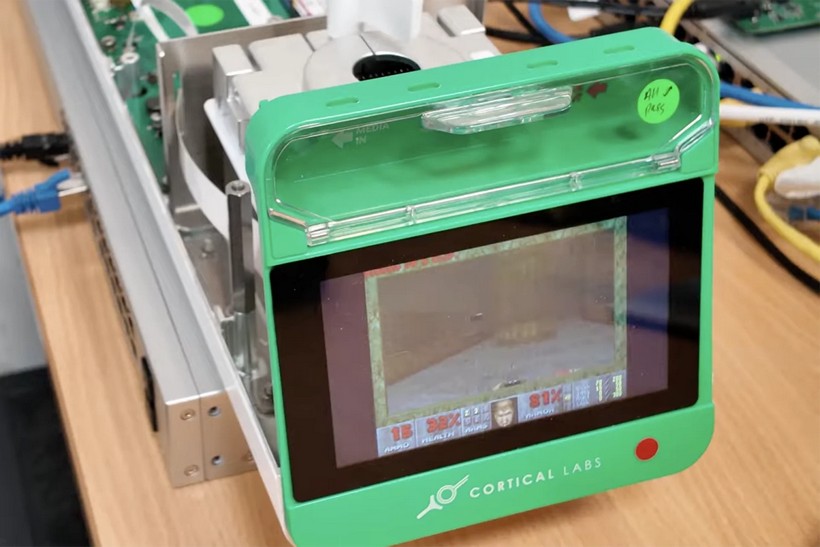
A few years ago, the company Cortical Labs already demonstrated how a culture of human neurons in a petra dish controls a simplified version of Pong. Now the experiment reached a new level: neurons were connected to the shooter Doom.
The published video shows the operation of the CL-1 system, a neurocomputer module where about 200 thousand human neurons are placed on a microchip. Cells are grown on a so-called array of many electrodes through which they receive signals and transmit responses.
For comparison: there are tens of billions of neurons in the human brain. Even taking into account the scientific disputes about the exact number, this emphasizes the scale of the difference between a laboratory culture and a full-fledged brain.
The chip doesn’t start the game – it “plays” it
The developers emphasize that CL-1 does not execute game code in the traditional sense. Visual elements from the screen are transformed into patterns of electrical stimulation, which are fed to neurons. In response, cells generate their own signals. These signals are interpreted as character actions.
One pattern is a shot, the other is a movement to the right, and so on. In fact, the biological network becomes part of the control circuit.
Microscopic images show how the organic structures of neurons intertwine with the clear lines of electronic circuits. Visually, it resembles scenes from science fiction, but we are talking about a real laboratory prototype.
Training and limitations
According to the researchers, the cells are still “playing like a beginner.” They gradually adapt to incoming stimuli — thanks to neuroplasticity, new connections are formed. Theoretically, this allows the system to improve results over time.
It is important to clarify: the demonstration does not use the original version of Doom, but Freedoom — an open source project running on the Doom engine, but without copyrighted characters and elements.
Ethical questions and “Cortical Cloud”
The project is already causing discussions. One of the obvious questions is the origin of cells and the further use of similar technologies. Human neurons contain DNA from specific donors, and this raises legal and ethical issues.
In parallel, the company launched the Cortical Cloud platform — cloud access to CL-1 through a Python-based API. It is assumed that developers and researchers will be able to experiment with the system remotely.
For now, we are talking about a demonstration and research project. However, the very possibility of using biological neural networks for computing tasks — including game scenarios — shows how quickly the border between biotechnology and classical digital electronics is blurring.
Don't miss interesting news
Subscribe to our channels and read announcements of high-tech news, tes

Oppo A6 Pro smartphone review: ambitious

 0
0 
Creating new mid-range smartphones is no easy task. Manufacturers have to balance performance, camera capabilities, displays, and the overall cost impact of each component. How the new Oppo A6 Pro balances these factors is discussed in our review.
Acer Nitro Lite 16 (NL16-71G) laptop review: versatile and attractive
0 
The 2025 Acer Nitro Lite 16 features an interesting case design, gaming accents, and proven components. Let’s take a closer look at its features.
Neurons in a petra dish were forced to play Doom development Doom games
The developers emphasize that CL-1 does not execute game code in the traditional sense. Visual elements from the screen are transformed into patterns of electrical stimulation, which are fed to neurons
Stop Killing Games will create non-governmental organizations protecting gamers’ rights in the EU and the US games law

Initiative aims to promote laws against publishers who disable game support and effectively deprive users of access to already purchased products.