

Best 27-49 inch OLED monitors in 2025
24.11.25
The world of gaming monitors is changing rapidly, and models with OLED panels are coming to the fore. Samsung Odyssey, ASUS ROG Swift, MSI MPG and LG UltraGear are different in format and size, but they are united by technology that provides deep black and high contrast. OLED allows you to achieve instant response and high refresh rates, which is especially important for eSports and dynamic games.
Ultrawide and curved screens add an immersive effect, and support for modern synchronization standards makes the image output stable. Despite the differences in diagonal and design, all these models demonstrate the key advantage of OLED – a combination of speed and image quality. Of course, the asking price is also high compared to monitors on more familiar IPS, VA and TN matrices.
What is OLED ?
OLED (Organic Light-Emitting Diode) is a display technology in which each pixel consists of organic materials that glow when an electric current is passed through it. Unlike LCD, such a panel does not require a separate backlight: each element emits light on its own.
The structure of an OLED pixel has layers of organic compounds placed between the anode and cathode. When voltage is applied to the structure, electrons and “holes” recombine in the active layer, creating a glow of a certain color. The brightness and color of the pixel are regulated by the current intensity.
Advantages of OLED
-
Absolutely deep black and very high contrast, as pixels can be completely turned off.
-
Wide viewing angles without loss of saturation.
-
High speed response, which reduces ghosting in dynamic scenes.
-
Thinner panel thickness and the ability to create flexible or curved screens.
Disadvantages OLED
-
Potential burn-in of individual pixels during prolonged static images.
-
Gradual aging of organic materials, which can affect brightness uniformity.
-
Higher production cost compared to LCD, especially for large panels.
Samsung Odyssey OLED G6 (LS27DG612S) 27-inch diagonal
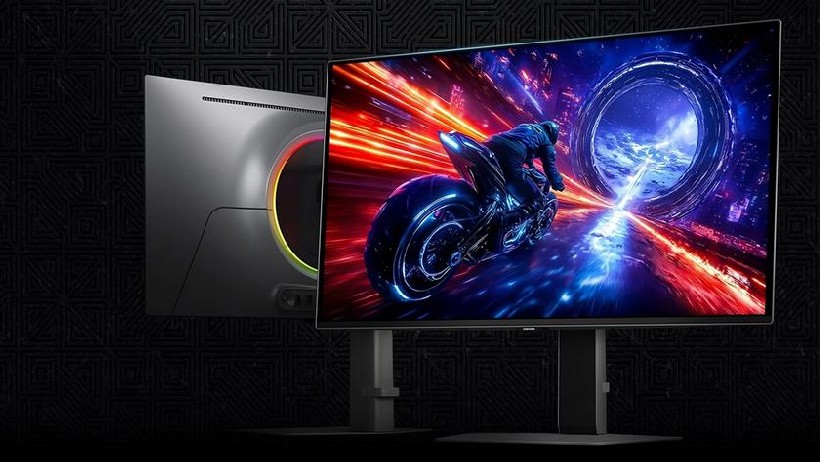
Samsung Odyssey OLED G6 (LS27DG612S) received a screen with a resolution of 2560×1440 pixels, operating at a refresh rate of up to 360 Hz. The OLED panel has a response time declared at 0.03 ms. There is an anti-glare coating. The monitor supports AMD FreeSync Premium Pro and NVIDIA G-Sync Compatible technologies.
Brightness reaches 250 cd/m² in standard mode, and HDR adds detail in light and dark areas. The design provides height, tilt and swivel adjustment, which makes it convenient for long-term use. Connection is implemented via two HDMI 2.1 ports, one DisplayPort 1.4 and a USB hub. The case has CoreSync backlighting on the rear panel. The device weighs about 6 kg. You can learn more and view reviews of this model in the section smartphones, TV and electronics on Rozetka.
Disadvantages and advantages of Samsung Odyssey OLED G6
+ High refresh rate of 360 Hz.
+ OLED matrix with deep black and instant response.
+ Wide possibilities for adjusting the screen position.
- Lack of built-in speakers.
ASUS ROG Swift OLED PG32UCDMZ (90LM09T0-B01371) with a diagonal of 32 inches.
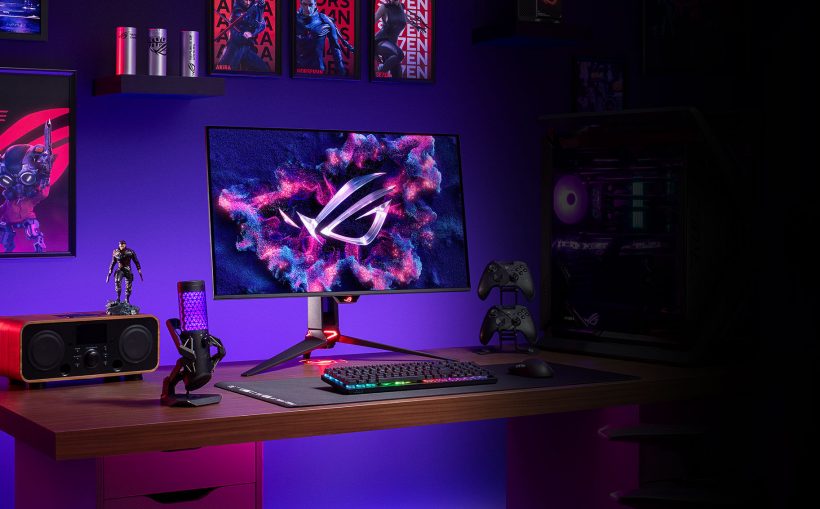
a screen with a refresh rate of 240 Hz, focused on esports and modern games. The OLED panel provides deep blacks and high contrast, and the response time is stated at 0.03 ms. The monitor supports NVIDIA G-Sync Compatible and AMD FreeSync Premium Pro technologies, which reduce artifacts during fast movements. Brightness in standard mode reaches 250 cd/m², and HDR10 adds detail in light and dark scenes. Moreover, the 99% DCI-P3 color gamut coverage makes this and other monitors a great choice for working with graphics. The design includes height, tilt, and swivel adjustments, making it suitable for long gaming sessions. Connectivity is provided via two HDMI 2.1, one DisplayPort 1.4, and a USB hub. ROG-style case design with accents on the back panel and a compact stand. The weight of the device is about 9 kg.
Disadvantages and advantages of ASUS ROG Swift OLED PG32UCDMZ
+ High refresh rate of 240 Hz at 4K resolution.
+ OLED matrix with instant response and deep black.
+ Ergonomic design with adjustable screen position.
- Significant weight compared to smaller models.
MSI MPG 341CQPX QD-OLED 34
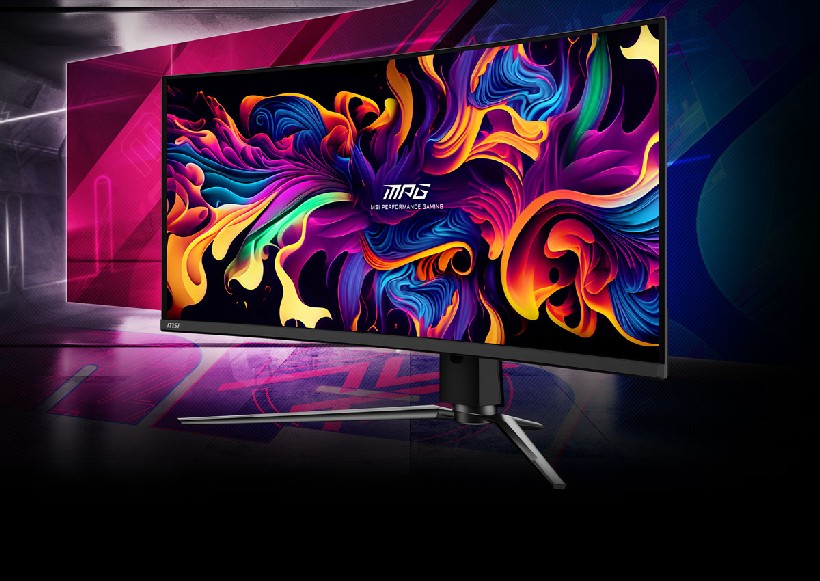
The monitor has an aspect ratio of 21:9. This is already a representative of widescreen models. It has a curved shape with a radius of 1800R. The QD-OLED panel is characterized by a refresh rate of 175 Hz. The response time is declared at 0.03 ms, which allows you to display fast scenes without blurring. The monitor supports adaptive synchronization technologies, including NVIDIA G-Sync Compatible and AMD FreeSync Premium Pro. The brightness in standard mode is 250 cd/m², and HDR True Black 400 adds detail in light and dark areas. The design provides tilt and height adjustment. Connection is implemented via two HDMI 2.1, one DisplayPort 1.4 and a USB hub with 98 W power support. The design is made in a strict style with a minimalist stand.
Disadvantages and advantages of MSI MPG 341CQPX QD-OLED
+ Ultra-wide 21:9 format with panoramic effect.
+ QD-OLED panel with deep black and fast response.
+ 175 Hz refresh rate for smooth display.
- Large dimensions that require space on the desk.
LG 45″ LG UltraGear OLED Gaming Monitor (45GX90SA-B) diagonal 45

The OLED panel with an 800R curve provides deep blacks and high contrast, and the refresh rate reaches 240 Hz. The response time is stated at 0.03 ms. The monitor supports NVIDIA technologies G-Sync Compatible and AMD FreeSync Premium Pro. Brightness in standard mode is 275 cd/m², and HDR10 adds detail in bright and dark areas. The design provides tilt and height adjustment. Connection is implemented via two HDMI 2.1, one DisplayPort 1.4 and a USB hub. The design is made in the UltraGear style – with a minimalist stand and accents on the back panel. You can also buy this monitor at Rozetka.
Disadvantages and advantages LG 45″ LG UltraGear OLED
+ Large 45-inch curved screen with a 21:9 aspect ratio.
+ Increased display brightness
+ Increased display brightness 400;”>+ 240 Hz refresh rate for smooth display.
- Heavy weight and dimensions that require a lot of space.
Samsung Odyssey OLED G9 G93SC (LS49CG930SIXCI) 49″ diagonal

This is a super large monitor that actually replaces two and is actually comparable to TVs. The OLED panel has a refresh rate of 240 Hz. The monitor supports adaptive synchronization technologies that reduce frame tearing in dynamic scenes. The design provides height adjustment up to 120 mm, as well as tilt and swivel. Connection is implemented via HDMI and DisplayPort, and there is also a USB hub. There are two built-in 5 W speakers. The curved shape of the screen creates an immersive effect, especially when multitasking and playing games. HDR adds detail in light and dark areas, although maximum brightness is limited. It has dimensions of 1195x529x237 mm, so it is more of a solution for game consoles than a PC monitor.
Disadvantages and advantages of Samsung Odyssey OLED G9 G93SC
+ Large 49-inch screen with 32:9 aspect ratio.
+ OLED panel with high contrast and fast response.
+ 240 Hz refresh rate for smooth display.
- In fact, this is a TV and the distance to the player from it should be several meters.
Comparison of OLED monitors
| Specifications | Samsung Odyssey OLED G6 | ASUS ROG Swift OLED PG32UCDMZ | MSI MPG 341CQPX QD-OLED | LG UltraGear OLED 45GX90SA-B | Samsung Odyssey OLED G9 G93SC |
|---|---|---|---|---|---|
| Diagonal | 27″ | 32″ | 34″ | 45″ | 49″ |
| Format | 16:9 | 16:9 | 21:9 | 21:9 | 32:9 |
| Divide resolution | 2560×1440 | 3840×2160 | 3440×1440 | 3440×1440 | 5120×1440 |
| Panel type | OLED | OLED | QD-OLED | OLED | |
| Refresh rate | 360 Hz | 240 Hz | 175 Hz | 240 Hz | 240 Hz |
| Response Time | 0.03 ms | 0.03 ms | 0.03 ms | 0.03 ms | Fast (OLED) |
| Synchronization | FreeSync Premium Pro, G-Sync Compatible | FreeSync Premium Pro, G-Sync Compatible | FreeSync Premium Pro, G-Sync Compatible | FreeSync Premium Pro, G-Sync Compatible | Adaptive Sync |
| Brightness (Standard) | 250 cd/m² | 250 cd/m² | 250 cd/m² | 275 cd/m² | 250 cd/m² |
| HDR | HDR | HDR10 | HDR True Black 400 | HDR10 | HDR |
| Curvature | Flat | Flat | 1800R | 800R | 1800R |
| Ergonomics | Height adjustment, tilt, swivel | Height adjustment, tilt, swivel | Height adjustment, tilt | Height adjustment, tilt | Height adjustment, tilt, twist |
| Ports | 2× HDMI 2.1, 1× DP 1.4, USB hub | 2× HDMI 2.1, 1× DP 1.4, USB hub | 2× HDMI 2.1, 1× DP 1.4, USB hub | 2× HDMI 2.1, 1× DP 1.4, USB hub | HDMI, DP, USB hub |
| Weight | ~6 kg | ~9 kg | — | — | — |


Don't miss interesting news
Subscribe to our channels and read announcements of high-tech news, tes





Oppo A6 Pro smartphone review: ambitious

 0
0 
Creating new mid-range smartphones is no easy task. Manufacturers have to balance performance, camera capabilities, displays, and the overall cost impact of each component. How the new Oppo A6 Pro balances these factors is discussed in our review.
Logitech G G325 headphones review: reliable and long-lasting
0 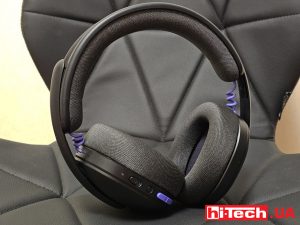
Logitech G has released a new gaming headset that offers good ergonomics, stable connectivity, and high battery life at a very affordable price. Let’s talk about the Logitech G G325 in more detail
In Kyivstar’s network, 40% of voice traffic comes from VoLTE and VoWiFi Kyivstar

High usage rates on Kyivstar’s network were recorded in Lviv and Kyiv. In Lviv, the share of voice traffic via VoLTE and VoWiFi reached 61%, while in the capital it was about 57%.
Google Docs can now read documents thanks to Gemini AI artificial intelligence Google

The web version of Google Docs has a new audio summary feature that allows you to listen to the content of documents instead of reading the text