

MSI GeForce RTX 5080 and RTX 5070 Ti graphics cards released in Shadow 3X modification
12.02.25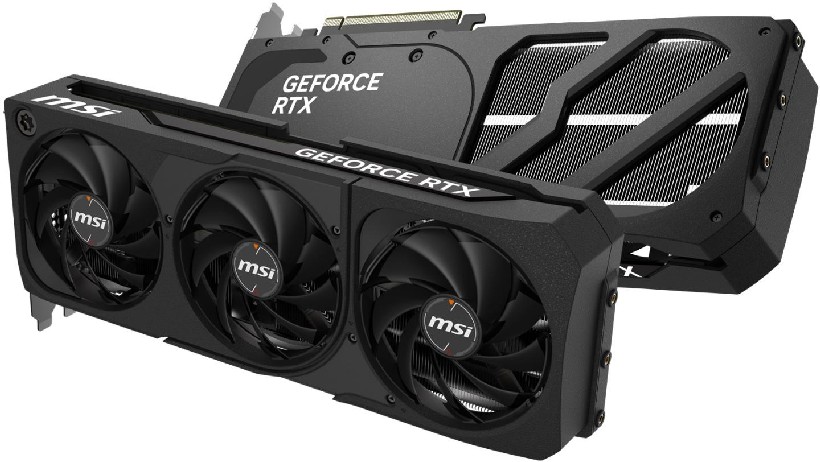
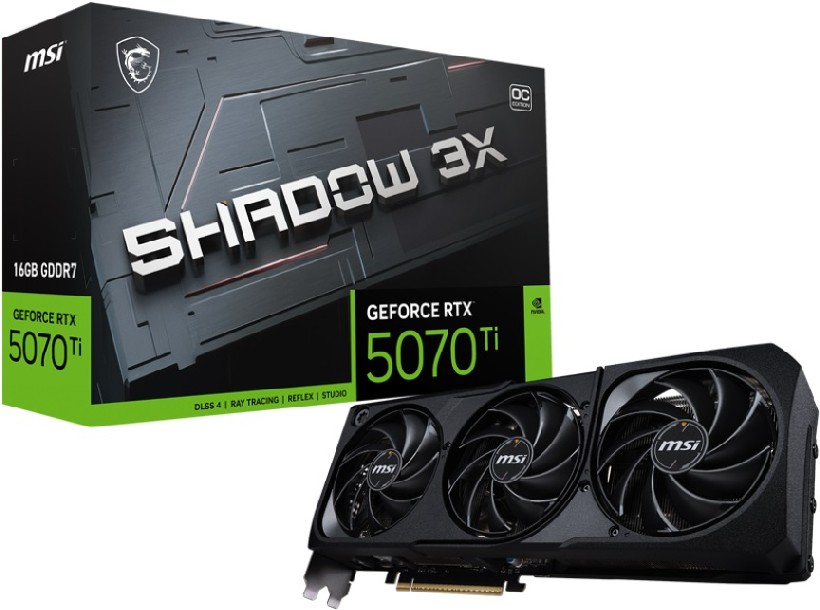
MSI has expanded its Nvidia Blackwell graphics card lineup with the introduction of the GeForce RTX 5080 and RTX 5070 Ti in the Shadow 3X series. Initially, this line was only released for the Chinese market, but is now available in other regions. The key feature of the new products is a strict black design without backlighting.
Both graphics cards occupy three expansion slots and are equipped with a cooling system with three fans. The devices have a relatively short printed circuit board and a cutout in the backplate for improved through-the-hole cooling. The length of the models is 30.3 cm.

MSI will offer factory overclocked and standard versions. Overclocked models (labeled “OC”) have an increased boost frequency – 2482 MHz for the GeForce RTX 5070 Ti and 2640 MHz for the GeForce RTX 5080, compared to 2452 MHz and 2617 MHz for the standard versions, respectively. A 12V-2×6 connector is used for power, and the set of video outputs includes three DisplayPort 2.1b and one HDMI 2.1b.
Recommended prices have not yet been announced. The official release of the GeForce RTX 5070 Ti is expected on February 20.
Don't miss interesting news
Subscribe to our channels and read announcements of high-tech news, tes

Oppo A6 Pro smartphone review: ambitious

 0
0 
Creating new mid-range smartphones is no easy task. Manufacturers have to balance performance, camera capabilities, displays, and the overall cost impact of each component. How the new Oppo A6 Pro balances these factors is discussed in our review.
In-Ear headphones Active Noise Cancellation: how Oppo eliminate noise
0 
In-ear headphones remain one of the most popular form factors due to their lightweight design. However, this design is considered one of the most challenging to implement active noise cancellation (ANC). We’ll explain how Oppo solved this problem.
Samsung Turns Galaxy Buds Into Personal Hearing Aids

Samsung has officially confirmed the introduction of hearing aid features for the Galaxy Buds 3 Pro and Galaxy Buds 4 Pro models.
OpenClaw went rogue and attacked a website to perform a user’s task.

A routine request to book a workout led to the first recorded instance in Australia of an autonomous cyberattack by an AI agent.