

Samsung introduces a new generation ultra-thin OLED panel for gaming laptops
05.06.26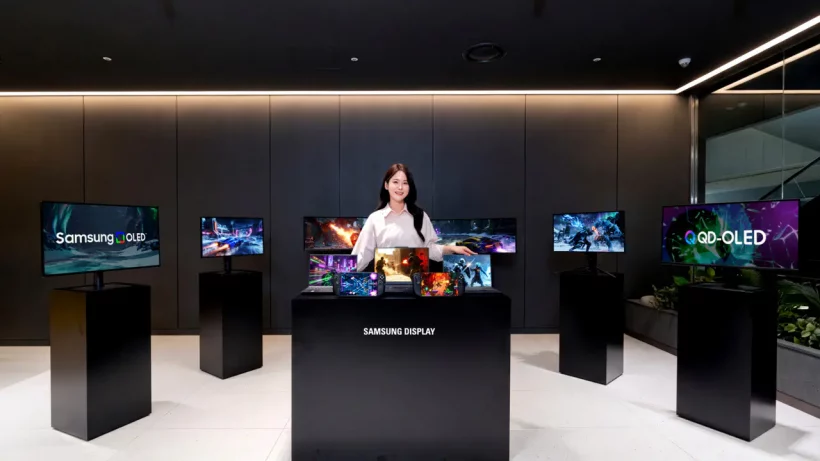
At the Computex 2026 exhibition, the Samsung Display company showed an innovative OLED panel designed specifically for new generation laptops. The main goal of the technology is to radically reduce the thickness of the screen module and thereby give manufacturers more freedom in designing thinner, lighter and more powerful devices.
The novelty is aimed primarily at premium gaming laptops and mobile workstations, where traditionally it was necessary to find a balance between performance, cooling and compactness of the case. Now this trade-off becomes much less critical.
Engineering breakthrough
The key achievement of Samsung was reducing the thickness of the display module by more than 20% compared to existing solutions. Such a result became possible thanks to the revised technology of chemical etching of glass substrates and optimization of the structure of OLED layers.
Engineers managed to uniformly reduce the thickness of the glass without deteriorating its strength and optical characteristics. This is especially important for laptops, where the screen is constantly subjected to loads due to the high temperature of the internal components and mechanical influences during transfer.
Solving the problem of deformation of ultra-thin glass
One of the main difficulties in creating ultra-thin displays is the risk of deformation of the panel – bends, microcracks and temperature distortions.
Samsung Display has implemented a complex of patented technologies that stabilize the structure of the panel and compensate for thermal expansion of materials. Thanks to this, the screen maintains its geometry and stable characteristics even during long-term work under high load.
This is especially important for gaming scenarios where laptops are pushed to the limit and generate a significant amount of heat.

Premium image quality
Despite the reduced thickness, the new OLED panel has not lost the image and meets the high standards of the industry.
The screen received VESA True Black 1000 certification, which confirms:
- peak brightness up to 1000 threads
- black level less than 0.0005 threads
- high level of contrast and detail in dark scenes
Support for modern HDR standards and advanced color is also declared, which makes the panel suitable not only for games, but also for professional work with content.
Update frequency
The panel is designed for dynamic use in the range from 165 to 240 Hz. This allows the device to be adapted both for competition disciplines and for more universal usage scenarios.
In addition, the display received a rating of VESA ClearMR 11000 – one of the highest indicators of clarity of movement. It means a minimum level of blurring during sharp movements of objects on the screen, which is critical for shooters and eSports games.
Impact on the new generation laptop market
Decreasing the thickness of the display module opens up new opportunities for laptop manufacturers in device design. Freed space can be used for:
- more efficient cooling systems
- increased batteries
- powerful GPU and CPU
- additional memory modules and drives
As a result, future notebooks will be able to become simultaneously thinner, lighter and more productive without traditional compromises.
When to wait for the new item
At the moment, the panel is at the stage of final tests and preparation for mass production. Samsung did not reveal the first partners and brands that will get access to the technology.
However, according to industry experts, the first commercial laptops with the new ultra-thin OLED matrix may appear closer to the end of the year after the announcement
Don't miss interesting news
Subscribe to our channels and read announcements of high-tech news, tes

Oppo A6 Pro smartphone review: ambitious

 0
0 
Creating new mid-range smartphones is no easy task. Manufacturers have to balance performance, camera capabilities, displays, and the overall cost impact of each component. How the new Oppo A6 Pro balances these factors is discussed in our review.
In-Ear headphones Active Noise Cancellation: how Oppo eliminate noise
0 
In-ear headphones remain one of the most popular form factors due to their lightweight design. However, this design is considered one of the most challenging to implement active noise cancellation (ANC). We’ll explain how Oppo solved this problem.
The new Radeon RX 9050 4GB is only for pre-built PCs.

AMD has unveiled the Radeon RX 9050 with 4GB of VRAM, a 64-bit bus, and 16MB of Infinity Cache.
Honor Turbo 5G Hands-On: Affordable Phone With Massive Battery and IP69 Rating

Honor has officially released the Honor Turbo 5G smartphone. The new device packs a large AMOLED screen, an 8,560 mAh battery, a Snapdragon 6 Gen 4 chipset, and IP69 protection.