

Indiana Jones and the Great Circle system requirements revealed
06.12.24
Indiana Jones and the Great Circle, an action-adventure game developed by MachineGames, is set to release next week. Expectations are high for the game, given the studio’s successful projects such as the modern Wolfenstein games.
The technical side of the game demonstrates an ambitious approach to visual performance, which is reflected in the system requirements. Even for the minimum settings, significant computing power is required. To run the game, you will need an RTX 2060 Super graphics card, an Intel Core i7-10700K processor, 16 GB of RAM and 120 GB of free space on an SSD. These parameters provide only basic graphics quality, and higher settings require even more powerful hardware.
The game promises to take players on an eventful adventure with detailed worlds, but the requirements emphasize the need for modern gaming equipment to fully enjoy this project.
System Requirements for Indiana Jones and the Great Circle
Minimum (Low Settings, 1080p at 60 fps)
- Operating System: 64-bit Windows 10;
- Processor: Intel Core i7-10700K or AMD Ryzen 5 3600;
- Graphics: NVIDIA GeForce RTX 2060 Super (8GB), AMD Radeon RX 6600 (8GB) or Intel Arc A580;
- RAM: 16GB;
- SSD Space: 120GB.
Recommended (High settings, 1440p at 60 fps)
- Operating system: 64-bit Windows 10;
- Processor: Intel Core i7-12700K or AMD Ryzen 7 7700;
- Graphics: NVIDIA GeForce RTX 3080Ti (12 GB) or AMD Radeon RX 7700 XT (12 GB);
- RAM: 32 GB;
- SSD space: 120 GB.
Ultra settings (4K at 60 fps)
- operating system: 64-bit Windows 10;
- processor: Intel Core i9-13900K or AMD Ryzen 9 7900X;
- video card: NVIDIA GeForce RTX 4080 (16 GB) or AMD Radeon RX 7900 XT (20 GB);
- RAM: 32 GB;
- SSD space: 120 GB.
And here are the requirements with full ray tracing (the configurations that work in conjunction with DLSS 3 and frame generation technologies are described below, without them the performance will be much lower)
Minimal (low settings, 1080p upscaled at 60 fps)
- operating system: 64-bit Windows 10;
- processor: i7-10700K or AMD Ryzen 5 3600;
- video card: NVIDIA GeForce RTX 4070 (12 GB);
- RAM: 16 GB;
- SSD space: 120 GB.
Recommended (High settings, 1440p upscaled at 60 fps)
- Operating system: 64-bit Windows 10;
- Processor: Intel Core i7-12700K or AMD Ryzen 7 7700;
- Graphics card: NVIDIA GeForce RTX 4080 (16 GB);
- RAM: 32 GB;
- SSD space: 120 GB.
Ultra settings (4K with upscaling at 60 fps)
- operating system: 64-bit Windows 10;
- processor: i7-13900K and Ryzen 7 7900X (please note! the developer made a mistake and indicated non-existent processors, most likely they meant Intel Core i9-13900K or AMD Ryzen 9 7900X) li>
- video card: NVIDIA GeForce RTX 4090 (24 GB);
- RAM: 32 GB;
- SSD space: 120 GB.
Don't miss interesting news
Subscribe to our channels and read announcements of high-tech news, tes

Oppo A6 Pro smartphone review: ambitious

 0
0 
Creating new mid-range smartphones is no easy task. Manufacturers have to balance performance, camera capabilities, displays, and the overall cost impact of each component. How the new Oppo A6 Pro balances these factors is discussed in our review.
In-Ear headphones Active Noise Cancellation: how Oppo eliminate noise
0 
In-ear headphones remain one of the most popular form factors due to their lightweight design. However, this design is considered one of the most challenging to implement active noise cancellation (ANC). We’ll explain how Oppo solved this problem.
Honor Robot Phone Repair Costs Revealed

Discover the official repair costs for the innovative Honor Robot Phone. We break down the pricing for replacing the unique gimbal module, motherboard, and other components in case of damage.
The new Radeon RX 9050 4GB is only for pre-built PCs.
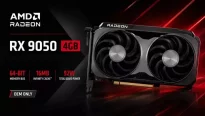
AMD has unveiled the Radeon RX 9050 with 4GB of VRAM, a 64-bit bus, and 16MB of Infinity Cache.