

Google Ironwood is the company’s new chip for artificial intelligence operations
11.04.25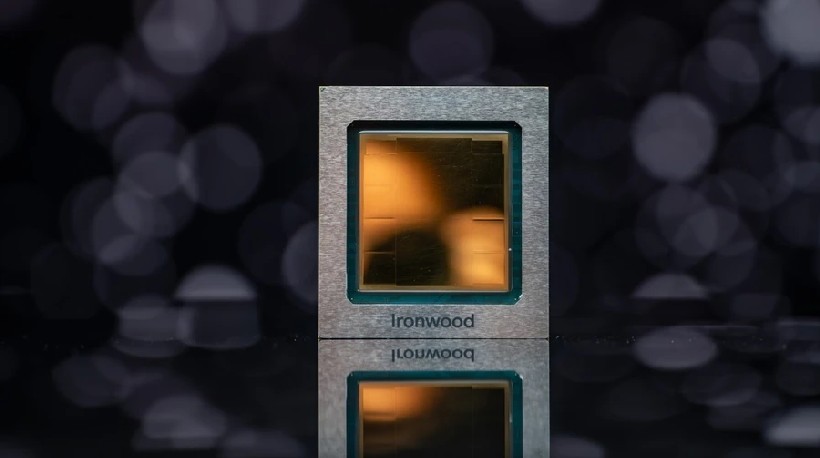
Google unveiled a new AI acceleration chip called Ironwood at its Cloud Next conference. It’s the company’s seventh-generation Tensor Processing Unit (TPU) and the first optimized for AI inferencing. The chip will be available to Google Cloud customers this year in two configurations: a 256-chip cluster and a 9216-chip cluster.
Ironwood delivers up to 4,614 TFLOPs of performance, has 192GB of dedicated RAM, and has a bandwidth of up to 7.4Tbps. It also includes an advanced SparseCore core designed to handle specific data. The chip’s architecture is designed to minimize data movement and latency on the chip, which helps reduce power consumption.
Ironwood will be a key part of Google’s strategy to integrate AI into its services. The chip will be integrated with the AI Hypercomputer, a modular cluster of computing resources in Google Cloud that will allow for even more efficient processing of large amounts of data for AI.
Google announced Ironwood against the backdrop of increasing competition in the field of AI accelerators. While NVIDIA leads the market, other companies such as Amazon and Microsoft are also actively developing their own solutions. Amazon offers Trainium, Inferentia and Graviton processors through its AWS platform, and Microsoft has its Cobalt 100 chip for AI, available through Azure.
Google emphasizes that Ironwood is the most powerful and energy-efficient TPU to date, and its architecture allows you to efficiently run inferential AI models.
Don't miss interesting news
Subscribe to our channels and read announcements of high-tech news, tes

Oppo A6 Pro smartphone review: ambitious

 0
0 
Creating new mid-range smartphones is no easy task. Manufacturers have to balance performance, camera capabilities, displays, and the overall cost impact of each component. How the new Oppo A6 Pro balances these factors is discussed in our review.
Oppo Reno16 Pro 5G smartphone review: well-heeled
0 
Oppo Reno16 Pro 5G looks like a balanced smartphone, in which the manufacturer tried not to make a single characteristic the defining one. It has many advantages. Let’s tell you what
Gemini, Keep, and Motion Assist: The New Android Drop Features

Google introduced a fresh package of Android Drop updates for smartphone users, including AI integration in search, new messaging capabilities, and health-related features.
Acer Predator Atlas 7: A New Handheld With 24GB RAM and 1TB SSD

At IFA 2026, Acer introduced the Predator Atlas 7, an updated 7-inch handheld gaming console.