

Thermaltake CAPO X is a solution for those who are cramped in one PC
11.06.26
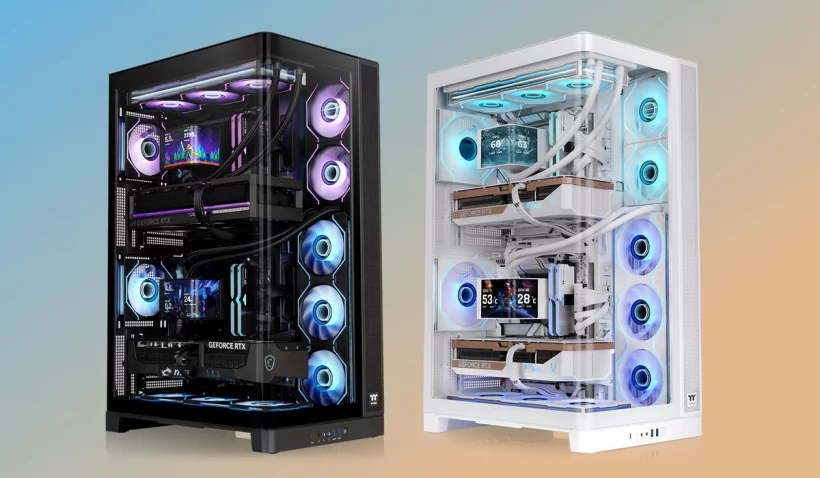
At Computex, Thermaltake presented CAPO X, an unusual case that actually turns one system unit into two independent computers. Instead of the usual “one motherboard – one PC” scheme, the manufacturer offers a solution where two full-fledged systems coexist inside one case.
The idea is aimed at users who need to share the load without using two separate cases – be it gaming, streaming, workflows or computing.
Two PCs without compromising on form factor
Unlike typical two-system solutions, where a compact Mini-ITX configuration is added to the main ATX board, CAPO X is built differently. The case is designed to accommodate two mATX motherboards, each of which gets its own space inside the chassis.
Both systems are placed on different levels, which allows you to avoid dense layout and maintain full compatibility with powerful components. The user can assemble two equivalent configurations without performance restrictions – including modern processors and full-size video cards, including the NVIDIA GeForce RTX 50 series.
In demo assemblies, each of the systems was also equipped with a separate 360 mm liquid cooling system, emphasizing the independence of the circuits.
Extreme approach to cooling
Two high-performance computers in one case means a serious heat load, and Thermaltake is betting on large-scale cooling. CAPO X supports the installation of up to 13 120 mm fans, as well as two separate 360 mm heatsinks.
In the custom configurations shown at the show, each system used its own liquid cooling circuit with individual reservoirs and water blocks. As a result, the internal layout looks extremely dense and technically saturated, more reminiscent of an engineering bench than an ordinary PC.
For ease of use, each system received its own set of interface ports on the front panel.
Why do you need a case with two systems
The main idea of CAPO X is the division of tasks between two independent computing environments. One computer can be fully used for games or heavy graphics tasks, and the second – for streaming, background processes, work with artificial intelligence or calculations.
This approach allows you to reduce the load on one system and avoid resource conflicts that often occur when several heavy tasks are running simultaneously.
In addition, the case does not limit the user in the choice of platforms: it is possible to combine solutions based on AMD and Intel inside, creating two completely autonomous configurations.
A niche solution for enthusiasts and professionals
Thermaltake has not yet revealed the price and release date of CAPO X. It is clear that it is not a mass product, but a specialized solution for enthusiasts, content creators and professional users who need to combine high performance.
CAPO X offers a non-standard approach to PC organization – not increasing the power of one system, but the distribution of calculations between two independent computers in one case
Don't miss interesting news
Subscribe to our channels and read announcements of high-tech news, tes

Oppo A6 Pro smartphone review: ambitious

 0
0 
Creating new mid-range smartphones is no easy task. Manufacturers have to balance performance, camera capabilities, displays, and the overall cost impact of each component. How the new Oppo A6 Pro balances these factors is discussed in our review.
In-Ear headphones Active Noise Cancellation: how Oppo eliminate noise
0 
In-ear headphones remain one of the most popular form factors due to their lightweight design. However, this design is considered one of the most challenging to implement active noise cancellation (ANC). We’ll explain how Oppo solved this problem.
The new Radeon RX 9050 4GB is only for pre-built PCs.
AMD has unveiled the Radeon RX 9050 with 4GB of VRAM, a 64-bit bus, and 16MB of Infinity Cache.
Honor Turbo 5G Hands-On: Affordable Phone With Massive Battery and IP69 Rating

Honor has officially released the Honor Turbo 5G smartphone. The new device packs a large AMOLED screen, an 8,560 mAh battery, a Snapdragon 6 Gen 4 chipset, and IP69 protection.