

DOOM game launched in PCB designer
06.12.25
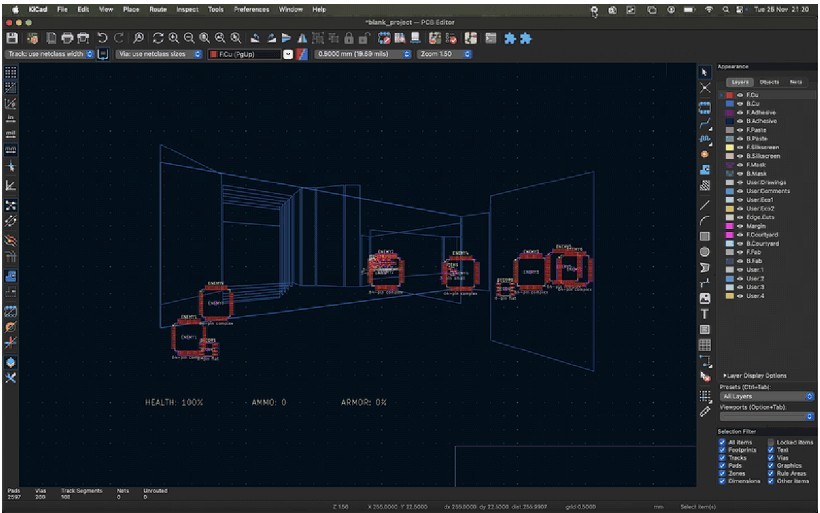
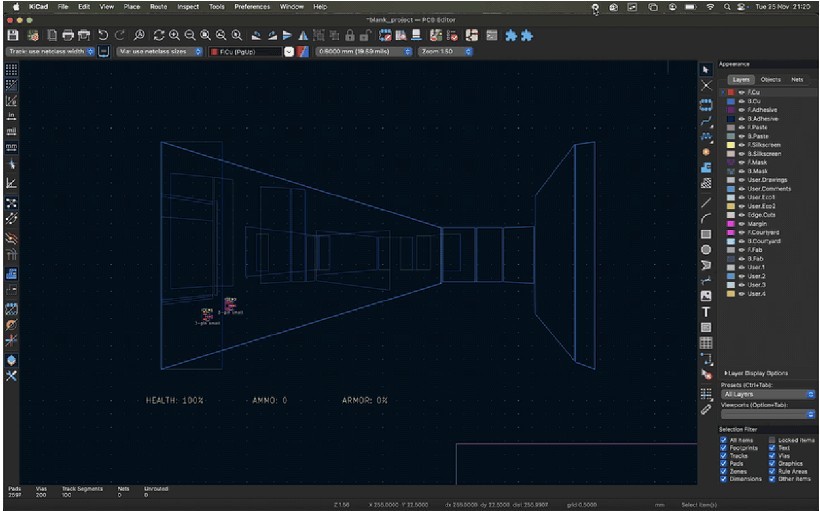
Developer Michael Ailes has introduced an unusual experiment by bringing DOOM to the PCB design environment. The project is called KiDOOM, a portmanteau of KiCad, a free and open-source software for circuit board design, and the iconic 1993 shooter DOOM. In this version, the game runs directly in the board editing window, where KiCad acts as a visualizer. The DOOM game engine itself runs as a separate process, but all graphics are rendered inside the design program.
How it works
KiDOOM’s visual style looks unusual and immediately evokes associations with the era of arcade machines such as Atari Battlezone, or with the aesthetics of Vectrex. Ailes went further, replacing standard enemies with conventional electronic components: demons and zombies are depicted as QFP-64 packages, cartridges as small SOT-3. Even the explosive barrels, torches and “dead bodies” are represented by elements in the SOIC-8 package. As a result, the game world looks as if it was created from neon tracks of a printed circuit board.
A feature of KiDOOM is that each frame of the game is a full-fledged board project, which can theoretically be manufactured. Instead of a regular screenshot, you can get a physical board, more like a souvenir, since it has no practical application, but the fact itself gives the game a certain absurd charm.
How to Play Doom in a PCB Design Environment
KiDOOM offers three rendering modes and a six-step rendering sequence. Ailes explains that the DOOM engine first considers geometry as vectors, and the circuit board tracing is also based on vector lines. Therefore, only 100-300 lines per frame are required for rendering instead of tens of thousands of pixels, which provides unexpectedly high speed.
The developer tested KiDOOM on various systems and noted acceptable smoothness. On a MacBook Pro with an M1 chip, the game produces about 15-25 frames per second, and on a configuration with a Core i7 and RTX 3050 Ti – about 18-28 frames. It is not yet clear whether more powerful hardware will be able to increase performance; there may be other bottlenecks in the rendering. For those who want to try it themselves, Ailes described in detail the KiCad settings, without which performance drops by 2-5 times.
The KiDOOM project is not focused on comfortable gameplay, its meaning lies in technical curiosity and creativity. The experiment shows how flexible modern circuit design tools can be and how much fans are willing to go into experiments when interest outweighs common sense. This is another reminder that classic DOOM runs on almost any computing platform, even in a printed circuit board editor. Previously, the game has already been run on video cards, alarm clocks, chargers, pregnancy tests, masturbators, and even with the help of intestinal bacteria.
Don't miss interesting news
Subscribe to our channels and read announcements of high-tech news, tes

Oppo A6 Pro smartphone review: ambitious

 0
0 
Creating new mid-range smartphones is no easy task. Manufacturers have to balance performance, camera capabilities, displays, and the overall cost impact of each component. How the new Oppo A6 Pro balances these factors is discussed in our review.
Logitech G G325 headphones review: reliable and long-lasting
0 
Logitech G has released a new gaming headset that offers good ergonomics, stable connectivity, and high battery life at a very affordable price. Let’s talk about the Logitech G G325 in more detail
Enthusiasts have found a way to use YouTube as cloud storage for any files YouTube

A project has appeared on the GitHub platform that offers a way to store files on YouTube as videos without losing data. The development, called yt-media-storage, actually turns video hosting into storage, using the features of processing and uploading content to the service.
Norwegian electronics store will give GTA 6 to those who give birth on the day the game is released games GTA

Norwegian electronics retailer Komplett has announced an unusual promotion dedicated to the release of Grand Theft Auto VI. The company has promised to give a free copy of the game to all families whose children are born on the official release date – November 19, 2026.