

Charging stations for any task – from smartphones to large household appliances
23.11.25
In the modern world, portable charging stations are becoming indispensable assistants. They were once created for outdoor recreation, organizing parties and events. However, over time, their role turned out to be much more significant. They come in different capacities – from compact to high-powered – and it is this variety that covers our rating of models. In the article you will find reviews of the brands Bluetti, EcoFlow, Anker, Fossibot and Oukitel, as well as comparative tables for key parameters.
We divided the devices into categories by capacity — from models with 1000–1500 Wh to systems over 5000 Wh — to make it easier to choose a station for specific tasks. Each section considers output power, battery type, UPS capability, portability, and additional features to show the strengths and weaknesses of different models. You can buy these and many other models of charging stations at Rozetka.
What types of batteries are used in charging stations?
Portable charging stations (power stations) today use several main types of batteries — each with its own advantages and disadvantages:
- Li-ion
- Most common in mid-range models.
- High energy intensity with low weight, so the stations are more compact.
- Disadvantages: they gradually lose capacity, are sensitive to high temperatures, have a shorter life compared to LiFePO₄.
- NMC/NCA (nickel-manganese-cobalt/nickel-cobalt-aluminum)
- A variety of lithium-ion, often used in more powerful and mobile stations.
- A very high indicator of energy intensity — “more watt-hours at the same size”.
- Disadvantages: shorter cycle life and lower thermal stability compared to LiFePO₄.
- LiFePO₄ (lithium-iron-phosphate)
- The most durable: 3000–6000+ cycles without significant degradation.
- More thermally stable and safe — they do not overheat and are difficult to catch fire.
- Disadvantage: lower energy density — stations are heavier and larger with the same capacity.
For small – smartphones, laptops, routers
BLUETTI Elite 100 V2 (P-EL100V2-EU-GY-BL-010)
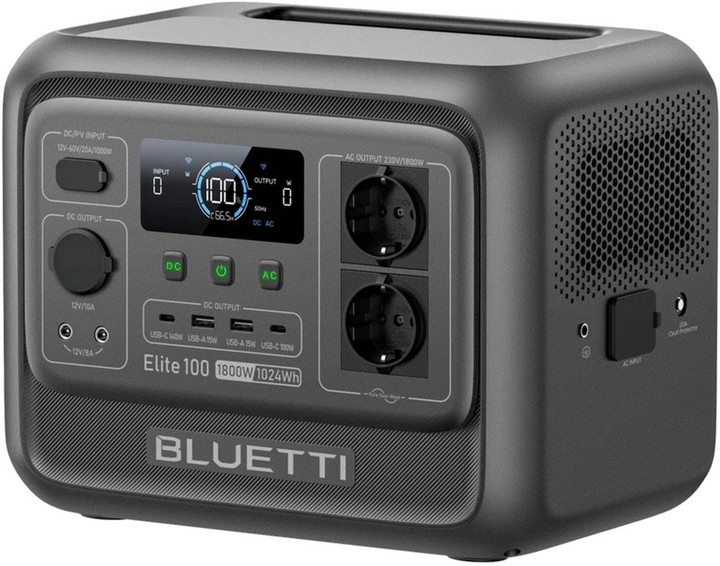
BLUETTI Elite 100 V2 charging station is a portable charging station with a LiFePO4 battery with a capacity of 1024 Wh, designed for home and outdoor use without excessive emphasis on autonomy. The nominal output power of the inverter is 1800 W, which allows you to have a continuous load for most household appliances compatible with a pure sine wave of 230 V. In the modes of increased load, the station supports an increase in power up to 2700 W and a short-term peak up to 3600 W, suitable for starters. Two AC 230 V sockets, two USB Type-C and two USB Type-A ports are provided on the case for powering and charging various categories of equipment.
Advantages and disadvantages of BLUETTI Elite 100 V2
+ Nominal 1800 W with pure sine wave and peaks up to 3600 W for starting loads
+ Two AC 230 V and USB-C/USB-A ports
- Limitation of continuous power of 1800 W is not suitable for long-term operation of energy-intensive systems
EcoFlow DELTA 3 (EFDELTA3-CN)
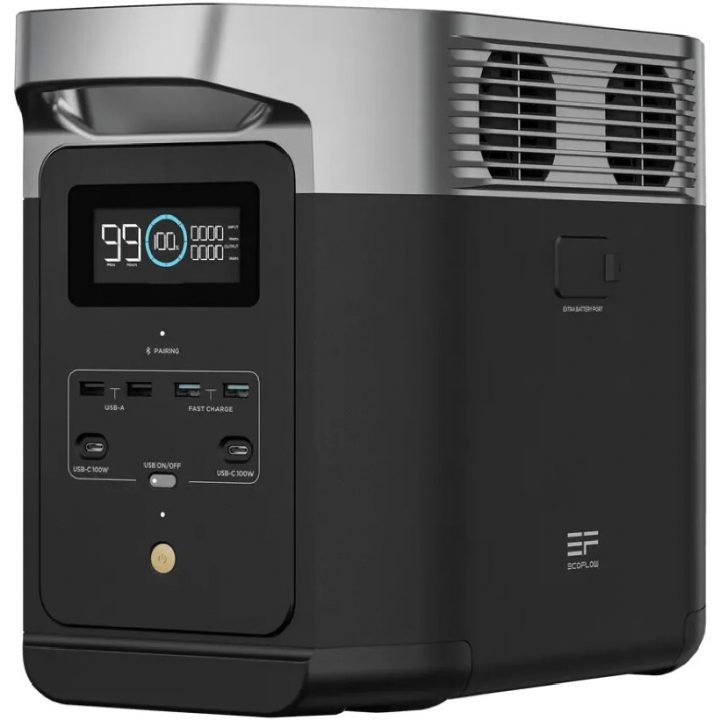
Portable power plant EcoFlow DELTA 3 with a cast-iron-phosphate battery with a capacity of 1800 Wh. According to the nominal power, it produces 2200 W. Several outputs are provided: alternating current (sockets), USB-C and USB-A ports, as well as an automobile connector. The ports have QC3.0 support. Thanks to the X-Stream technology, it is possible to charge the station from the household network quite quickly – in about 1 hour. In addition, it supports charging from solar panels, which expands the possibilities of autonomous power. EcoFlow DELTA 3 can also work as a UPS, connecting to the network and turning on when the power goes out. The device is quite heavy – about 12.5 kg, which limits mobility, but this is quite expected for such powerful sources. There is a display for status indication.
Advantages and disadvantages of EcoFlow DELTA 3
+ Fast charging thanks to X-Stream
+ Possibility of charging from solar panels
+ 6 outlets, USB-C and USB-A
Comparative table of charging stations for 1000-1500 Wh
| Characteristics | BLUETTI Elite 100 V2 | EcoFlow DELTA 3 CN |
|---|---|---|
| Capacity (Wh) | 1024 | 1800 |
| Rated power (W) | 1800 | 2200 |
| Peak power (W) | 3600 (short term) | no specified |
| Battery type | LiFePO₄ | LiFePO₄ |
| Resource cycles | not specified | not specified |
| Source ports | 2xAC, 2xUSB-C, 2xUSB-A | AC, USB-C, USB-A, car output |
| UPS | not specified | yes |
| Charging from the sun | no specified | yes |
| Fast charging | not specified | X-Stream (~1 hour) |
| Weight (kg) | not specified | 12.5 |
Charging stations for computers and small household appliances
BLUETTI Elite 200 V2

BLUETTI Elite 200 V2 charging station has a LiFePO₄ battery with a declared capacity of about 2073.6 Wh. The nominal output power is 2600 W, and the peak power can reach 3900 W. The inverter produces a pure sine wave. The case has two AC connectors (220–230 V), two USB-A ports, two USB-C ports and a 12 V car output. Charging is possible from three sources: from the network, from solar panels (up to 1000 W) and from the car.
The maximum input power reaches 2400 W with combined AC + DC connection. The mass of the station is approximately 24.2 kg, the dimensions are 350×250×324 mm. Bluetooth and Wi-Fi are available for control, which allows you to monitor the charge status remotely. The device supports the UPS function, automatically switching to emergency power mode when the external network is disconnected. TurboBoost charging technology allows you to reach approximately 80% charge in an hour and a half. Battery life is estimated at more than 6,000 cycles to 80% of initial capacity.
Advantages and disadvantages of BLUETTI Elite 200 V2
+ Long-life LiFePO₄ battery with a resource of more than 6000 cycles.
+ Flexible charging methods: network, solar panels, car.
- High weight – almost 24.2 kg may make transportation difficult.
EcoFlow E2000 (EFE2000-EU-CBOX)

EcoFlow E2000 charging station has batteries with a declared capacity of about 2048 Wh. Its nominal output power is approximately 2300 W, but with the support of X-Boost technology, the device can briefly output up to 4800 W. The case has four direct current sockets (AC 230 V), two USB-C ports, two USB-A ports, two DC outputs and a car output.
The station weighs about 23 kg and has dimensions of approximately 497×305×242 mm, which makes it quite heavy, but still portable given the presence of handles. It can be charged through an AC outlet, and also supports the possibility of connecting additional battery modules, which allows you to increase the total capacity. According to the manufacturer, the battery lasts up to 4000 cycles.
The interface is complemented by an LCD screen that informs about the charge level, power consumption and connection status. Wireless capabilities (Wi-Fi and Bluetooth) allow you to control the station through a mobile application.
Advantages and disadvantages of EcoFlow E2000
+ Large capacity of 2048 Wh
- Peak power is limited in time – 4800 W lasts for a short time
DJI Power 2000 (DYM2000H)
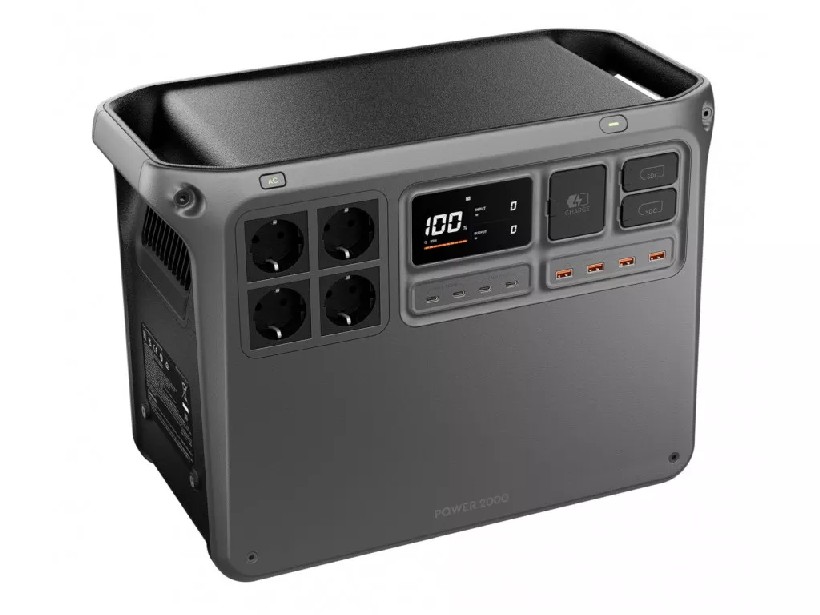
The DJI Power 2000 charging station in the DYM2000H version has a cast-iron-phosphate (LiFePO₄) battery with a capacity of 2048 Wh. Four AC outlets, four USB-C ports, four USB-A ports, and two SDC outputs are located in the device body, which allows you to charge various devices at the same time. The device is designed for a voltage of 220–240 V at the AC output. The mass of the station is about 22 kg, and its dimensions are 448×225×324 mm.
According to the manufacturer, the battery retains more than 80% of its capacity for up to 4000 full cycles. The device has active cooling — the fans start under load to avoid overheating. In addition, it supports charging through external sources, such as solar panels, which expands usage scenarios. On the other hand, significant weight limits mobility, especially if the station needs to be moved often. Also, even at peak load, some USB-C or SDC ports may not support the maximum output power all the time, which affects the efficiency when charging powerful devices.
Advantages and disadvantages of DJI Power 2000
+ Large capacity (2048 Wh) for long-term backup power.
+ A wide selection of ports — AC, USB-C, USB-A, SDC.
- Significant weight (22 kg) complicates frequent movements.
Comparative table of charging stations for 2000-2500 Wh
| Characteristics | BLUETTI Elite 200 V2 | EcoFlow E2000 | DJI Power 2000 |
|---|---|---|---|
| Capacity (Wh) | 2073.6 | 2048 | 2048 |
| Rated power (W) | 2600 | 2300 | not specified |
| Peak power (W) | 3900 | 4800 (X-Boost, short-term) | not specified |
| Battery type | LiFePO₄ | Li-ion / LiFePO₄ | LiFePO₄ |
| Resource cycles | 6000+ | 4000 | 4000+ |
| Source ports | 2×AC, 2×USB-A, 2×USB-C, 12V | 4×AC, 2×USB-A, 2×USB-C, 2×DC, 12V | 4×AC, 4×USB-A, 4×USB-C, 2×SDC |
| UPS | yes | not specified | not specified |
| Temperature range | not specified | not specified | not specified |
| Protection / Security | not specified | not specified | active fan cooling |
| Weight (kg) | 24.2 | 23 | 22 |
Charging stations for household appliances
EcoFlow DELTA Pro 3 EU-Version (EFDELTAPRO3-EU-CBox)
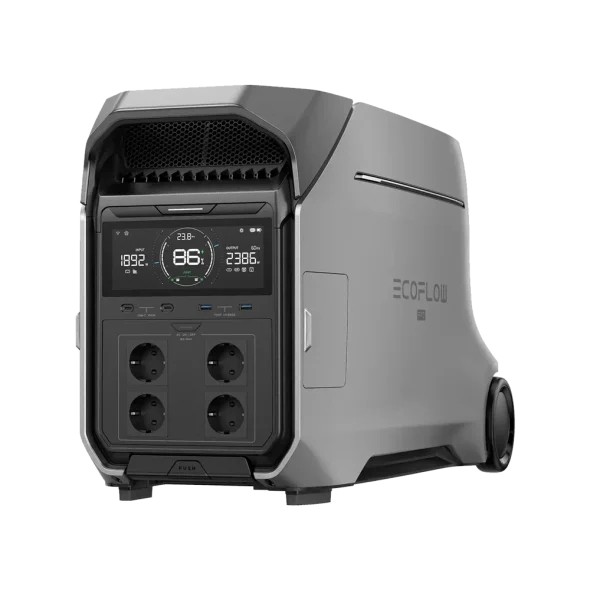
EcoFlow DELTA Pro 3 is able to provide autonomous power for a large number of devices. Its capacity is 4096 Wh, which gives a significant reserve of energy even for backup power at home. According to the nominal power, it produces 4000 W, and thanks to the X-Boost technology, it can reach a peak of 8000 W. The device has 7 230 V sockets, which gives flexibility in connecting several devices at the same time. In addition, there are two USB-C and two USB-A ports for charging gadgets. The station has an IP65 protection class, that is, it withstands the influence of dust and splashes. The security system is implemented through BMS X-Guard, which monitors many battery parameters. The weight of the device is approximately 51.5 kg. You can charge this block in a short time — from networks.
Advantages and disadvantages of EcoFlow DELTA Pro 3
+ Large capacity (4096 Wh) for long-term autonomous power supply
+ Good protection (IP65) and BMS security system
Anker Solix F3800 (A1790311)

Anker Solix F3800 is a portable charging station with a capacity of 3840Wh. Withstands more than 3000 cycles of charging and discharging. The initial nominal power is 6000W, and the peak power with the use of X-Boost is up to 9000W. The device has six 230 V AC outlets, as well as three USB-C ports, two USB-A ports, and a 12 V car outlet. For charging, you can use the network (up to 2990 W), solar panels (up to 2400 W), or auto charging (up to 120 W). The station supports expansion – you can connect additional batteries to increase the total supply. There is a display on the case, as well as the possibility of control via Bluetooth or Wi-Fi. Physically, this is a very heavy block – it weighs 60 kg, and the dimensions are large (approximately 702×388×395 mm).
Advantages and disadvantages
+ High power and peak output (up to 9000W) — suitable for energy-intensive devices.
+ Significant capacity 3840Wh + support for additional batteries — a large reserve of energy.
- Weight — 60 kg makes the station small and heavy for transportation.
Comparative table of charging stations for 3000-5000 Wh
| Characteristics | EcoFlow DELTA Pro 3 | Anker Solix F3800 |
|---|---|---|
| Capacity (Wh) | 4096 | 3840 |
| Rated power (W) | 4000 | 6000 |
| Peak power (W) | 8000 (X-Boost) | 9000 (X-Boost) |
| Battery type | Li-ion / LiFePO₄ | Li-ion / LiFePO₄ |
| Resource cycles | not specified | 3000+ |
| Source ports | 7×AC 230V, 2×USB-C, 2×USB-A | 6×AC 230V, 3×USB-C, 2×USB-A, 12V |
| UPS | not specified | no specified |
| Temperature range | not specified | not specified |
| Protection / Security | IP65, BMS “X-Guard” | not specified |
| Weight (kg) | 51.5 | 60 |
Charging stations for refrigerators, heating, full life
Fossibot F7200
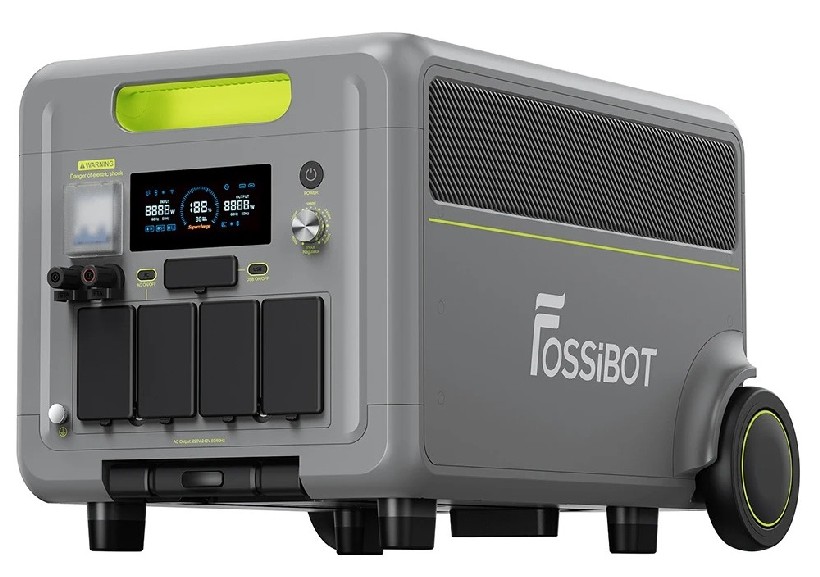
FossibotF7200 is designed for serious loads. Its battery has a capacity of approximately 5222 Wh. The battery type is LiFePO₄, and the manufacturer claims a resource of more than 6500 cycles. The nominal output power is 7200W, while the peak power can reach 9000W. Charging can be carried out via an alternating current network, and the AC charging power is up to 3000 W, which allows you to fully charge the station in a few hours. There is also an input from solar panels: high-voltage (120-450V, up to 2500W) and low-voltage (12-50V, up to 1200W), which gives flexibility in charging methods.
The device supports simultaneous reception of energy from the network and solar panels. There is a UPS function with fast switching – less than 10 ms. The station also supports the connection of additional battery modules, which allows you to expand the total capacity to 15.66 kWh. There is a display on the case, and control can be done through a mobile application (Bluetooth and Wi-Fi). Output ports include several 230 V sockets, USB-C (up to 100 W), USB-A, as well as 12-volt outputs. The current in the off state is very low – less than 200 μA. The working temperature range is declared from -10°C to +40°C, which limits the use in severe frost outside.
Advantages and disadvantages of FossibotF7200
+ Very high output power — suitable for loading large household appliances or tools.
+ Large capacity (5222Wh) plus the possibility of expansion
- The limited temperature range may be unsuitable for severe frosts
Oukitel P5000 PRO

OukitelP5000PRO portable charging station with a capacity of 5120Wh, built on a safe cast-iron-phosphate (LiFePO₄) battery. In nominal mode, it produces 4000W, and the peak power can reach 8000W. It includes five AC outlets (230V), two USB-C ports, four USB-A ports, as well as DC and cigarette lighter outputs. It supports the UPS function and switches to battery power in less than 10 ms when the network is disconnected.
Charging can be done through the network (up to 3200W), through solar panels (up to 1000W). At the same time, the combined charging of the network and the sun allows you to accelerate the replenishment of energy. Charging up to 80% through an outlet takes about 90 minutes, and with a combination network + solar panel – about 70 minutes. It is possible to control the operation of the station through a mobile application with Bluetooth and Wi-Fi. The case is equipped with wheels and telescopic handles. The dimensions are about 550×299×487 mm, so you need a spacious place for placement. The working temperature range is also from -10°C to +40°C. In particular, this model can also be bought at Rosetka.
Advantages and disadvantages of OukitelP5000PRO
+ High output power (up to 8000W peak) can run powerful devices.
+ Wide range of ports (AC, USB-C, USB-A, DC, cigarette lighter) and UPS function with quick switching.
- Temperature restrictions (-10°C to +40°C)
EcoFlow DELTA Pro Ultra
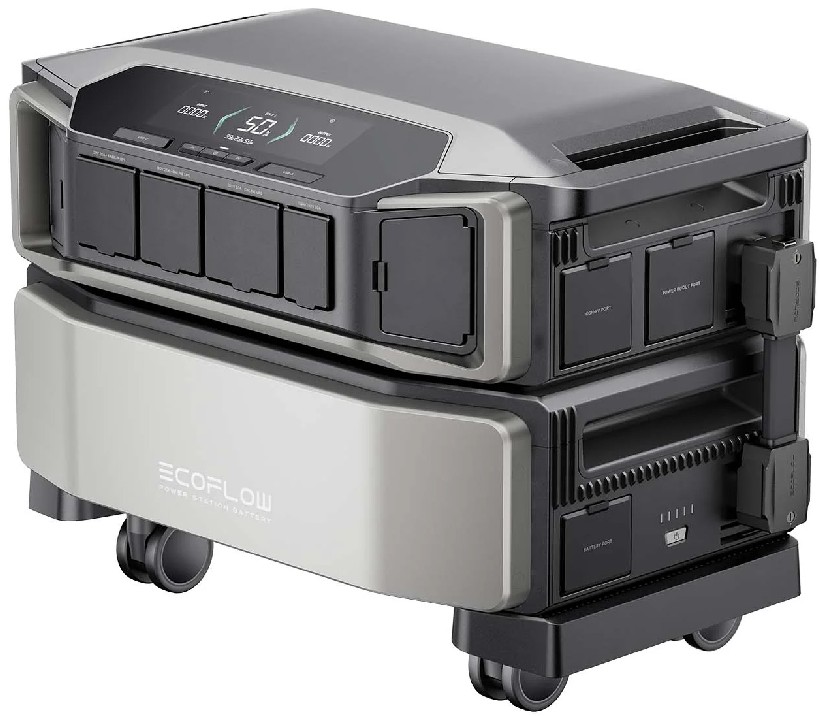
EcoFlow DELTA Pro Ultra is not just a station, but a modular battery designed to expand the existing power system. Its capacity is 6144 Wh. The battery type is LiFePO₄, providing a long service life. The resource of charging cycles is about 3500. The nominal power of the station is 6200W, and the peak power is up to 7200W. The form of the output signal is a pure sinusoid, that is, suitable even for sensitive equipment. Charging is possible in several ways: from the network, solar panels, etc. — according to the manufacturer, through a standard 3000W outlet, the battery is charged in approximately 3 hours. Multicharge technology allows you to connect several sources at the same time.
The station supports scaling — you can connect up to 15 modules, increasing the total supply to dozens of kilowatt-hours. The weight of the battery is about 50.7 kg according to official data, and the inverter weighs about 32 kg. Dimensions – 660×455×204 mm for the battery part. The degree of protection is IP54, that is, protection against dust and splashes. For remote monitoring, control via Wi-Fi and Bluetooth is provided, which allows you to monitor the state of charge and load.
Advantages and disadvantages of EcoFlow DELTA Pro Ultra
+ High capacity (6144Wh)
+ Large peak power (up to 7200W)
+ Modularity — the ability to scale the system up to dozens of kilowatt-hours.
- Limited temperature range (-15°C) may affect use in very cold climates.
Comparative table of charging stations for 5000 Wh and more
| Characteristics | Fossibot F7200 | Oukitel P5000 PRO | EcoFlow DELTA Pro Ultra |
|---|---|---|---|
| Capacity (Wh) | 5222 | 5120 | 6144 |
| Rated power (W) | 7200 | 4000 | 6200 |
| Peak power (W) | 9000 | 8000 | 7200 |
| Battery type | LiFePO₄ | LiFePO₄ | LiFePO₄ |
| Resource cycles | 6500+ | not specified | 3500 |
| Source ports | AC, USB-C, USB-A, DC, 12V | AC, USB-C, USB-A, DC, cigarette lighter | AC, USB, DC |
| UPS | yes, <10ms | yes, <10ms | yes |
| Temperature range | –10°C to +40°C | –10°C to +40°C | -15°C to +45°C |


Don't miss interesting news
Subscribe to our channels and read announcements of high-tech news, tes





Oppo A6 Pro smartphone review: ambitious

 0
0 
Creating new mid-range smartphones is no easy task. Manufacturers have to balance performance, camera capabilities, displays, and the overall cost impact of each component. How the new Oppo A6 Pro balances these factors is discussed in our review.
Logitech G G325 headphones review: reliable and long-lasting
0 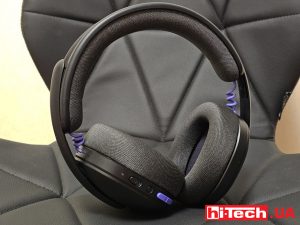
Logitech G has released a new gaming headset that offers good ergonomics, stable connectivity, and high battery life at a very affordable price. Let’s talk about the Logitech G G325 in more detail
In Kyivstar’s network, 40% of voice traffic comes from VoLTE and VoWiFi Kyivstar

High usage rates on Kyivstar’s network were recorded in Lviv and Kyiv. In Lviv, the share of voice traffic via VoLTE and VoWiFi reached 61%, while in the capital it was about 57%.
Google Docs can now read documents thanks to Gemini AI artificial intelligence Google

The web version of Google Docs has a new audio summary feature that allows you to listen to the content of documents instead of reading the text