

Best gaming laptops with NVIDIA GeForce RTX 50
05.11.25
This year, NVIDIA introduced the Blackwell architecture, which became the basis for the GeForce RTX 50-series graphics cards. It made it possible to make a number of algorithms and technologies even more efficient. DLSS and Frame Generation have reached a new level, generating frames even better. This is ensured not only by computing power, but also by optimization for updated software algorithms and artificial intelligence elements.
About the NVIDIA Blackwell architecture
The NVIDIA Blackwell graphics architecture is built on a modular principle. It includes two computing chiplets with a total of 104 billion transistors. It also includes eight HBM3E memory chiplets. The components are connected using TSMC’s CoWoS-L packaging technology. The connection uses the new proprietary NV-HBI (NVIDIA High Bandwidth Interface) interface, which provides a bandwidth of up to 10 TB/s. This allows data to be transferred between computing chiplets, minimizing delays when working with large data sets.
GeForce RTX 50 laptops
What you need to understand about the mobile version of NVIDIA RTX 50 graphics:
- Power dependence on energy consumption: Mobile video cards, unlike their desktop counterparts, can operate with a different range of power consumption (GPU Subsystem Power). That is, laptop manufacturers can adjust this indicator themselves, which affects the final performance. For example, the RTX 5080 can operate at both 80 W and 150 W, with the latter option being much more productive, but also more energy-consuming. This has an impact on the test results – some laptops with RTX 5090 may not show much better results compared to devices with RTX 5080, but they will have significantly better other characteristics, such as autonomy and weight.
- Architecture and cores: The mobile RTX 50×90 and RTX 50×80 are based on the same GB203 chip, but with a different number of active cores. But the desktop versions use different GB202 and GB203 chips, respectively. The younger models of the mobile line (5070, 5060, 5050) use the more compact GB205, GB206 and GB207 chips, just like the desktop versions.
- RTX 5070 Ti Laptop GPU and RTX 5070 Laptop GPU: They differ in the number of CUDA cores and memory. Both are based on the GB205 chip. The RTX 5070 Ti has more cores and memory, which gives it a performance advantage.
Comparative table of NVIDIA GeForce RTX 50 graphics cards for laptops
| Model | CUDA cores | Video memory | Tire / BW | Boost (MHz) | Typical Mobile TGP |
|---|---|---|---|---|---|
| GeForce RTX 5090 (Laptop) | 10 496 | 24 GB GDDR7 | — / 896 GB/s | ~1597–2160 | ~95-150 W (+25 W Dyn. Boost) (varies by laptop) |
| GeForce RTX 5080 (Laptop) | 7,680 (mobile SKU reported) | 16 GB GDDR7 | 256-bit / 896 GB/s | ~1500-2287 (variations by model) | ~80-150 W (+25 W Dyn. Boost) (varies) |
| GeForce RTX 5070 Ti (Laptop) | 5,888 | 12 GB GDDR7 | 192-256 bit / ~672 GB/s | ~1447–2220 (variations) | ~60–115 W (depends on configuration) |
| GeForce RTX 5070 (Laptop) | 4,608 | 8 GB GDDR7 | 128-bit / ~512 GB/s | ~1425–2347 (variations) | ~50-100 W (variable config) |
| GeForce RTX 5060 (Laptop) | 3 328 | 8 GB GDDR7 | — / 384 GB/s | (model variations) | usually below 80-100 W (depends on the laptop) |
| GeForce RTX 5050 (Laptop) | 2 560 | 8 GB GDDR7 | — / 384 GB/s | (model variations) | typically below 80 W (variable) |
| Note: The values given are partially averaged from official specifications and reviews – specific frequencies and TGP depend on the laptop configuration and vendor solutions. | |||||
Notebook with VGA NVIDIA GeForce RTX 50 available since spring of this year. The first models with RTX 5090, 5080 and 5070 Ti accelerators were released in March, and models with RTX 5070 appeared in April 2025. Traditionally, each vendor has several series of gaming laptops of different classes and various combinations of central processors and video card models.
We were curious to see what modules are offered in three segments – the highest with the flagship RTX 5090, the powerful RTX 5080 and the slightly more affordable RTX 5070. Each manufacturer has a dozen variations of hardware with different settings, so choosing a gaming laptop on Rozetka will be most convenient, since there are filter presets for gaming models.
Ultimate with RTX 5090 in MSI Titan 18 HX AI A2XW

The MSI Titan 18 HX AI A2XW is part of the flagship Titan series and is aimed at users who need maximum performance in a laptop format. The device is equipped with an Intel Core Ultra 9 285HX processor and NVIDIA GeForce RTX 5090 Laptop GPU.
Inside, there is up to 96 GB of DDR5 RAM and up to four NVMe SSDs, accessible via internal slots. The battery has a capacity of 99.99 Wh, the cooling system is an evaporation chamber, copper tubes and two fans.
The laptop has an 18-inch Mini LED screen with a resolution of 3840×2400 pixels and a frequency of 120 Hz, supports the DisplayHDR 1000 standard. The case is made of aluminum alloy, dimensions – 404 × 307.5 × 24-32 mm, weight – about 3.6 kg. The keyboard is mechanical Cherry MX Ultra Low Profile, with RGB backlighting of each key.
The Titan 18 HX AI supports OverBoost Ultra technology, which allows the system to consume up to 270 W in total between the CPU and GPU during load. For connectivity, there are two Thunderbolt 5 ports, three USB-A, HDMI 2.1, an SD Express card reader, 2.5 Gbps Ethernet, Wi-Fi 7 and Bluetooth 5.4 wireless modules.
Maximum power with RTX 5080 in ASUS ROG Strix G16 G615LW
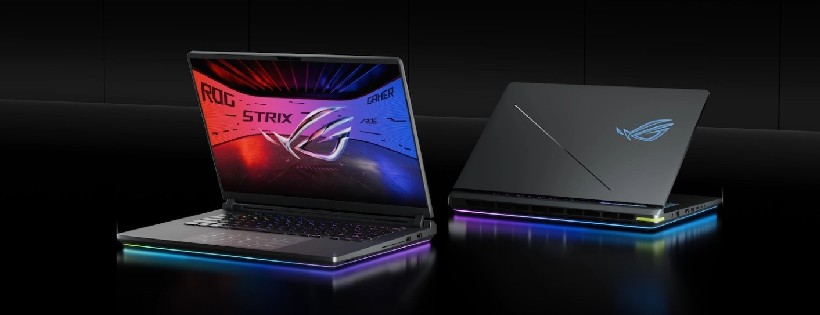
The ASUS ROG Strix G16 G615LW laptop is equipped with an Intel Core Ultra 9 275HX processor with 24 cores (8 productive and 16 energy-efficient), support for the Intel AI Boost neuroprocessor and a maximum frequency of up to 5.4 GHz.
The graphics are handled by an NVIDIA GeForce RTX 5080 Laptop GPU with 16 GB of GDDR7 memory and a maximum TGP power of 175 W. The configuration is focused on gaming projects with ray tracing, working with high-resolution video and 3D rendering.
The display has a diagonal of 16 inches, a resolution of 2560×1600 pixels and a frequency of 240 Hz (in basic configurations – 165 Hz). The panel supports the 100% DCI-P3 standard and Adaptive Sync technology.
RAM – DDR5-5600 MHz, in the standard version 32 GB with the ability to expand to 64 GB. For data storage, a PCIe 4.0 NVMe SSD with a capacity of up to 2 TB is used. The cooling system is implemented based on ROG Intelligent Cooling solutions, with three fans and heat pipes covering the CPU and GPU.
Interfaces include Thunderbolt 4, HDMI 2.1, several USB-A, RJ-45, a combo audio jack, a card reader, and support for Wi-Fi 7 and Bluetooth 5.4. The device weighs about 2.7 kg, and its thickness is up to 30 mm. By the way, this and the next model are available in this configuration on Rosetka.
Available innovations of the RTX 5070 in the Acer Nitro V 17 ANV17-41

Acer Nitro V 17 ANV17-41 is a laptop with a large 17.3-inch diagonal, equipped with an AMD Ryzen 7 260 processor, which has 8 cores and 16 threads, with a dynamic frequency of up to 5.1 GHz. The graphics subsystem is based on the NVIDIA GeForce RTX 5070 with 8 GB of GDDR7 video memory and support for ray tracing technologies.
DDR5-5600 RAM is available in a volume of 16 GB, with the ability to expand up to 64 GB thanks to two SO-DIMM slots. For data storage, an NVMe PCIe 4.0 SSD is used, the laptop has two connectors for storage devices. The audio system includes two stereo speakers with DTS:X Ultra support, noise-canceling microphones and a 1080p webcam.
The display has a diagonal of 17.3 inches, Full HD resolution (1920×1080 pixels) and a refresh rate of 144 Hz. Some configurations provide a version with a resolution of 2560×1440 pixels and a frequency of 165 Hz. The panel uses IPS technology, has a matte ComfyView coating and a brightness level of about 300 nits.
The set of ports includes HDMI 2.1, several USB-A (Gen 1 and Gen 2), modern USB-C / USB4 with video transfer support, an RJ-45 network port and a microSD card reader. Wi-Fi 6E and Bluetooth 5.3 are provided for wireless communication. Power is provided by a 76 Wh battery, the adapter has a power of 180 W. At the same time, autonomy remains typical for the class – about 5-6 hours in mixed mode. Dimensions are about 400 × 275 × 24 mm, weight – about 2.7 kg.
Comparison of RTX gaming laptops
Now let’s compare these three models. GeForce RTX 5000-series video cards not only provide an increase in frames per second, but also open up access to proprietary image processing technologies. Updated algorithms work more efficiently and give a more interesting result.
Of course, performance will naturally be higher in more powerful solutions, with some exceptions. However, it is also worth noting that the price will also increase disproportionately. MSI with RTX 5090 will not be 4-5% more expensive than ASUS with RTX 5080. The increase in price will be 15% or more. This is the price for acquiring the literally ultimate device.
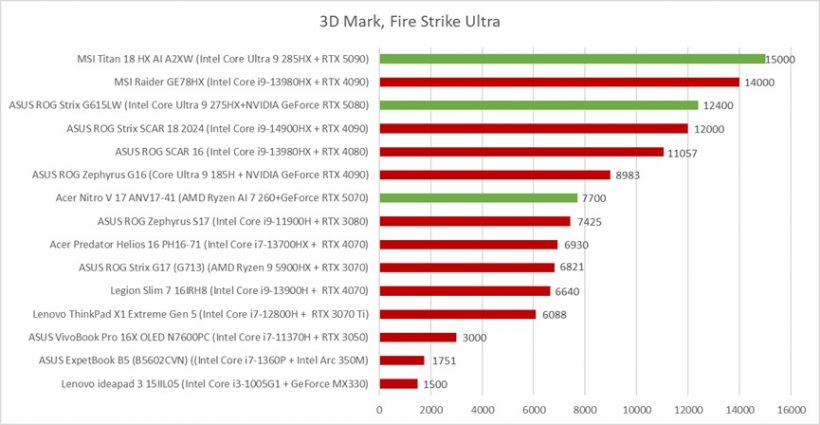
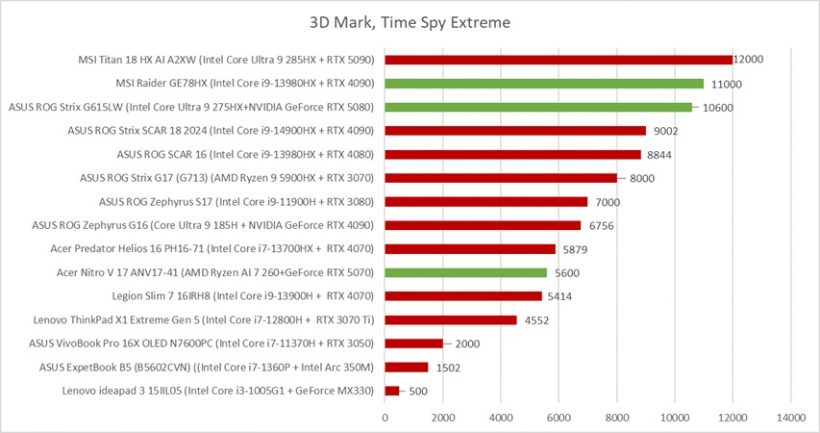
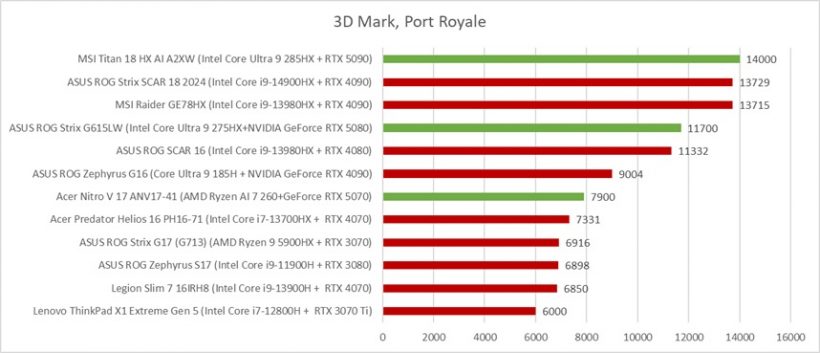
When the performance is at the level of desktop solutions, and you can always take a gaming monster with you. For clarity, here are a number of histograms with approximate results in various synthetic tests compared to a wide variety of layouts of previous generations of hardware


Don't miss interesting news
Subscribe to our channels and read announcements of high-tech news, tes






Oppo A6 Pro smartphone review: ambitious

 0
0 
Creating new mid-range smartphones is no easy task. Manufacturers have to balance performance, camera capabilities, displays, and the overall cost impact of each component. How the new Oppo A6 Pro balances these factors is discussed in our review.
In-Ear headphones Active Noise Cancellation: how Oppo eliminate noise
0 
In-ear headphones remain one of the most popular form factors due to their lightweight design. However, this design is considered one of the most challenging to implement active noise cancellation (ANC). We’ll explain how Oppo solved this problem.
Official: Modular Fairphone 6+ Debuts with Snapdragon 7s Gen 4 and U.S. Availability

Fairphone has introduced the updated 6+ model. The new version features increased RAM, a new processor, and marks the brand’s official entry into the U.S. market.
Ukrainian Studio Launches Realistic Air Defense VR Simulator

Air Defence Simulator VR from Ukrainian developer LemmoLab challenges players to master the role of an air defense operator.