

Apple M5 Pro and Apple M5 Max processors introduced – up to 30% performance boost
04.03.26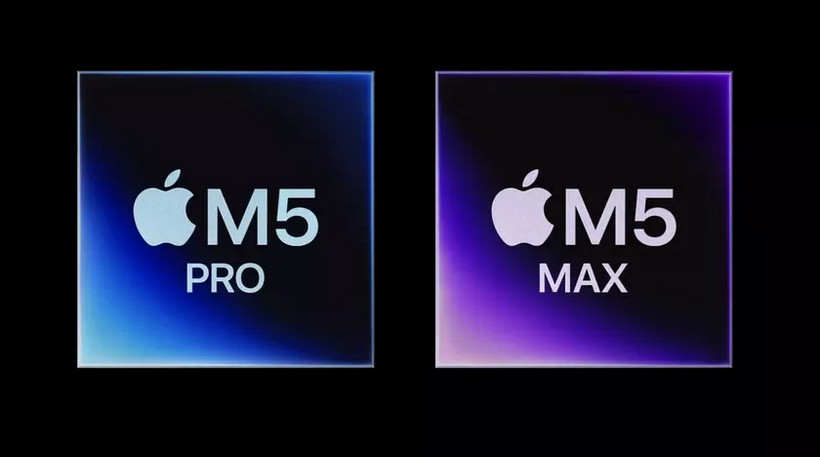
Apple introduced new processors – Apple M5 Pro and Apple M5 Max. The company showed the main update of its professional line. This is not about the planned increase in frequencies, but about the revision of the Apple Silicon architecture itself.
Switching to Fusion Architecture and abandoning “small” cores
The key change is the new Fusion Architecture. In fact, Apple has switched to a chiplet layout. Instead of one monolithic crystal, two separate ones are now used, combined into a single system-on-chip. This approach simplifies production and increases the yield of usable chips while maintaining a high density of component placement.
The SoC includes a central and graphics processor, a Thunderbolt 5 controller, and unified memory. Production, as before, is carried out using a 3-nm process technology, which the company continues to optimize.
The changes also affected the CPU structure. Apple abandoned the division into productive and energy-efficient cores in the usual form. Now “super cores” and “high-performance” cores are used. In the maximum configuration – 18 cores: six super cores and 12 high-performance. The declared increase in CPU performance reaches 30% compared to the previous generation.
Interestingly, now the M5 Pro and M5 Max are equal in the number of CPU cores – in both cases there are 18. The differences between the models are concentrated in graphics and memory bandwidth. Thus, Apple has clearly divided professional scenarios: calculations – at the same level, graphics and data work – depending on the chip version.
Graphics, memory and computing for AI tasks
The graphics subsystem remains the main difference between the models. The M5 Pro is equipped with a GPU with up to 20 cores, the M5 Max with up to 40 cores.
The main emphasis is on accelerating calculations related to artificial intelligence. According to the company, the peak GPU performance in AI tasks has increased fourfold compared to the previous generation of Pro and sixfold compared to early Pro chips.
Memory options are as follows:
- M5 Pro — up to 64 GB of unified memory with a bandwidth of 307 GB/s.
- M5 Max — up to 128 GB with a bandwidth of 614 GB/s.
The media block has also been updated. The Apple Media Engine hardware accelerates H.264, HEVC, AV1 encoding and decoding, as well as working with ProRes. Thunderbolt 5 support provides faster connection speeds to external storage and displays.
As a result, the M5 Pro and M5 Max demonstrate not a point update, but a change in the approach to chip design. Apple is betting on a scalable architecture, increasing computing power and strengthening its position in the professional segment.
Don't miss interesting news
Subscribe to our channels and read announcements of high-tech news, tes

Oppo A6 Pro smartphone review: ambitious

 0
0 
Creating new mid-range smartphones is no easy task. Manufacturers have to balance performance, camera capabilities, displays, and the overall cost impact of each component. How the new Oppo A6 Pro balances these factors is discussed in our review.
Acer Nitro Lite 16 (NL16-71G) laptop review: versatile and attractive
0 
The 2025 Acer Nitro Lite 16 features an interesting case design, gaming accents, and proven components. Let’s take a closer look at its features.
XGIMI Z6X – projector for watching movies on the ceiling projector

Main update of the Xgimi Z6X is the built-in swivel stand. The body can be tilted up to 150 degrees, which makes it easier to project onto the ceiling.
MWC 2026: Honor Robot Phone – smartphone with movable external camera Honor MWC smartphone

Honor reveals new details about the Robot Phone smartphone. The main feature of the device is a movable camera