

Starlink Mobile 5G will provide connection speeds of 150 Mbps even in the Arctic
01.03.26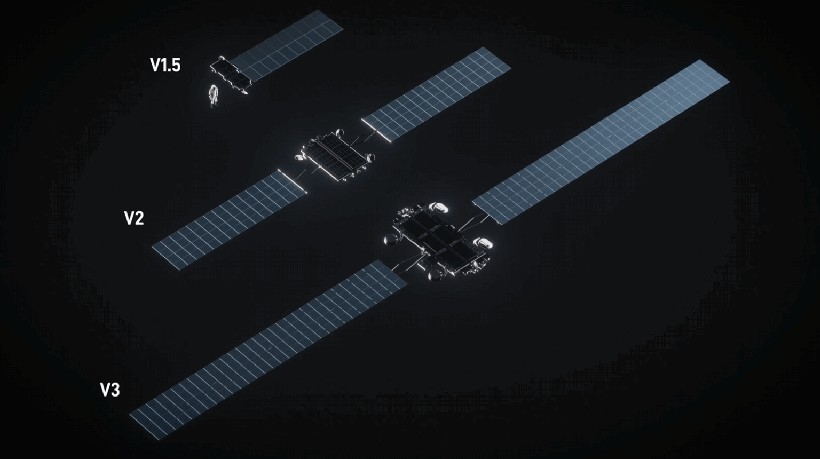
SpaceX is preparing to launch a global mobile service. The US Federal Communications Commission (FCC) has approved the launch of up to 15,000 direct-to-cell (D2C) or direct-to-device (D2D) satellites. There are currently about 650 of these devices in orbit.
After purchasing the frequency spectrum from EchoStar (formerly DISH), the company announced its intention to deploy an autonomous Starlink Mobile network that will be able to compete with terrestrial operators such as T-Mobile and Verizon. This is not just a backup satellite connection, but also a full-fledged operator service.
Betting on V3 satellites and the Starship rocket
The key element of the project will be the V3 generation satellites, which are planned to be launched using the Starship rocket. The V3 direct-to-cell satellites are comparable in size to a Boeing 737 with the solar panels deployed and, according to the company, have a throughput 20 times higher than the current V2 D2C.
The declared characteristics are up to 1 Tbit/s for download and 160 Gbit/s for data transfer per satellite. This will provide:
- Gigabit Starlink satellite internet via the Performance antenna;
- Up to 150 Mbps download directly to 5G smartphones without an external antenna.
These figures were announced by SpaceX representatives at the profile panel of the International Telecommunication Union (ITU).
150 Mbps even in the Arctic
In the new configuration, the service should provide speeds of up to 150 Mbps per user, including northern latitudes – Arctic and subarctic regions, where there is no stable mobile infrastructure.
Previously, the company announced speeds of about 100 Mbps and positioned satellite mobile communications as a complement to terrestrial 5G networks with 4G LTE-level performance. Currently, we are talking about higher performance that should compete with traditional mobile networks.
For this, it is planned to use the Mobile Satellite Services (MSS) spectrum in the 2 GHz band, as well as additional frequencies after the completion of the EchoStar transaction, which is expected by the end of 2027. Support for the 3GPP n256 band involves collaboration with mobile chip manufacturers, including Qualcomm, MediaTek and Samsung.
Prices not yet disclosed
The price of a Starlink Mobile subscription has not been announced. For comparison, the company AST SpaceMobile, which is also developing the direct-to-device direction, announced that it is considering different pricing models.
In the event of a successful launch of the V3 satellites and the closing of the deal with EchoStar, SpaceX will be able to enter the market as a global mobile operator with its own satellite infrastructure and frequency resources. This creates the prerequisites for direct competition with traditional terrestrial communication networks.
Don't miss interesting news
Subscribe to our channels and read announcements of high-tech news, tes

Oppo A6 Pro smartphone review: ambitious

 0
0 
Creating new mid-range smartphones is no easy task. Manufacturers have to balance performance, camera capabilities, displays, and the overall cost impact of each component. How the new Oppo A6 Pro balances these factors is discussed in our review.
Oppo Reno 15 5G smartphone review: confident
0 
The Oppo Reno15 smartphone emphasizes design, a high-quality display, versatile cameras, and good battery life. Let’s take a closer look.
Starlink Mobile 5G will provide connection speeds of 150 Mbps even in the Arctic internet SpaceX

SpaceX is preparing to launch its global 5G-enabled Starlink Mobile service. The US Federal Communications Commission (FCC) has approved the launch of up to 15,000 direct-to-cell (D2C) satellites.
Study: Artificial Intelligence uses nuclear weapons in 95% of simulations artificial intelligence war

Researchers at King’s College London conducted a series of military simulations using leading artificial intelligence models. The tests used OpenAI’s GPT-5.2, Anthropic’s Claude Sonnet 4, and Google’s Gemini 3 Flash.