

Qualcomm Snapdragon Wear Elite – new chip with Wi-Fi 8 support
09.03.26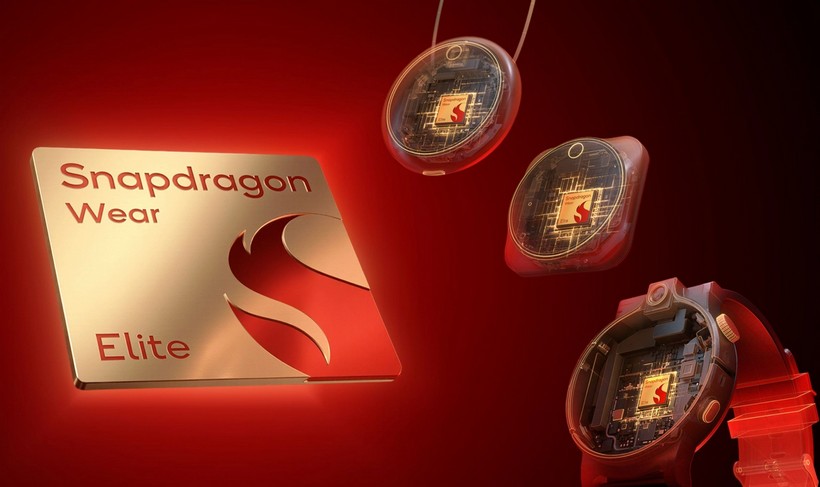
At the MWC 2026 exhibition in Barcelona, Qualcomm introduced two key solutions at once: the flagship W processor, the flagship W processor, and the FastConnect 8800 network chip with Wi-Fi 8 support. Both developments are focused on next-generation devices – from smartwatches to IoT equipment.
Qualcomm Snapdragon Wear Elite: betting on AI and autonomy
Snapdragon Wear Elite is positioned as the successor to the Snapdragon W5+ Gen 2 introduced in the past. The new chip is made using a 3-nm process technology and is built on the big.LITTLE architecture. At the same time, it does not use Oryon cores and has a more compact body.
It consists of one productive core with a frequency of 2.1 GHz and four energy-efficient cores of 1.95 GHz. According to Qualcomm, the increase in performance per core compared to the W5+ Gen 2 reaches a fivefold value. This should harm the speed of launching programs, multitasking and device boot time.
The Adreno graphics subsystem provides up to a sevenfold increase in the maximum frame rate at a resolution of 1080p and 60 FPS. The chip is designed to perform AI tasks directly on the device. The Hexagon neuroprocessor is responsible for this, capable of processing up to 2 billion parameters and up to 10 tokens per second.
Additionally, eNPU is provided – a separate energy-efficient accelerator for tasks of keyword recognition, user activity and noise reduction. Qualcomm considers it as a separate system inside the main SoC, along with sensor, audio and display modules.
Wi-Fi (802.11ax), Bluetooth 6.0, UWB, GNSS and 5G RedCap with NB-NTN are supported. The manufacturer claims to reduce the power consumption of the Wi-Fi module by up to 80% compared to previous solutions, which allows you to keep the connection constantly active. Fast charging provides up to 50% capacity in about 10 minutes. Battery life is increased by 30%.
Snapdragon Wear Elite is compatible with Android, Wear OS and Linux for lightweight systems. The chip is expected to appear in the next generations of Samsung Galaxy Watch and Google Pixel Watch, and can also be used in smart glasses and devices with cameras and AI functions. The company promises to release the first commercial devices based on it in the coming months.
FastConnect 8800: Transition to Wi-Fi 8
The second announcement is the FastConnect 8800 network chip with Wi-Fi 8 support. The solution also uses AI mechanisms to optimize the connection. According to Qualcomm, peak speeds are twice as high as those of FastConnect devices based on Wi-Fi 7.
The chip is manufactured using a 6-nm process, like its predecessor. The performance increase is provided by an updated 4×4 radio configuration, which, according to the company, increases the gigabit range by up to three times compared to previous standards.
In addition to Wi-Fi 8, support for Bluetooth 7.0 and Bluetooth HDT (High Data Throughput) has been implemented. The latter is an evolution of Bluetooth LE with an increase in the maximum data transfer rate to 7.5 Mbps.
The first products of the Dragonwing Wi-Fi 8 family for the IoT and enterprise solutions segment are expected by the end of 2026.
6G plans
Separately, Qualcomm announced the creation of a strategic coalition with partners to prepare for the global launch of 6G. According to current plans, standards and specifications should be fixed by 2028, and commercial network deployment will begin in 2029.
The company describes 6G as an AI-oriented technology with an emphasis on sensor functions and high-performance computing. Specific application scenarios remain at the level of general formulations for now, but Qualcomm expects to play a prominent role in shaping the new communication standard.
Don't miss interesting news
Subscribe to our channels and read announcements of high-tech news, tes

Oppo A6 Pro smartphone review: ambitious

 0
0 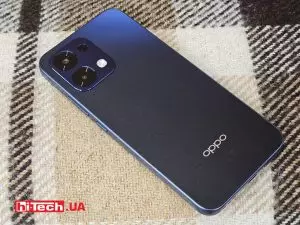
Creating new mid-range smartphones is no easy task. Manufacturers have to balance performance, camera capabilities, displays, and the overall cost impact of each component. How the new Oppo A6 Pro balances these factors is discussed in our review.
Oppo Reno16 Pro 5G smartphone review: well-heeled
0 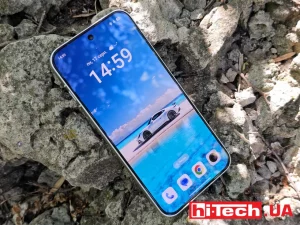
Oppo Reno16 Pro 5G looks like a balanced smartphone, in which the manufacturer tried not to make a single characteristic the defining one. It has many advantages. Let’s tell you what
Framework Laptop 13 Pro Hits 27-Hour Battery Life, Outlasting MacBook Pro 14

Framework Laptop 13 Pro sets new endurance standards for compact laptops, surpassing the results of the Apple MacBook Pro 14 (2025) in battery tests. Learn about the engineering behind its 27.5-hour runtime and whether it is worth an upgrade.
GTA 6 Dominates Netflix: Game Presentation Outperforms Top Movies

The massive 27-minute GTA 6 presentation by Rockstar Games has become the most popular content on Netflix in 87 countries.