

G.Skill’s new DDR5-6400 RAM in a 32GB kit has CL28 latencies
06.02.25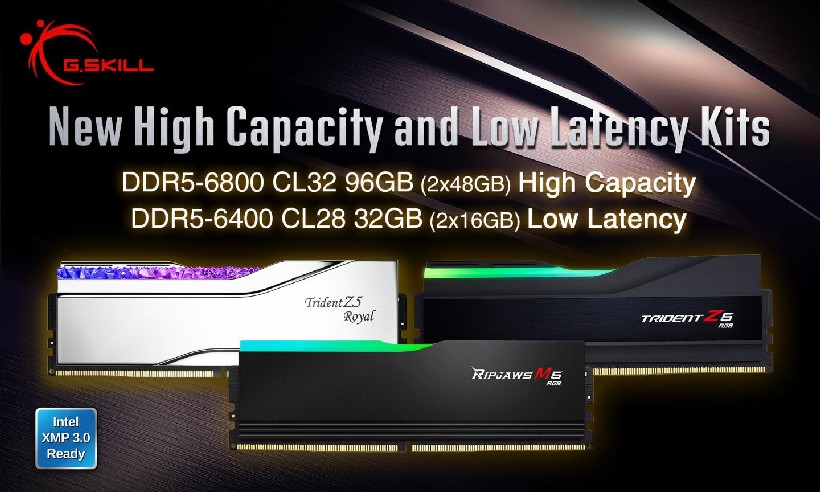
Taiwanese company G.Skill is expanding its line of low-latency DDR5 memory modules. In the near future, the manufacturer will begin shipping a new 96 GB kit (2 modules of 48 GB) with a frequency of 6800 MT/s and CL32 latencies, as well as a 32 GB kit (2 modules of 16 GB) with characteristics of 6400 MT/s and CL28. These solutions will be included in the Trident Z5 Royal, Trident Z5 RGB and Ripjaws M5 RGB series.
The manufacturer emphasizes the high stability of the new modules, citing as an example test tests on Intel platforms with LGA1700 and LGA1851 sockets. Testing was conducted using ASUS ROG Maximus Z790 Dark Hero and ROG Maximus Z890 Hero motherboards, where the memory worked in conjunction with Core Ultra 7 265K and Core i9-14900K processors.
One of the features of the updated series was the presence of Intel XMP 3.0 overclocking profiles, which gives users additional options for optimizing performance. The new kits are expected to go on sale next month. The cost of the modules will be announced closer to the start of sales.
Don't miss interesting news
Subscribe to our channels and read announcements of high-tech news, tes

Oppo A6 Pro smartphone review: ambitious

 0
0 
Creating new mid-range smartphones is no easy task. Manufacturers have to balance performance, camera capabilities, displays, and the overall cost impact of each component. How the new Oppo A6 Pro balances these factors is discussed in our review.
Poco M8 Pro smartphone review: give us more
0 
Poco M8 Pro 5G immediately catches the eye with its size and the manufacturer’s desire to offer more than you’d typically expect from a device in this price range. It’s not just another mid-range device.
Samsung Galaxy A07 5G smartphone with a 120Hz screen and 6000 mAh costs $140 Samsung smartphone

Samsung has officially announced the Galaxy A07 5G smartphone, a new model in the affordable A-series that focuses on a larger battery.
Microsoft Maia 200 – AI chip with 216 GB of HBM3e, 750 W TDP and 10 petaflops artificial intelligence Microsoft processor
Microsoft has officially announced its Azure Maia 200 server GPU accelerator, the second-generation chip in the Maia series, designed specifically for AI model inference.