

Cortical Labs’ first biological PC has human neurons and silicon chip
07.06.25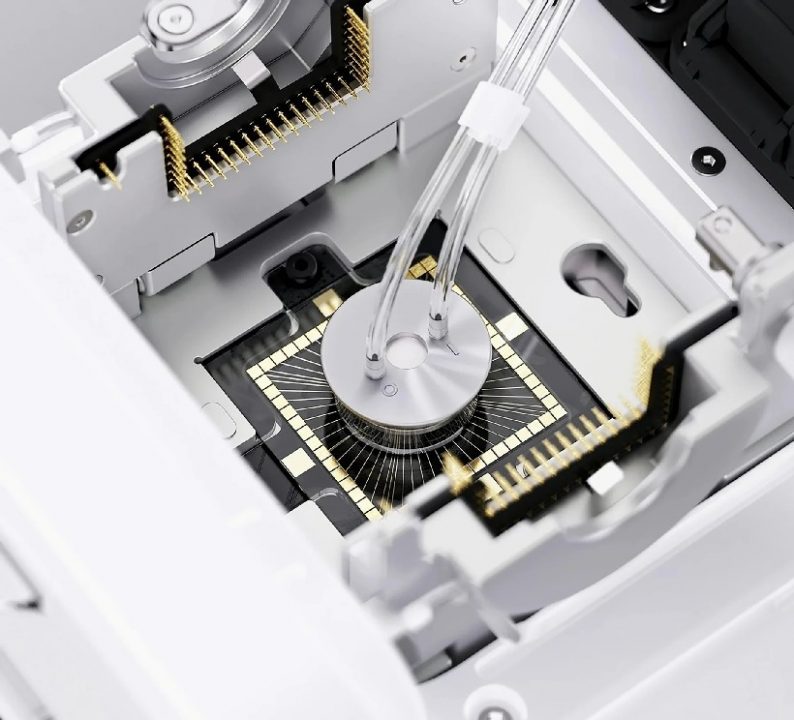
Australian biotech company Cortical Labs has begun shipping CL1, a device the company says is the world’s first commercially available biological computer. The platform combines lab-grown human neurons with a silicon chip and can process information with sub-millisecond latency.
CL1 is primarily intended for neuroscience and biotechnology research, including disease modeling and drug testing. Inside the device are 800,000 neurons reprogrammed from skin cells or blood from adult donors. They remain viable for up to six months and are supported by an onboard life support system that controls temperature, filters waste, delivers nutrients and monitors chemical balance.

Neurons respond to electrical signals in real time, adapt to them, and demonstrate elements of learning with each interaction. “We fire pulses corresponding to bits of information, record the response, and then record new data — all in sub-millisecond cycles,” explains Cortical Labs chief scientific officer Brett Kagan.
The CL1 consumes between 850 and 1,000 watts, which is significantly lower than systems running AI tasks in data centers. A single CL1 costs $35,000, but when ordering a rack of 30 units, the price drops to $20,000 each. A remote wetware-as-a-service subscription is also available, at $300 per week for access to a live culture.
Cortical Labs reports strong interest from academic institutions and biotech companies. Potential applications include testing drugs for epilepsy, Alzheimer’s, and other neurodegenerative conditions. One recent study on CL1 was able to restore learning ability in a neural culture that simulated epilepsy using antiepileptic compounds.
In addition to medical projects, the company is considering partnerships in the fields of neurocomputing, AI acceleration, and non-standard areas, such as cryptocurrency mining. According to representatives of Cortical Labs, they have been approached by representatives of the music and media industries with ideas for combining biocomputing and art. One concept involved connecting the neurons of a deceased composer to the system, but this project was not realized.
The CL1 technology grew out of the DishBrain prototype, in which neurons learned to play Pong, adapting to the game in a matter of minutes. A 2022 study published in Neuron reported that such bionetworks could demonstrate efficiency and flexibility that outperform some deep learning algorithms.
The startup emphasizes that using CL1 requires institutional ethical approval and specialized lab conditions. In the future, Cortical Labs plans to create a full-fledged “bioengineered intelligence” capable of outperforming both traditional neural networks and silicon systems.
Don't miss interesting news
Subscribe to our channels and read announcements of high-tech news, tes

Oppo A6 Pro smartphone review: ambitious

 0
0 
Creating new mid-range smartphones is no easy task. Manufacturers have to balance performance, camera capabilities, displays, and the overall cost impact of each component. How the new Oppo A6 Pro balances these factors is discussed in our review.
Acer Nitro Lite 16 (NL16-71G) laptop review: versatile and attractive
0 
The 2025 Acer Nitro Lite 16 features an interesting case design, gaming accents, and proven components. Let’s take a closer look at its features.
XGIMI Z6X – projector for watching movies on the ceiling projector

Main update of the Xgimi Z6X is the built-in swivel stand. The body can be tilted up to 150 degrees, which makes it easier to project onto the ceiling.
MWC 2026: Honor Robot Phone – smartphone with movable external camera Honor MWC smartphone

Honor reveals new details about the Robot Phone smartphone. The main feature of the device is a movable camera