

NVIDIA Blackwell – architecture with new capabilities for AI and content creation
25.07.25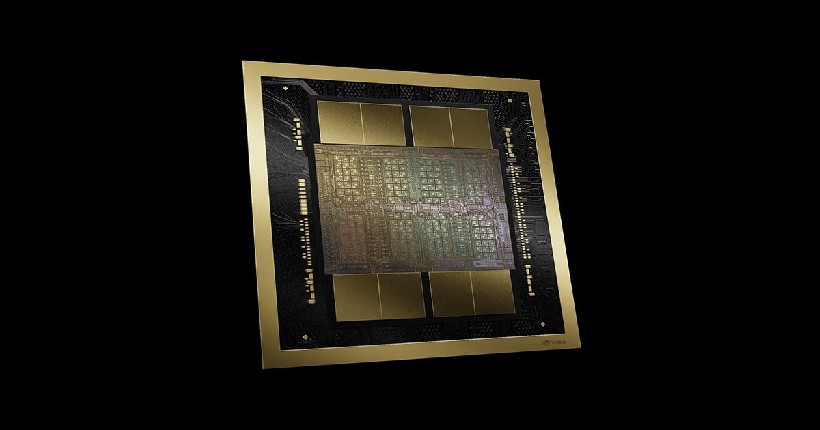
Important achievements of the video accelerator industry in recent years are not only the increase in their direct performance, but also the development of related software products and algorithms. Using the same power, they allow you to process and generate a larger amount of content in real time. We described this in detail in the article about the capabilities of the new NVIDIA Blackwell architecture in games with DLSS and Multi Frame Generation technologies.
What is included in the Blackwell architecture
The Blackwell architecture that underpins the new graphics cards is designed with the needs of artificial intelligence in mind. It includes fifth-generation tensor cores, supports new neural shaders, is equipped with GDDR7 memory, and is optimized for processing complex ray-traced render scenes and working with video.
Tensor cores are special components in RTX graphics cards designed to quickly perform calculations related to artificial intelligence, especially such as large matrix multiplication. It is on such operations that modern neural networks and the so-called artificial intelligence are based.
In the latest, fifth generation of Tensor cores (present in video cards NVIDIA GeForce RTX 50-series), these cores are even faster and have wider registers, that is, they can “process” more data simultaneously. This allows you to run complex artificial intelligence models on a regular computer. Such models include, for example, image generators or advanced chatbots. Some professional applications have also gained access to AI functions that work faster when using the GPU. This allows us to talk about wider use of such graphics solutions outside the gaming context.
Despite the fact that the introduction of AI into workflows began earlier, today we are witnessing an active expansion of generative technologies. They cover more and more areas, from creating media content to automating tasks. GeForce RTX 50 graphics cards based on the Blackwell architecture are considered the technical basis for comfortable work in the new era of AI-based tools. In this article, we will analyze the main software and algorithmic innovations of NVIDIA in the field of neural networks and artificial intelligence.
NVIDIA: Game Ready and Studio – more than drivers

For GeForce RTX users, the company offers two driver options. Game Ready is focused on gaming and provides support for new games. Studio is designed for professional use, with an emphasis on stability in creative applications, such as video editing and 3D rendering.
Despite the difference in focus, both drivers support key features. The Studio driver is updated faster in the context of professional tasks – for example, one of the latest updates added support for TensorRT and the FP8 format to work with Stable Diffusion 3.5. At the same time, the set of gaming fixes in Studio is identical to Game Ready.
Next, we will talk about specific NVIDIA software products that use artificial intelligence algorithms and new architectural features.
NVIDIA Broadcast – Streaming for Everyone
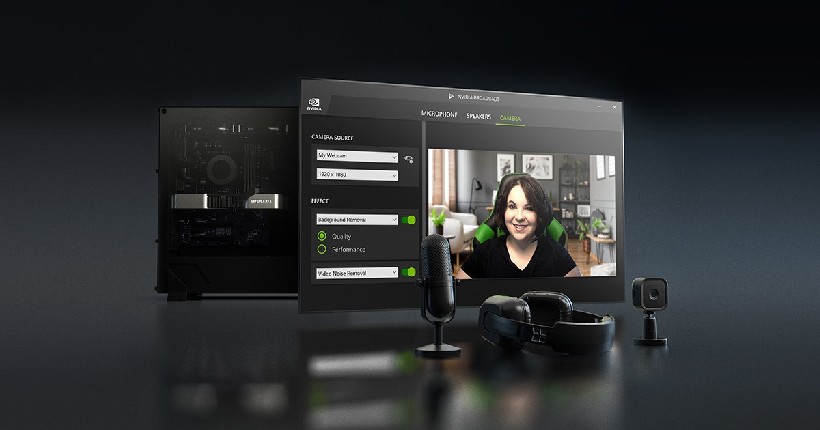
A separate niche is occupied by NVIDIA Broadcast software, which improves the quality of broadcasts. The program is available both through the NVIDIA App and separately from the website. It provides processing of microphone sound and camera images using AI algorithms.
Among the functions are noise reduction, echo cancellation, and Studio Voice to improve sound to studio level. The latter option requires significant GPU resources, so it is recommended for high-performance models.
For video, there are AI-based effects, frame auto-centering, virtual backgrounds, and gaze direction correction. Noise reduction and Virtual Key Light functions for lighting are working in beta mode.
GeForce RTX 50 graphics cards support AV1 hardware encoding with 4K@60 fps transmission, which is already being tested in Twitch Enhanced Broadcasting. In the future, this format may become a standard on streaming platforms.
And one of the biggest advantages is that NVIDIA Broadcast software is free for all GeForce RTX graphics card owners.
Video rendering using Blackwell accelerators
The Blackwell architecture includes ninth-generation NVENC/NVDEC for accelerated video encoding/decoding. Among the innovations are support for AV1 Ultra High Quality and 10-bit 4:2:2 color format, which is important for professional work.
Unlike 4:2:0, which is used by consumer devices, 4:2:2 provides more accurate color reproduction. For example, the new RTX 5090 demonstrates 11 times faster processing of 4:2:2 video compared to the Intel Core i9-14900K CPU.
In Premiere Pro, CapCut, DaVinci Resolve and Filmora, RTX 50th generation video cards also provide significant acceleration. Exporting files with the RTX 5090 is 4 times faster than on the RTX 3090. Hardware support for multi-threaded rendering allows you to process multiple videos in parallel.
Adobe software actively uses GPUs to optimize features — from Scene Edit Detection to Auto Reframe. DaVinci Resolve offers a set of AI features, including UltraNR, IntelliTrack AI, and SuperScale.
3D rendering and modeling
Generative AI is changing the approach to 3D modeling — scene preparation is simplified, and the ability to automatically generate textures and models appears.
NVIDIA GeForce RTX 5090 demonstrates noticeable acceleration in Autodesk, Blender, V-Ray, D5 Render, and more. Blackwell architecture supports ray tracing, noise reduction, and DLSS 4.
NVIDIA’s Audio2Face solution is used to synchronize facial animation with voice, which is becoming relevant for gaming and 3D projects.
Generative tools for artists
NVIDIA not only offers its own tools based on artificial intelligence, but also ensures the effective operation of tools in third-party applications. AI is intensively integrated into the work of digital artists. Photoshop, for example, has a set of Neural Filters for portrait processing, and Super Resolution allows you to enlarge images without losing quality.
The Firefly–Photoshop–After Effects program combination allows you to create images and animations, edit them in one environment. Substance 3D Collection also uses AI algorithms, including Text to Texture.
Apps like ON1 Resize AI for photo scaling are also supported. Stability AI’s new SPAR3D model, in collaboration with NVIDIA, converts 2D objects into detailed 3D models.
RTX Remix: Remastering a Classic Game
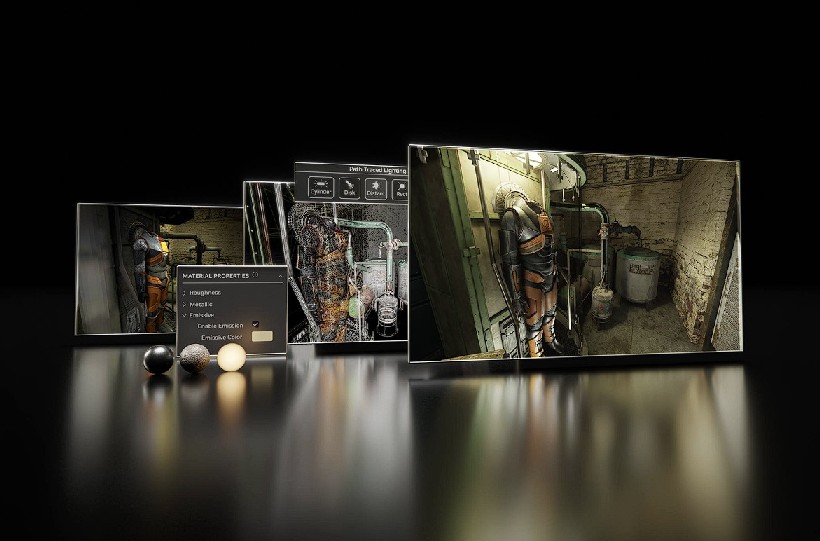
RTX Remix is a set of tools for improving the visual component of games. The platform translates the DirectX 8/9 API to Vulkan and allows you to add path tracing, DLSS 4, new textures and materials.
These capabilities were demonstrated in the Portal RTX remaster. Half-Life 2 RTX is currently in development, which will receive completely updated graphics with tracing and support for new technologies. In particular, such solutions as RTX Skin and RTX Volumetrics have been added. RTX Skin is a subsurface scattering technology for creating realistic skin for virtual characters. RTX Volumetrics, in turn, allows you to create realistic volumetric lighting taking into account particles and atmospheric effects.
AI assistants Chat RTX and Project G-Assist
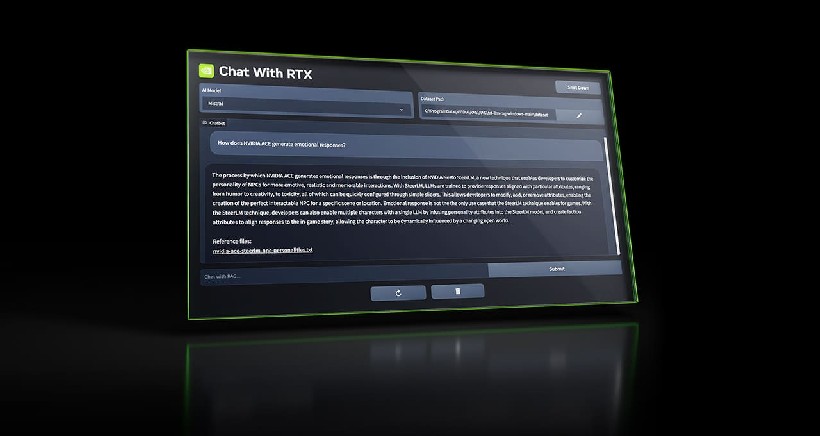
Two assistants are available to GeForce RTX users: Chat RTX and Project G-Assist. The first allows you to work with local files using a language model (for example, Llama or Mistral). The assistant processes data from documents and gives relevant answers. Voice input is supported.
Project G-Assist is focused on interaction with the PC – it helps with video card settings, launching games, recording videos and other functions. It recognizes voice commands (in English) and provides advice on optimizing settings.
NVIDIA NIM and AI Blueprints – scaling and readiness
One of the key highlights of the RTX 50 series announcement is the ability to bring generative AI workflows directly to content creators’ PCs using NIM.
NVIDIA NIM (NVIDIA Inference Microservices) is a set of pre-built, optimized inference microservices that can be run locally on accelerators.
NIM simplifies the development of AI applications using standard APIs and tools that can be run on local systems. NIM also supports custom models and offers enterprise-grade features with dedicated support.
AI Blueprints are pre-configured workflows for implementing complex AI scenarios. These solutions are built on NVIDIA NIM (NVIDIA Inference Microservices) microservices and combine multiple models and tools in the form of reference applications.
AI Blueprints are focused on the applied use of AI in business, in particular in text processing, video analysis, image generation, building virtual assistants, etc. NVIDIA positions them as ready-to-deploy solutions that can be adapted to the needs of a specific project.
Conclusions and Perspectives
Creators and content creators rarely lack inspiration. However, they may not have the time or knowledge of the tools that would allow them to realize their creative ideas faster. NVIDIA GeForce RTX 50-series graphics cards seem to satisfy this need, allowing them to perform more efficiently and conveniently. At the same time, they reduce the factors that can limit the implementation of ideas.
NVIDIA graphics adapters are actively used in professional environments for working with video, graphics and 3D modeling. Thanks to hardware acceleration of processing, they have long become an integral part of workstations focused on content production. Today, new tools based on artificial intelligence are being introduced into such applications, in particular generative models, which affect the change in approaches to working with graphic and 3D content.
The Blackwell architecture, on which the new generation of video cards is built, is designed taking into account the needs of neural computing. This allows you to significantly speed up the execution of relevant tasks in modern software complexes. Support for such capabilities is not limited to the professional NVIDIA RTX line – many tasks are effectively processed by consumer GeForce RTX 50 models.
For working with large neural networks and processing volumetric data, preference should be given to graphics processors with an expanded amount of video memory. In particular, the GeForce RTX 5090 and RTX 5080 models provide the necessary resources not only for demanding games, but also for stable work with complex AI applications and digital content creation.
The algorithms, technologies and functions we have described make the GeForce RTX 50 series video cards a qualitatively new solution in the field of content and the use of artificial intelligence. You can buy NVIDIA GeForce RTX 50 video cards at Telemart, where many models are already available.


Don't miss interesting news
Subscribe to our channels and read announcements of high-tech news, tes





Oppo A6 Pro smartphone review: ambitious

 0
0 
Creating new mid-range smartphones is no easy task. Manufacturers have to balance performance, camera capabilities, displays, and the overall cost impact of each component. How the new Oppo A6 Pro balances these factors is discussed in our review.
Poco M8 Pro smartphone review: give us more
0 
Poco M8 Pro 5G immediately catches the eye with its size and the manufacturer’s desire to offer more than you’d typically expect from a device in this price range. It’s not just another mid-range device.
Apple’s Vision Pro augmented reality headset now has a native YouTube app Apple augmented reality headsets YouTube

During the launch of Apple’s augmented reality headset in 2024, several major services refused to release native apps for the new platform.
Tecno Pova Curve 2 5G – a slim smartphone with an 8000 mAh battery and a 144 Hz AMOLED screen MediaTek smartphone Tecno

Tecno has announced the release of a budget sub-flagship smartphone, the Pova Curve 2 5G. The new product is a continuation of the Pova Curve 5G model and has received a number of updates