

SpaceX Starlink V3 satellites will provide gigabit internet, 20 times faster than V2 mini
20.10.25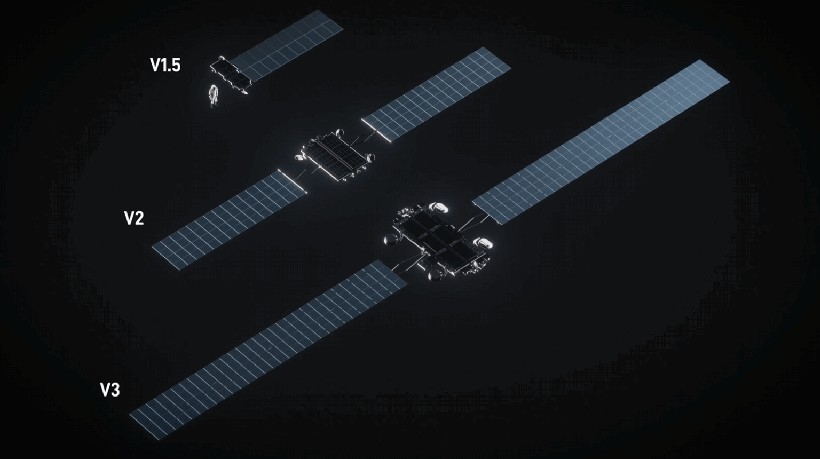
SpaceX has officially unveiled its new generation of Starlink V3 satellites, promising gigabit connectivity and record data transfer speeds of up to 60 terabits per second across the entire network.
According to the company, each Starship launch will significantly increase the system’s throughput compared to the current V2 Mini satellites operating in orbit.
The Starlink V3 presentation took place on October 13 during the 11th test flight of the Starship spacecraft, which will now act as the main carrier for launching satellites into orbit. Unlike the Falcon 9, the new system will allow delivering up to 60 devices in one launch.
The new satellites have become significantly larger and heavier – up to 2 tons each. For comparison, the V2 Mini weighs about 600 kg, and the first generation V1 – only 300 kg. Each Starlink V3 satellite will have a bandwidth of 1 Tbit/s and will be able to receive data at speeds of up to 200 Gbit/s, which is about 20 times higher than the V2 Mini.
The first launch of V3 satellites is expected in early 2026. This will be an important step towards the realization of Elon Musk’s vision of creating a global broadband Internet that will reach even the most remote corners of the planet.
The updated Starlink V3 architecture is designed to provide wider coverage, higher speeds and more stable connections, eliminating network congestion problems. At the same time, users may have to upgrade their equipment to take advantage of the full potential of the new satellites.
SpaceX currently has more than 8,500 Starlink satellites in orbit, but some of them are failing. According to astrophysicist Jonathan McDowell of the Harvard-Smithsonian Center, 1-2 vehicles disappear from orbit every day, and later this figure may increase to 5 per day.
Against this background, SpaceX is preparing to expand its activities, in particular, to enter the mobile network market under its own brand.
Interestingly, the Japanese company SoftBank successfully conducted a test of 5G communication with ordinary smartphones, using a base station on board an aircraft at an altitude of about 3 km. This could be another step in creating a global mobile network of the next generation.
Don't miss interesting news
Subscribe to our channels and read announcements of high-tech news, tes

Oppo A6 Pro smartphone review: ambitious

 0
0 
Creating new mid-range smartphones is no easy task. Manufacturers have to balance performance, camera capabilities, displays, and the overall cost impact of each component. How the new Oppo A6 Pro balances these factors is discussed in our review.
Acer Nitro Lite 16 (NL16-71G) laptop review: versatile and attractive
0 
The 2025 Acer Nitro Lite 16 features an interesting case design, gaming accents, and proven components. Let’s take a closer look at its features.
Ukrainian Company DeViro Unveils New SOKYRA Interceptor Drone DeViro interceptor drone SOKYRA

Ukrainian defense company DeViro has presented the SOKYRA interceptor drone, capable of reaching speeds of 240 km/h with an operational range of 45 km.
XGIMI Z6X – projector for watching movies on the ceiling projector

Main update of the Xgimi Z6X is the built-in swivel stand. The body can be tilted up to 150 degrees, which makes it easier to project onto the ceiling.