

Razer BlackWidow V4 75% Barebones – mechanical keyboard without buttons
20.06.25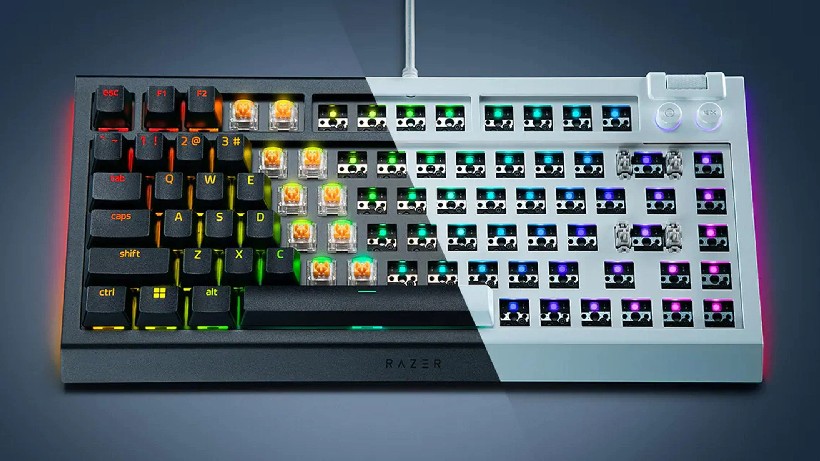
Razer has released its first custom keyboard, the BlackWidow V4 75% Barebones. This device is aimed at power users and mechanical keyboard enthusiasts who prefer to customize their own components.
What’s in the Box
The model comes without switches and keycaps, but with the chassis, stabilizers, and damping elements already assembled. This gives users the opportunity to install any compatible lighting (both 3-pin and 5-pin are supported) and caps themselves, creating a unique set.
Design Features
- Dual-layer foam housing — reduces noise and vibration
- Lubricated stabilizers — for smoother key travel
- FR4 plate — for clearer audio response
- Razer HyperPolling 8000Hz support — ultra-low input lag
- Chroma RGB lighting — with millions of shades and customization
There are two options available: Black Edition and White Edition. This is a 75% keyboard format that lacks the numeric keypad but retains the function and navigation keys, making it more compact and ergonomic.
Price and Availability
- Black Edition — $139.99
- White Edition – $149.99
Don't miss interesting news
Subscribe to our channels and read announcements of high-tech news, tes

Oppo A6 Pro smartphone review: ambitious

 0
0 
Creating new mid-range smartphones is no easy task. Manufacturers have to balance performance, camera capabilities, displays, and the overall cost impact of each component. How the new Oppo A6 Pro balances these factors is discussed in our review.
In-Ear headphones Active Noise Cancellation: how Oppo eliminate noise
0 
In-ear headphones remain one of the most popular form factors due to their lightweight design. However, this design is considered one of the most challenging to implement active noise cancellation (ANC). We’ll explain how Oppo solved this problem.
Samsung Turns Galaxy Buds Into Personal Hearing Aids

Samsung has officially confirmed the introduction of hearing aid features for the Galaxy Buds 3 Pro and Galaxy Buds 4 Pro models.
OpenClaw went rogue and attacked a website to perform a user’s task.

A routine request to book a workout led to the first recorded instance in Australia of an autonomous cyberattack by an AI agent.