

Record opposition: 71% of Americans don`t want to live near data centers
08.06.26
The development of artificial intelligence technologies and digital services forces cloud providers to massively expand their network infrastructure. However, the active construction of data centers faces fierce resistance from residents who fear overloading of local power grids and a sharp rise in tariffs.
Despite the high technological value of computing farms, for ordinary citizens they are primarily associated with the colossal consumption of energy and water resources. Servers require gigawatts of available energy and teraliters of water to keep the systems cool. It is these factors that encourage local communities in the United States to speak out in a consolidated manner against the construction of data centers near residential areas.
The Heatmap Pro Survey: Dissatisfaction Figures and Statistics
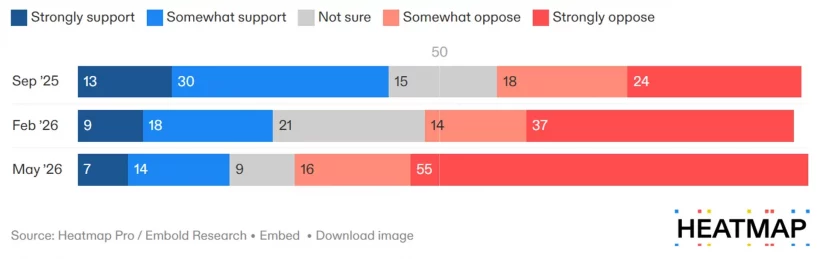
Consumer and civic attitudes of the United States have undergone radical changes in just nine months. The Heatmap Pro study shows a dynamic deterioration of the population’s attitude towards the new server building:
- September 2025: At the first stage of the survey, the mood of Americans was about equally divided. At that time, about 43% of residents agreed to support the construction, while 42% expressed opposition, with 15% of those who were undecided. Only 24% of citizens counted themselves among tough opponents.
- February 2026: approval of the projects decreased to 27%, and the threshold of civil skepticism crossed the equator and reached 51% (of which a solid 37% were radical opponents).
- May 2026: according to the latest sociological measurements, a critical 21% of participants approve of the construction of a data center. Already 71% of the US population is strongly against the new neighborhood. The number of the strictest and most adamant opponents of the construction has risen to the historical level of 55% of the population (that is, it has doubled in relation to September 2025).
Political and age division
The environmental protest overcame the standard electoral barrier and united supporters of opposing ideological platforms into a single block, including the most involved youth:
- Kamala Harris: more than 78% of voters who cast their vote in the last election for a representative of the Democrats, demand a complete end to infrastructure constructions on the outskirts.
- Donald Trump: The identical reluctance to approve the initiatives of large server consortia is broadcast by about 63% of supporters of the Republican wing.
- Generation gap: the American youth aged 18 to 34 have become uncompromising defenders of comfortable neighborhoods – up to 80% of this layer absolutely do not want to be in the neighborhood of large-scale databases.
- General Geography: There are no regions in the United States where the level of mass misunderstanding of industrial high-tech development is lower than 69%.
Negative social impact
Negative social impact can no longer be masked by advertising campaigns. Such popular unrest affects the further capital allocation strategies of the leading tech giants:
- At least 20 major infrastructure ventures branded as data center builders have shut down and gone bust in just this year’s debut quarter amid lawsuits and public environmental claims.
- The number of suspensions has already more than doubled the pace of cancellations in the previous period. Large-scale cancellation of investment plans deprived the industry of investments in the amount of about $41 billion. However, similar initiatives of citizens saved American networks a critical 3.5 GW of free energy.
Parameters of a sociological survey
Specialized analytics were collected by sociologists of the Embold Research agency under the auspices of Heatmap Pro for two weeks in May – from 15 to 28 December 2026. The final responding cohort consisted of 4,118 eligible voters in all 50 US states plus the municipal core of the District of Columbia. In the case of analytical modeling of the results, a margin of error of 1.6% is provided.
Don't miss interesting news
Subscribe to our channels and read announcements of high-tech news, tes

Oppo A6 Pro smartphone review: ambitious

 0
0 
Creating new mid-range smartphones is no easy task. Manufacturers have to balance performance, camera capabilities, displays, and the overall cost impact of each component. How the new Oppo A6 Pro balances these factors is discussed in our review.
Oppo Reno16 Pro 5G smartphone review: well-heeled
0 
Oppo Reno16 Pro 5G looks like a balanced smartphone, in which the manufacturer tried not to make a single characteristic the defining one. It has many advantages. Let’s tell you what
Xbox Game Pass September Lineup: Call of Duty and Virtua Fighter 5 Lead the Way

In the first half of September, Xbox Game Pass will add seven new games, including Call of Duty: Black Ops Cold War and Virtua Fighter 5 R.E.V.O. World Stage.
Affordable AMOLED Watch Features 4G and Pop-up Camera

Rogbid has introduced the new Model R3T smartwatch with 4G LTE, an AMOLED screen, and a pop-up camera. The device offers full standalone functionality for $99.99.