

Lenovo ThinkBook Plus G7 Auto Twist: Motorized OLED and up to 21 hours of battery life
11.08.26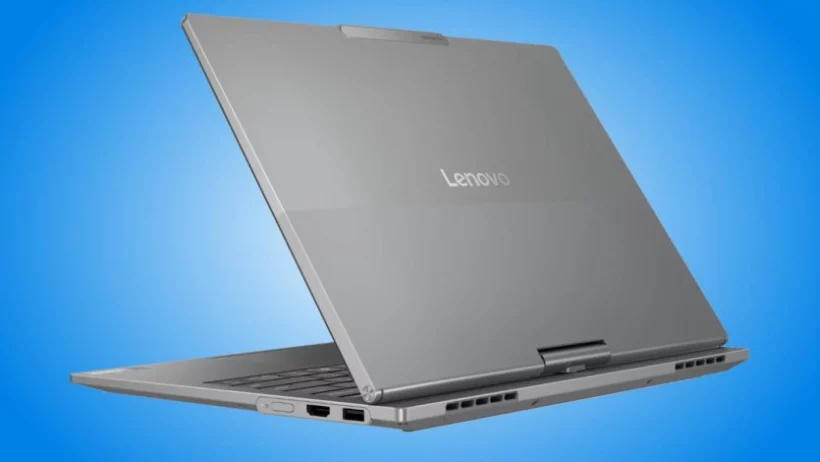
Lenovo is getting closer to launching the unusual ThinkBook Plus G7 Auto Twist, which was first unveiled back in 2024. The device’s standout feature is not its processor or memory capacity, but its motorized hinge, which allows the display to automatically adjust its position and turn toward the person sitting in front of it.
Development history
The story of the model began nearly two years ago. Lenovo first showcased a similar design at IFA 2024, where the device was presented as the ThinkBook Auto Twist and positioned as a concept product. In January 2026, the company brought a more production-ready version to CES 2026, renaming it the ThinkBook Plus G7 Auto Twist.
At the time, Lenovo expected to begin shipping the laptop in June, but the schedule was later pushed back. The company has now confirmed the laptop’s global launch, although the exact sales date remains unknown.
Motorized display
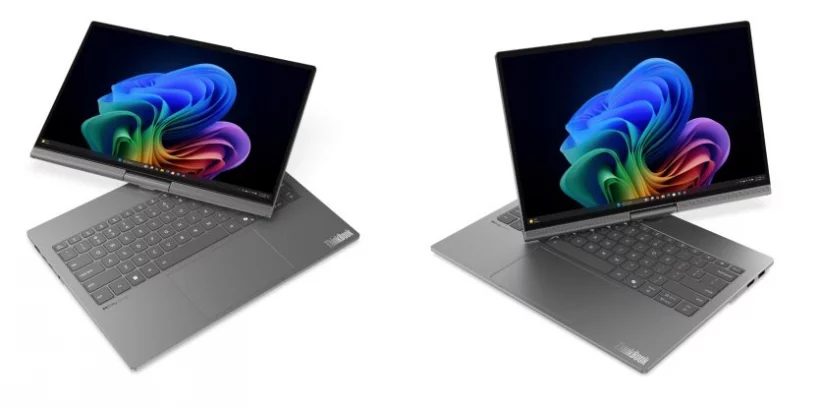
Instead of conventional mechanical hinges, the ThinkBook Plus G7 Auto Twist features a motorized mechanism that can automatically adjust the position of the screen. The system tracks the user and can rotate the display so that it remains oriented toward them.
This solution is primarily designed for scenarios where several people are sitting in front of the laptop at the same time or when the user moves around relative to the device. At the same time, the display can still be adjusted manually.
It is this motorized mechanism that sets the model apart from conventional laptops, turning what would normally be a simple hinge into a dedicated functional system.
The OLED display is designed for more than office work
Lenovo has equipped the laptop with a 14-inch OLED panel featuring a resolution of 2880 × 1800 pixels. The display supports an adaptive refresh rate ranging from 30 to 120 Hz, allowing the refresh rate to adjust depending on the usage scenario.
The panel covers the full DCI-P3 color gamut. Peak brightness reaches 500 nits in SDR mode, while HDR content can push the figure as high as 1,100 nits.
As a result, the display is suited not only to everyday productivity tasks but also to multimedia consumption, where OLED’s high contrast, wide color gamut, and increased brightness can make a noticeable difference.
Intel processors and up to 32GB of RAM
The ThinkBook Plus G7 Auto Twist will be available with two Intel processor options: the Core Ultra 5 325 and Core Ultra X7 358H. The laptop will support up to 32GB of RAM.
For storage, the device supports the M.2 2280 form factor, although Lenovo plans to ship finished configurations with more compact M.2 2242 SSDs.
Graphics are handled by the integrated Intel Arc B390 GPU. There is no discrete graphics card, so the laptop is primarily aimed at everyday tasks, content creation, and demanding applications that do not require the performance of a full-fledged gaming laptop.
More than 21 hours of battery life
The laptop comes with a 75Wh battery. According to Lenovo’s internal testing conducted under the JEITA-BAT 3.0 methodology, the device can run for more than 21 hours on a single charge.
Naturally, actual battery life will depend on the usage scenario, brightness settings, and workload. Still, for a laptop featuring a 14-inch OLED display and a motorized hinge mechanism, the claimed battery life is a notable feature.
Release date and price
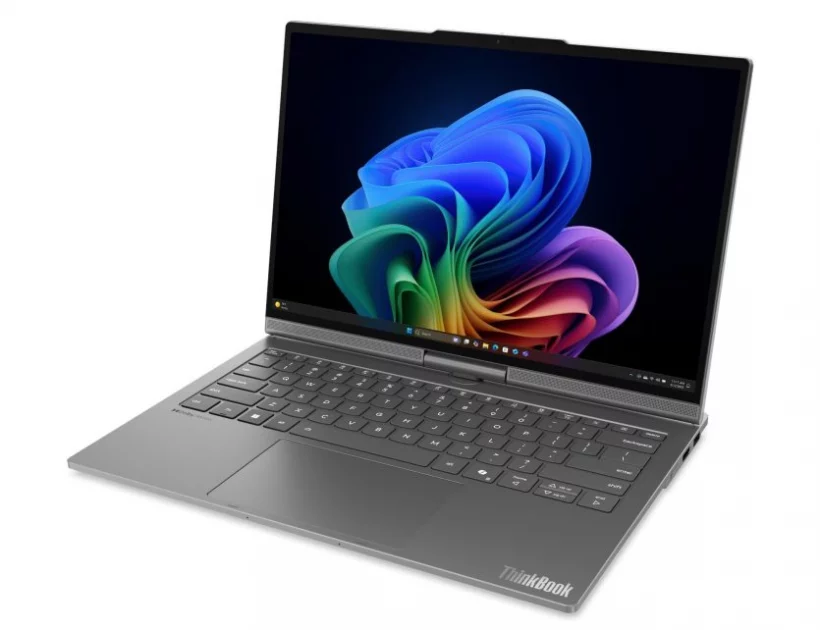
Although Lenovo has already confirmed the international launch of the ThinkBook Plus G7 Auto Twist, the company has yet to reveal either the price or the exact sales date.
Meanwhile, information about the upcoming configurations has already appeared in Lenovo’s PSREF database. It lists regional versions of the laptop for Australia, Africa, Asia, Europe, the Middle East, and North America. This suggests that Lenovo is preparing the device for a full international release rather than limited availability in select markets.
If Lenovo does begin sales in the near future, the model will become one of the company’s most unusual laptops in recent years — primarily thanks to a mechanism that turns an ordinary display into an automatically controlled part of the device.
Don't miss interesting news
Subscribe to our channels and read announcements of high-tech news, tes

Oppo A6 Pro smartphone review: ambitious

 0
0 
Creating new mid-range smartphones is no easy task. Manufacturers have to balance performance, camera capabilities, displays, and the overall cost impact of each component. How the new Oppo A6 Pro balances these factors is discussed in our review.
Oppo Reno16 Pro 5G smartphone review: well-heeled
0 
Oppo Reno16 Pro 5G looks like a balanced smartphone, in which the manufacturer tried not to make a single characteristic the defining one. It has many advantages. Let’s tell you what
CD Projekt RED Keeps Momentum: The Witcher and Cyberpunk Hit New Records

CD Projekt RED revealed its H1 2026 results, reporting on The Witcher and Cyberpunk 2077 sales and player interest in new projects.
Gemini, Keep, and Motion Assist: The New Android Drop Features

Google introduced a fresh package of Android Drop updates for smartphone users, including AI integration in search, new messaging capabilities, and health-related features.