

It’s not too late: Top charging stations for home while blackout
01.11.25
A home charging station combines a number of features that make it a convenient solution for everyday use in the absence of power. It operates almost silently, requires no fuel, and is considered safe for home use. While self-assembled units will certainly be cheaper, there are no guarantees of their functionality. Furthermore, it’s important to consider everything from the battery type to charging for recharge. Pre-made charging stations can be charged from a standard 220-volt outlet or using solar panels. Powerful models designed for home use can power most household appliances, not to mention smartphones, laptops, tablets, and LED lights. However, if necessary, a more affordable option is available, which is not suitable for portable devices.
What Kinds of Charging Stations Are There?
Today, EcoFlow and Bluetti hold significant leadership positions in the portable charging station market. At the same time, as in any technology segment, there are also more affordable models alongside these flagships, such as Allpowers, Jackery, CTECHi, and Zendure.
When choosing a charging station, it’s recommended to pay primary attention to its power rating. Based on this parameter, all such devices are typically divided into three groups: low-power (ranging from 200 to 800 W), mid-range models (up to 2 kW), and high-power stations (exceeding 5 kW). Competitive solutions in each power class are generally similar, although they may have their own unique characteristics. In particular, charging stations on Rozetka.
Bluetti AC70P 864Wh 1000W
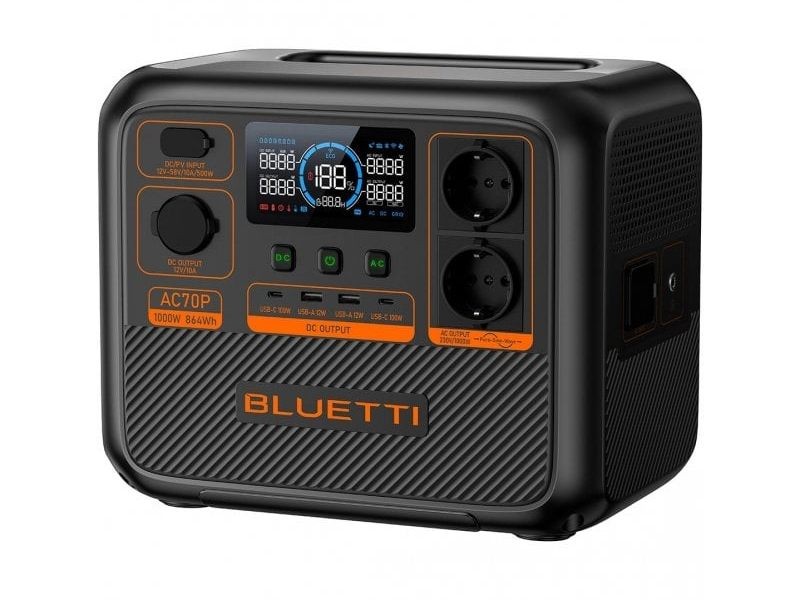
This solution is designed to power most household devices. Equipped with an 864 Wh battery, it delivers a continuous output of 1000 W, enough to power appliances such as electric grills, hair dryers, kettles, and more.
The Bluetti AC70P supports multiple charging methods—from a household AC outlet, a 12 V car charger, solar panels, or an external generator. With its 850 W fast charging mode, the station restores energy levels from zero to 80% in approximately 45 minutes. During operation, noise levels are as low as 45 decibels, and in silent charging mode, the device becomes virtually invisible.
The model’s key technical parameters include: a battery capacity of 864 Wh, four output ports, two 220 V sockets, two USB-A ports (5 V/2.4 A), and two USB-C ports (5/9/12/1). The device weighs 10.7 kg. A 500 W solar panel input (12–58 V, 10 A) allows the station to be charged from Bluetti panels or compatible alternative models with MC4 connectors. This specific station can be found in the corresponding Socket section.
+ small size and weight
+ enough for short-term blackouts
+ enough for a small apartment
+ LiFePO₄ battery durability – more than 3000 charge/discharge cycles
- not enough to connect devices with a total power of more than 4A
Anker 757 PowerHouse 1500W
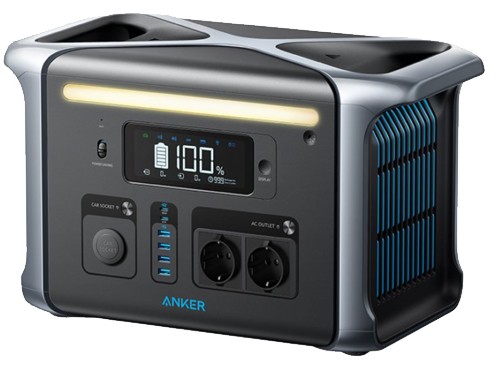
This device is an affordable solution in its class, boasting a nominal power of 1500 watts and a peak power of 3000 watts. The station can be connected to personal computers, small refrigerators, microwaves, or boilers.
The power station demonstrates good autonomy. On average, it can power a refrigerator, animal watering system, and chargers for six to eight hours. When connected to a TV or laptop, the runtime is approximately four hours.
The Anker 757 PowerHouse can function as an uninterruptible power supply, automatically switching from mains to battery power in 20 milliseconds.
The model is equipped with a variety of interfaces: two 230V AC outlets, two Type-C ports (60W and 100W), four 12W USB Type-A ports, four DC outputs, and a car outlet. The battery has a lithium iron phosphate chemistry with a capacity of 1229 Wh and is rated for approximately 3,000 charge cycles. Recharging from a power outlet takes an hour and a half, from solar panels about three and a half hours, and from a car port about 13.8 hours.
In terms of dimensions, the Anker 757 PowerHouse isn’t particularly compact: its dimensions are 46.3 x 28.8 x 23.7 cm and it weighs almost 20 kg. The design includes handles for transport, but its size makes it more suitable for semi-permanent use.
+ large set of connection options (sockets/ports)
+ LiFePO₄ battery durability – more than 3000 charge/discharge cycles
- immobility – large size and weight
EcoFlow DELTA Max 2000 560000mAh 2016Wh 2400W
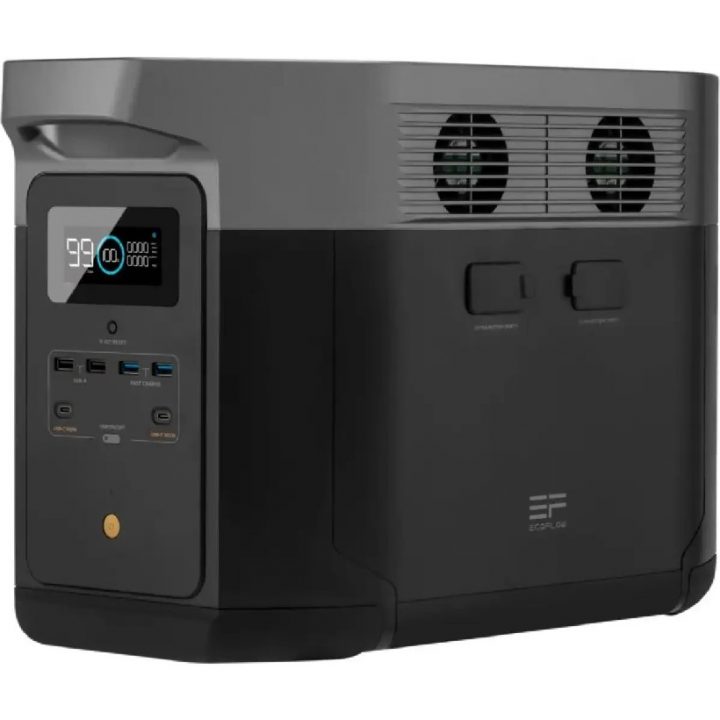
This model occupies a prominent position among portable power stations due to its combination of high output and expandable energy capacity. The device has a base capacity of 2016 Wh, which can be expanded to 6048 Wh with additional battery modules.
The model’s design is modular. All wires have a copper base and are covered with a polymer insulating layer, which increases heat resistance and safety. The housing is made of heat-resistant materials, and for easy transport, a reinforced handle and non-slip rubber base prevent accidental movement during operation.
The device delivers a rated power of 2400W and is equipped with multiple outputs—two USB Type-C ports, two USB Type-A ports, and a car cigarette lighter. The DELTA Max supports dual charging scenarios: AC power combined with a smart generator, AC power combined with solar panels, or a generator paired with a solar panel. A full charge from a standard 220V outlet takes approximately 2 hours.
The system features an intelligent battery management system (BMS), which automatically monitors voltage, current, and temperature. This ensures stable operation and prevents overheating or other technical emergencies.
The model supports Wi-Fi connectivity, allowing users to remotely monitor the station’s status and configure its operating modes. Using the EcoFlow mobile app, you can monitor energy consumption, view statistics, and adjust power settings to suit specific needs, making the management process more flexible and convenient.
+ enough to connect electrical equipment in an apartment and house
+ control the device via WiFi
- immobility – large size and weight
- small battery life, compared to those presented in the review, ~ 800 charge/discharge cycles
Comparison of main characteristics:
| Parameter | Bluetti AC70P | Anker 757 PowerHouse | EcoFlow DELTA Max 2000 |
|---|---|---|---|
| Capacity | 864 Wh | 1229 Wh | 2016 Wh |
| Power | 1000 W (peak 2000) | 1500 W | 2400 W (peak ~4600) |
| Battery type | LiFePO₄ | LiFePO₄ | Li-ion (NCM) |
| Cycles (up to 80%) | 3000+ | 3000+ | ~800 |
| Weight | 10.7 kg | 19.9 kg | ≈22 kg |
| Fast charging | up to 80% ≈1 h | up to 80% ≈1 h | up to 80% ≈1 h |
| AC sockets | 2 × 230 V | from 2 to 6 depending on the model × 230 V | 4 × 230 V |
| USB / DC ports | 2×USB-C, 2×USB-A, 12V, Qi | 2×USB-C, 4×USB-A, 12V | 2×USB-C, 4×USB-A, 12V |
Don't miss interesting news
Subscribe to our channels and read announcements of high-tech news, tes

Oppo A6 Pro smartphone review: ambitious

 0
0 
Creating new mid-range smartphones is no easy task. Manufacturers have to balance performance, camera capabilities, displays, and the overall cost impact of each component. How the new Oppo A6 Pro balances these factors is discussed in our review.
Logitech G G325 headphones review: reliable and long-lasting
0 
Logitech G has released a new gaming headset that offers good ergonomics, stable connectivity, and high battery life at a very affordable price. Let’s talk about the Logitech G G325 in more detail
LG Buds Plus xboom Buds Lite – the company’s new Bluetooth headphones Bluetooth earphones LG

LG xboom Buds Lite and xboom Buds Plus have joined the xboom Buds line and are aimed at different categories of users
In Kyivstar’s network, 40% of voice traffic comes from VoLTE and VoWiFi Kyivstar

High usage rates on Kyivstar’s network were recorded in Lviv and Kyiv. In Lviv, the share of voice traffic via VoLTE and VoWiFi reached 61%, while in the capital it was about 57%.