

Asus ROG Strix GS-BE18000 – router with AiMesh support and a channel of up to 18,000 Mbps
27.05.25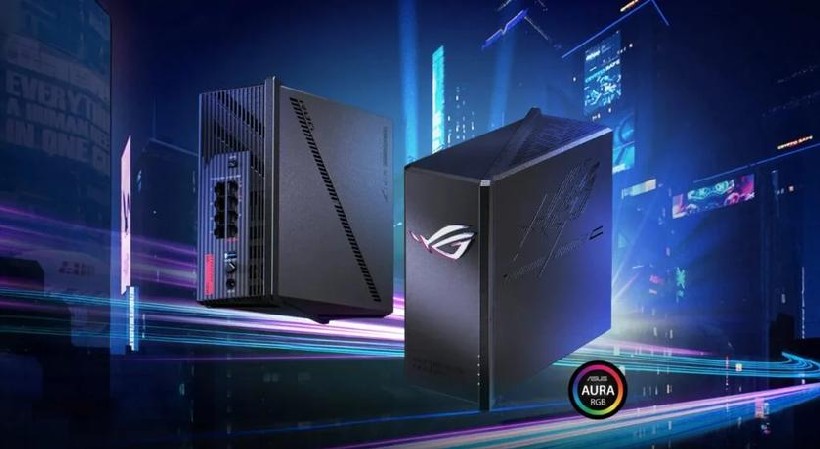
At Computex 2025, Asus introduced the flagship router ROG Strix GS-BE18000 – one of the brand’s first devices with full support for Wi-Fi 7.
Key features of the Asus ROG Strix GS-BE18000
The router provides tri-band data transfer with speeds up to 18000 Mbps:
- up to 688 Mbps on 2.4 GHz,
- up to 5765 Mbps on 5 GHz,
- up to 11529 Mbps on 6 GHz
Key Wi-Fi 7 technologies are supported: wideband 320 MHz channels, 4K-QAM modulation, Multi-Link Operation (MLO) for simultaneous connection across multiple bands, as well as automatic frequency control (AFC), which helps minimize interference and latency.
The device is equipped with eight antennas, a quad-core processor with a frequency of 2.0 GHz, 2 GB of RAM and 256 MB of built-in memory. The declared coverage is up to 300 m², which makes the GS-BE18000 suitable for large rooms and networks with many connected devices.
There are eight 2.5GbE ports on the case – one WAN and seven LAN, two of which are optimized for gaming. There is also USB 3.2 for connecting storage devices or modems.
The router supports proprietary AiMesh technology, has a built-in AiProtection Pro security system from Trend Micro, adaptive QoS, VPN and a set of features for gamers – including Game Boost and Mobile Game Mode. Externally, the model stands out with customizable RGB lighting.
Asus ROG Strix GS-BE18000 Price and Availability
The device has already appeared on the Best Buy website in the USA for $449.99.
Additionally, Asus at the exhibition showed the ROG 100W Gaming Charger Dock – a compact device that combines a charger with a power of up to 100 W and a hub for connecting peripherals.
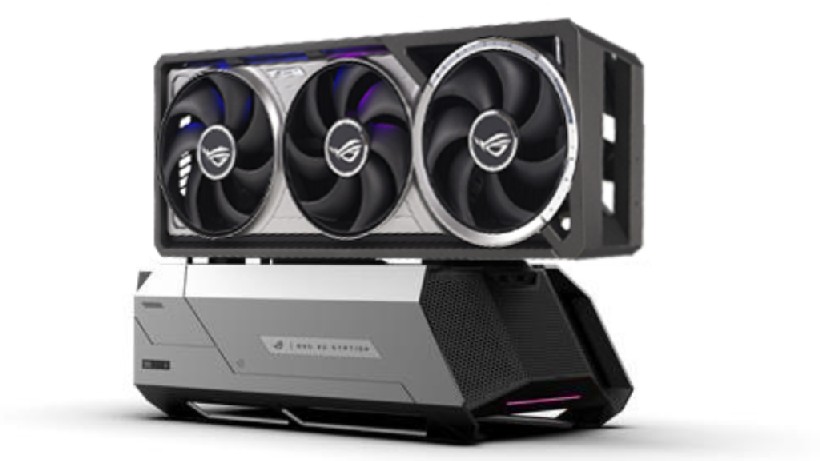
At Computex 2025, Asus announced a new version of its external docking station for graphics cards – ROG XG Station 3. The device received a modern Thunderbolt 5 interface, which allows you to connect powerful discrete graphics accelerators to laptops and compact PCs. The previous generation of this station was released back in 2016.
According to Asus, the transition to Thunderbolt 5 with a bandwidth of 80 Gbps has provided a significant increase in performance compared to solutions based on Thunderbolt 3 and 4 (40 Gbps) and even OCuLink (64 Gbps).
In the demonstration materials, the company compares the performance of the GeForce RTX 4090 installed in the Asus ROG XG Station 3 with the results of the same card in a desktop PC. The difference in speed does not exceed 20%, and in some scenarios the performance is close to full.
The station is equipped with a built-in power supply (power is not specified), ASUS Aura Sync RGB lighting and three USB 3.2 Gen2 Type-C ports. Compatibility with GeForce RTX 50 and Radeon RX 9000 series graphics cards, including BTF models with a GC-HPWR power connector, is declared.
Don't miss interesting news
Subscribe to our channels and read announcements of high-tech news, tes

Oppo A6 Pro smartphone review: ambitious

 0
0 
Creating new mid-range smartphones is no easy task. Manufacturers have to balance performance, camera capabilities, displays, and the overall cost impact of each component. How the new Oppo A6 Pro balances these factors is discussed in our review.
Oppo Reno 15 5G smartphone review: confident
0 
The Oppo Reno15 smartphone emphasizes design, a high-quality display, versatile cameras, and good battery life. Let’s take a closer look.
Asus ProArt GoPro Edition laptop for action camera fans has gone on sale in Ukraine action-camera Asus laptop
One of the key features of the Asus ProArt GoPro Edition is the proprietary StoryCube service – the first solution for Windows with support for GoPro cloud storage and 360-degree video.
Garmin has released a major update for 5 smartwatches Garmin smart watches update

Garmin has announced a major software update for several smartwatch models at once. The update has already started rolling out to the Garmin Venu X1, Garmin vívoactive 6, Garmin fēnix 8 Pro, Garmin Forerunner 570 and Garmin Forerunner 970.