

Scientists create artificial soft eye with autofocus
01.11.25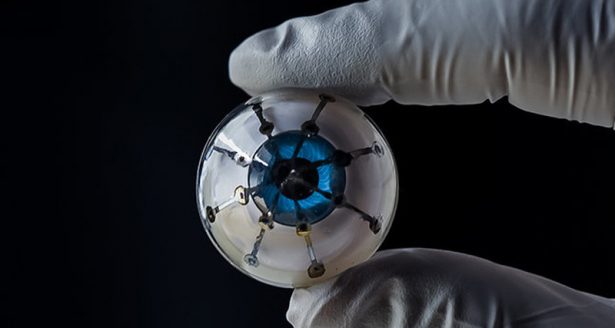
Researchers from the Georgia Institute of Technology presented the development of a soft robotic eye that can automatically focus
The created lens is highly sensitive: it can distinguish the smallest details, for example, hairs on the legs of an ant or grains of grain. The discovery brings engineers closer to creating soft robots with advanced vision that do not require separate power supply. It is assumed that such systems can be used in wearable devices and autonomous mechanisms that operate on uneven or dangerous surfaces.
According to the study’s first author, Dr. Corey Zheng of the Department of Biomedical Engineering, traditional robots that use electric actuators are equipped with rigid sensors and electronic components to perceive their environment. However, when creating more flexible and pliable robots that do not rely on electricity, the task of implementing sensory processing and controlling their perception in other ways arises.
Special artificial lens
The lens that the scientists developed is made of a hydrogel with a polymer framework that can retain and release water. Thanks to this, the material is able to quickly change its state – from soft to harder. The hydrogel responds to temperature: when heated, it releases water and shrinks, and when cooled, it absorbs moisture and swells.
The researchers formed a hydrogel ring around a silicon polymer lens and placed the structure in a housing that resembles the human eye. As Corey Zheng notes, the mechanics of the device are similar to the principle of operation of the human visual organ.
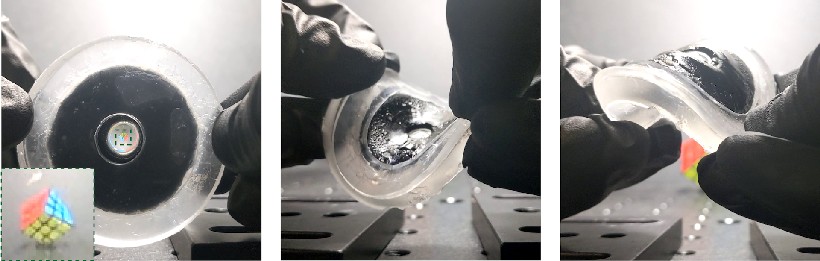
How the artificial eye works
Graphene oxide particles, which are dark in color and have the ability to absorb light, were added to the hydrogel. When light of an intensity comparable to sunlight hits them, the particles heat up and transfer heat to the material, causing the hydrogel to contract and pull the lens, providing focusing. When the light source disappears, the material swells again, relaxing the tension.
The development responds to light across the entire visible spectrum. Scientists also noted that this lens can be used as an alternative to traditional glass elements in optical microscopes. Experiments have shown that it is able to distinguish a 4-micrometer gap between a tick’s claws, see 5-micrometer fungal filaments, and identify 9-micrometer hairs on an ant’s legs.
Zheng said the researchers are now integrating the lens into a microfluidic system of valves made from the same sensitive hydrogel. This will allow light to be used not only for imaging but also as a power source for autonomous intelligent camera systems.
Thanks to the adaptability of the hydrogel, the new lens has the potential to expand the range of perception – from simulating the vertical slit pupil of a cat’s eye to reproducing the unusual W-shaped retina of a cuttlefish, which provides perception of a spectrum inaccessible to the human eye.
Don't miss interesting news
Subscribe to our channels and read announcements of high-tech news, tes

Oppo A6 Pro smartphone review: ambitious

 0
0 
Creating new mid-range smartphones is no easy task. Manufacturers have to balance performance, camera capabilities, displays, and the overall cost impact of each component. How the new Oppo A6 Pro balances these factors is discussed in our review.
Oppo Reno16 Pro 5G smartphone review: well-heeled
0 
Oppo Reno16 Pro 5G looks like a balanced smartphone, in which the manufacturer tried not to make a single characteristic the defining one. It has many advantages. Let’s tell you what
Danger in the Driver’s Seat: Waymo and Zoox Robotaxis Surface with Brake-Related Injuries

Dozens of robotaxi test drivers have been injured due to flaws in autonomous driving systems. The primary culprit is erratic emergency braking, which has led to significant neck and back injuries.
Samsung Galaxy Book6: An Affordable Laptop With 25-Hour Battery Life

Samsung has introduced a new affordable version of the Galaxy Book6. The device features Intel Core 3 or Core 5 processors, up to 16GB of RAM, up to 1TB of storage, and a rated battery life of up to 25 hours.