

NVIDIA Neural Texture Compression: Reduce video memory usage without losing image quality
08.04.26
At the GTC conference, NVIDIA introduced Neural Texture Compression (NTC), designed to dramatically reduce GPU memory usage in modern games. As games become increasingly detailed, texture sizes grow, and hardware demands rise, making efficient optimization more important than ever.
Texture compression using neural networks
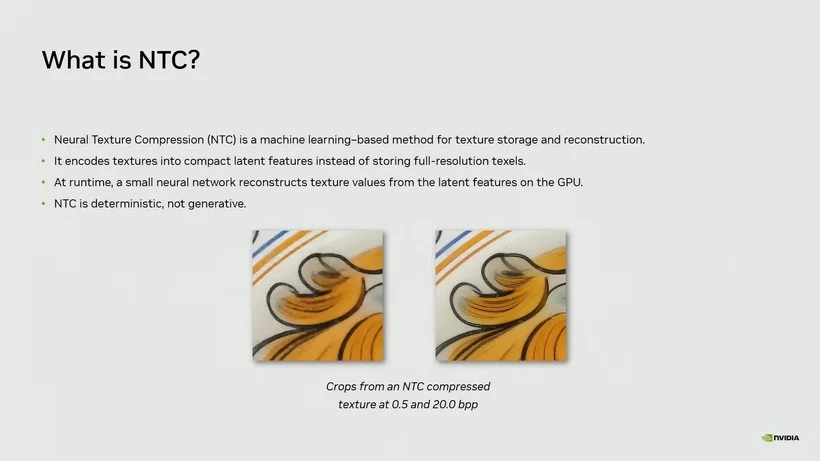
NTC replaces traditional block-based texture compression with small neural networks that process textures during rendering. This approach significantly reduces file sizes and decreases VRAM load without compromising visual quality, making game installations lighter and GPU workloads more efficient in real time.
Examples of VRAM reduction

In demonstrations, NVIDIA showcased a scene of a Tuscan villa: with standard compression, it occupied 6.5 GB of VRAM, while NTC reduced it to just 970 MB, with the image remaining virtually identical. Another example involved a pilot’s helmet: the original textures required 272 MB, block-based compression reduced them to 98 MB, and NTC brought it down to 11.37 MB — nearly 24 times smaller than the original size.
Neural Materials: faster rendering and enhanced lighting
Alongside texture compression, NVIDIA presented the Neural Materials concept, which allows neural networks to model light interactions with surfaces without complex physical calculations. Traditionally, GPUs compute lighting for all texture layers using BRDF models; now the network outputs final pixel shading directly, accounting for light and angle. In test scenes, this accelerated 1080p rendering up to 7.7 times without losing visual fidelity.
Efficient use of hardware accelerators
NTC leverages hardware accelerators — Tensor Cores in NVIDIA GPUs, XMX engines in Intel, and AI accelerators in AMD — enabling texture compression and lighting calculations without affecting baseline GPU performance.
Reliable and precise optimization
NTC is trained exclusively on the textures of the specific game, preventing generative artifacts or visual errors. This technology allows developers to create optimized, high-detail textures with accuracy and reliability, making it a safe and precise tool for modern game development.
Don't miss interesting news
Subscribe to our channels and read announcements of high-tech news, tes

Oppo A6 Pro smartphone review: ambitious

 0
0 
Creating new mid-range smartphones is no easy task. Manufacturers have to balance performance, camera capabilities, displays, and the overall cost impact of each component. How the new Oppo A6 Pro balances these factors is discussed in our review.
Oppo Reno16 Pro 5G smartphone review: well-heeled
0 
Oppo Reno16 Pro 5G looks like a balanced smartphone, in which the manufacturer tried not to make a single characteristic the defining one. It has many advantages. Let’s tell you what
iPhone 18 Price Hike Surfaces: $100 Increase Expected

It has emerged that the iPhone 18 lineup will likely see a price hike. Apple is forced to increase costs by $100 due to rising prices for RAM and NAND memory.
Apple Debuts M6 and M5 Ultra Chips for Pro Workflows

Apple has introduced the revolutionary M6 and M5 Ultra processors. The M6 utilizes a 2nm architecture with advanced AI capabilities, while the M5 Ultra stands as the company’s most powerful solution for 8K video production.