

Synthetic Video Detector from NVIDIA will help the media fight against deepfakes
23.07.26
Amid the rapid development of generative artificial intelligence, it is becoming increasingly difficult to distinguish real video from a neural network. To help newsrooms, fact-checkers and media companies fight the spread of misinformation, NVIDIA announced a new Synthetic Video Detector service integrated into the NVIDIA NIM microservices ecosystem.
The new development analyzes videos frame by frame and determines the probability that the content was generated with the help of AI. Based on the results of the review, the system gives each video a special rating that allows you to quickly determine whether the material requires additional review.
How the system works
Synthetic Video Detector does not make a final decision about the authenticity of the video. Instead, the tool helps editors set priorities: suspicious materials can be automatically sent for additional verification or temporarily excluded from publication until verification is complete.
NVIDIA emphasizes that the service does not replace traditional methods of checking sources, but serves as an additional level of protection, especially in situations when journalists need to make quick decisions.
Accuracy depends on video quality
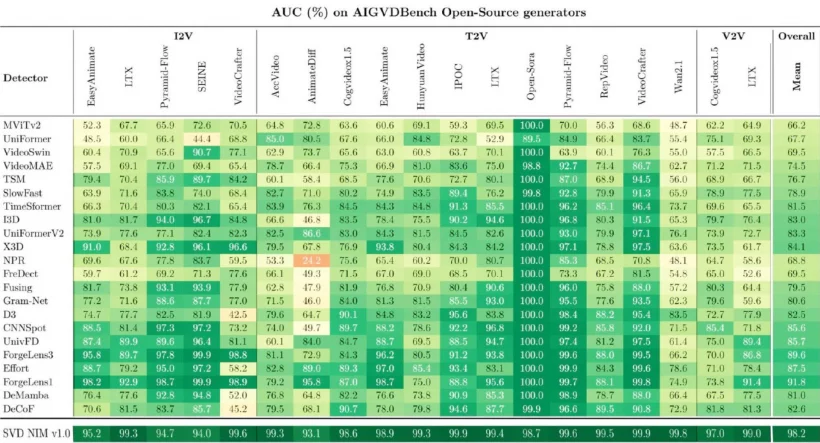 According to the company, the model demonstrates high efficiency when analyzing video recordings of different quality.
When working with uncompressed video, the accuracy of identifying synthetic content reaches 92%. If the video is compressed by about 15%, the figure drops to 87%, and with strong compression (about 50%) it is 82%.
The processing of one video in 1080p resolution takes about 22 milliseconds on systems with NVIDIA RTX video cards and about 30 milliseconds on L40 graphics accelerators, which allows you to use the service in almost real time.
In internal tests, the latest version of the model showed an AUC of 0.9614 and an accuracy of 0.9453, which indicates a high ability to correctly distinguish between real and generated video materials.
Sensitivity threshold can be configured
The developers have foreseen the possibility of adapting the system to different usage scenarios. Editors will be able to independently choose the sensitivity level of the algorithm depending on their requirements.
For example, more conservative settings can be used to minimize the chance of missing deepfakes, even if this results in more false positives. This approach is especially relevant for newsrooms working with potentially resonant materials.
The tool is already being prepared for mass implementation
According to NVIDIA, Synthetic Video Detector already holds leading positions in independent GVD Bench AI tests that evaluate the effectiveness of synthetic video content detection systems.
In addition, the company began cooperation with Wowza, which integrates new technology into the Intelligence Video platform. Thanks to this, the service can become available for more than 35 thousand installations in 170 countries, significantly expanding the capabilities of editorial offices and corporate clients in the fight against deepfakes.
Don't miss interesting news
Subscribe to our channels and read announcements of high-tech news, tes

Oppo A6 Pro smartphone review: ambitious

 0
0 
Creating new mid-range smartphones is no easy task. Manufacturers have to balance performance, camera capabilities, displays, and the overall cost impact of each component. How the new Oppo A6 Pro balances these factors is discussed in our review.
In-Ear headphones Active Noise Cancellation: how Oppo eliminate noise
0 
In-ear headphones remain one of the most popular form factors due to their lightweight design. However, this design is considered one of the most challenging to implement active noise cancellation (ANC). We’ll explain how Oppo solved this problem.
Ford Debuts AI Assistant That Knows Everything About Your Car

Ford has introduced a new AI assistant that brings personalized vehicle diagnostics and support to Ford and Lincoln owners.
Google Pixel 11 Pro Fold: The New Foldable Flagship With HiLight and Gemini

Google Pixel 11 Pro Fold features a 6.5-inch outer and 8-inch inner OLED display with peak brightness reaching 3600 nits.