

Google launches Gemma 4 for servers and Gemini Nano 4 for mobile devices
06.04.26
Google continues to expand the capabilities of its large language models. Following the success of Gemini 3 Pro, the company has introduced the new Gemma 4 series, bringing high-performance LLMs to both server systems and mobile devices.
Different versions for different needs
Gemma 4 is available in four versions:
- For lightweight devices — 2B and 4B “Effective”;
- For powerful servers — 26B “Mixture of Experts” and 31B “Dense”.
The number of parameters determines a model’s ability to handle complex tasks: more parameters usually mean higher intelligence, but also higher hardware requirements.
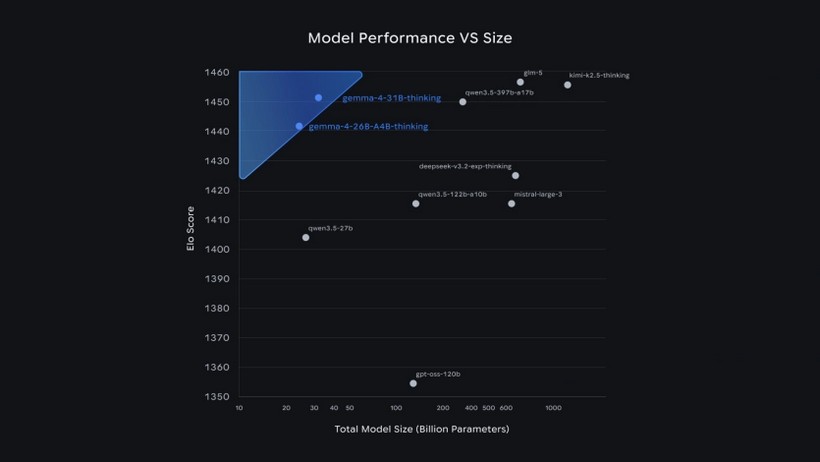
Arena AI tests showed that the 31B Dense and 26B MoE models rank highly, outperforming models that are 20 times larger. All versions support video and image processing, while the smaller models can also handle audio and speech recognition.
Offline coding and Apache 2.0 license
Gemma 4 models can generate code offline and have been trained in more than 140 languages. Released under the Apache 2.0 license, they provide developers with freedom to adapt and deploy safely, without the restrictions imposed by previous Gemma versions.
The Effective models are optimized for smartphones, Raspberry Pi, and Jetson Nano, consuming less power and demonstrating minimal latency. Server versions are designed for NVIDIA H100 GPUs with 80 GB of VRAM.
Performance and scalability
The 26B MoE model uses only a portion of its parameters during inference, speeding up token generation, while the 31B Dense model focuses on output quality and can be fine-tuned for specific tasks.
Gemma 4 supports agent-based workflows, function calling, structured JSON output, and context windows up to 256k tokens for large models, with cloud Gemini versions extending up to 1 million tokens.
Gemini Nano 4 for mobile devices
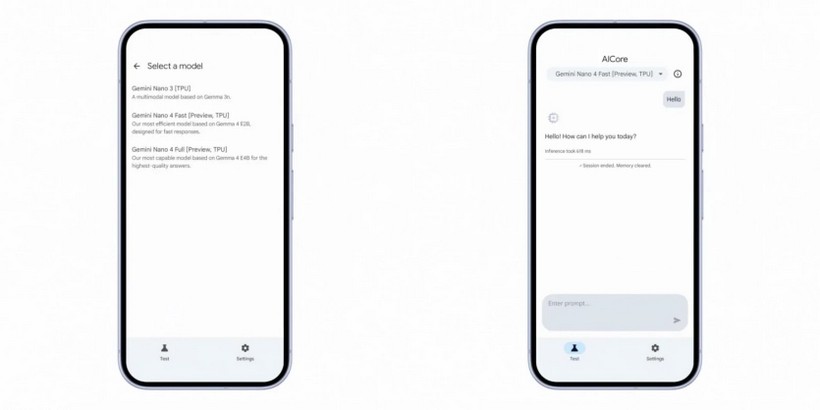
Google also unveiled Gemini Nano 4 for mobile devices. The Nano 4 Fast version, based on Gemma 4 E2B, is optimized for speed and low latency, while Nano 4 Full, based on Gemma 4 E4B, prioritizes quality over speed.
Nano 4 operates up to four times faster than previous models and reduces battery consumption by up to 60%. Code written for Gemma 4 is fully compatible with Nano 4.
In the near future, Google will add support for tool invocation, structured output, system prompts, and a “thinking” mode in the Prompt API for developers.
Don't miss interesting news
Subscribe to our channels and read announcements of high-tech news, tes

Oppo A6 Pro smartphone review: ambitious

 0
0 
Creating new mid-range smartphones is no easy task. Manufacturers have to balance performance, camera capabilities, displays, and the overall cost impact of each component. How the new Oppo A6 Pro balances these factors is discussed in our review.
Oppo Reno16 Pro 5G smartphone review: well-heeled
0 
Oppo Reno16 Pro 5G looks like a balanced smartphone, in which the manufacturer tried not to make a single characteristic the defining one. It has many advantages. Let’s tell you what
Iron Man Game Trailer Surfaces: Combat and Flight Mechanics Detailed

A gameplay trailer for the highly anticipated Iron Man game from EA and Motive Studios has leaked. The two-and-a-half-minute video showcases Tony Stark’s abilities and combat mechanics.
Haptic Feedback in Smart Rings: The Future of Wearable Interaction

Integrating a vibration motor into the RingConn Gen 3 changes the significance of the ring as a wearable device. We examine why haptic signals are the next step in smart ring evolution, what the feature can currently do, and the technical challenges involved.