

Without any fan: The RTX 5080 was launched in a naturally cooled system
25.05.26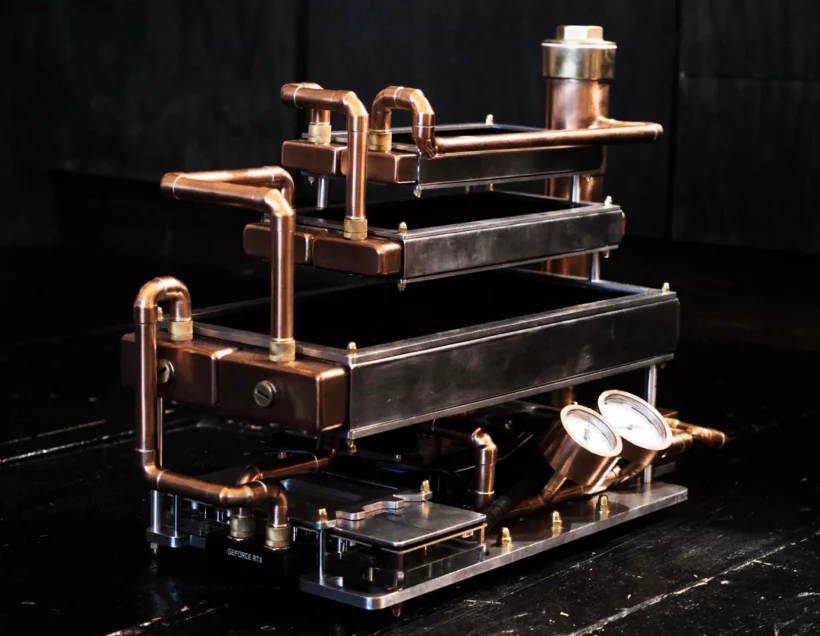
The idea of a completely silent gaming computer with a top video card sounded like an engineering utopia until recently. But an experiment by the British Billet Labs shows that this is no longer a theory: a system with NVIDIA GeForce RTX 5080 and AMD Ryzen 7 9800X3D is able to run modern games without a single fan in the case.
Radically redesigned cooling system
Instead of the usual coolers and active water, engineers abandoned any moving elements in cooling and built a completely passive thermal architecture. At its core are three large radiators combined into a single heat removal system.
The dimensions of the elements emphasize the scale of the solution: 40×20 cm for the main radiator, 28×14 cm for the second and 24×12 cm for the third. These are not standard computer components, but thermal infrastructure designed to work with high CPU and GPU power consumption.
No pump: circulation due to physics

The key feature of the project is the absence of not only fans, but also a pump. The cooling liquid moves independently thanks to natural convection: the heated coolant rises from the heat sources, and the colder one from the radiators returns down.
In fact, the system works as a thermosiphon circuit, where circulation is supported exclusively by the difference in temperature and density of the liquid. This makes the mechanics as easy as possible, but at the same time imposes strict limits on the thermal load.
Configuration and structural basis
At the heart of the assembly is the Gigabyte Aorus Pro B850, 32 GB of RAM, a 2 TB SSD and a 600 W power supply. The only active cooling element remains the PSU, which retains its own fan.
All major components are mounted on a massive 8mm thick aluminum plate. To improve heat exchange, large thermal pads are used, distributing heat over the surface of the structure and reducing local temperature peaks.
Behavior of the system under load
In simple terms, the temperature of the coolant was kept at around 28 °C, which is comparable to conventional PCs with active cooling. After 30 minutes of the Cinebench stress test, it rose to 39 °C and the CPU reached 90 °C, while maintaining stable performance with no noticeable throttling.
The game load turned out to be much heavier. At the launch of Cyberpunk 2077, the temperature of the liquid exceeded 55 ° C – already the borderline level of long-term operation of such passive systems. However, the system continued to work stably without reducing performance.
An engineering demo, not a product for the market
The Billet Labs project is unlikely to be a practical solution for mass gaming PCs: it requires bulky heatsinks, complex thermal architecture, and harsh operating conditions.
However, it demonstrates an important shift: modern processors and video cards can already be cooled almost silently – if you abandon the compactness and usual layout. This is not so much a step towards “quiet gaming” as an experiment showing the limits of what is possible in PC thermal design.
Don't miss interesting news
Subscribe to our channels and read announcements of high-tech news, tes

Oppo A6 Pro smartphone review: ambitious

 0
0 
Creating new mid-range smartphones is no easy task. Manufacturers have to balance performance, camera capabilities, displays, and the overall cost impact of each component. How the new Oppo A6 Pro balances these factors is discussed in our review.
In-Ear headphones Active Noise Cancellation: how Oppo eliminate noise
0 
In-ear headphones remain one of the most popular form factors due to their lightweight design. However, this design is considered one of the most challenging to implement active noise cancellation (ANC). We’ll explain how Oppo solved this problem.
Apple Music to Introduce AI Music Labels

Apple Music will introduce special Made With AI labels for songs created with generative artificial intelligence by the end of 2026.
Windows 11 Update Breaks Games: The RGB Fix

The latest cumulative Windows 11 update has caused issues with game performance and stability. Microsoft confirmed the conflict is triggered by RGB peripheral software.