

A market for renting appearances for AI-powered TV series has emerged in China.
02.08.26
The development of generative AI in China has given birth to a new digital market. Dedicated platforms offer users to officially license their appearance, and AI content developers pay for the right to use faces in advertisements and popular vertical mini-series.
Companies pay from $15 to $700, depending on the terms of the agreement, for the opportunity to manage their persona in the digital space.
Face rental platforms
New services, such as ActID and New Claw, operate on the model of photo stocks. Users upload their photos, and producers select candidates using filters based on gender, age, type or genre orientation — from thrillers and comedies to melodramas. The resulting images are used in advertisements and vertical short series that have become a hit on Chinese social networks. In the first quarter of 2026, more than 128,000 such miniseries were released in China, with 95% of the content generated by artificial intelligence.
Earning on appearance
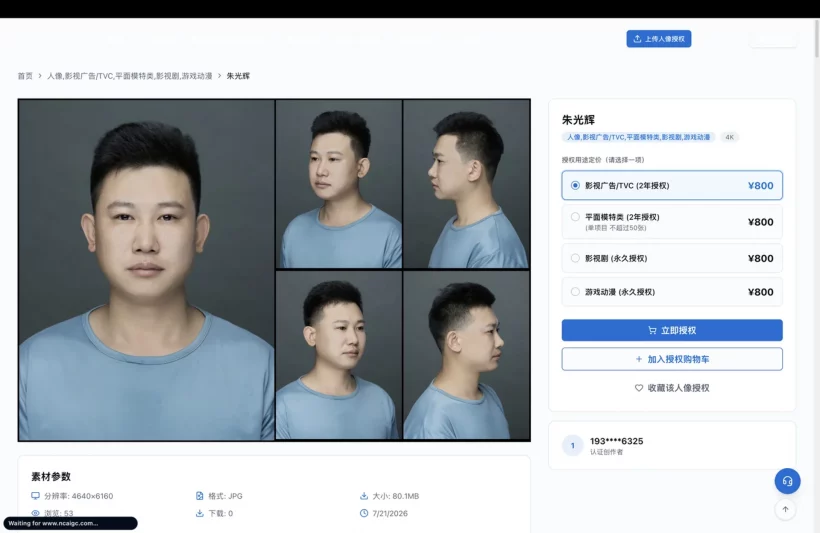
The market has already started showing the first financial results:
- The ActID service, launched in March, has gathered about 800 users, 300 of whom have already agreed to license their identities.
- Two AI-projects bought the rights to ten people at a rate from $15 ($15 USD, €13.85 (566 UAH)) to $74 ($74 USD, €68.31 (2794 UAH)) per episode, with a deduction of 10% of the platform commission.
- New Claw has set a minimum payout threshold of $74 ($74 USD, €68.31 (2794 UAH)) to prevent copyright depreciation.
Risks and legal nuances
The companies claim that this format legalizes the use of data and protects against illegal copying. However, experts warn of risks: by transmitting biometric data, the user loses control over the future use of his appearance. Contracts are often drawn up vaguely and guarantee protection against training models of this data.
Problems with protection of rights and judicial precedents
Violations are already happening. For example, two bloggers filed a complaint against ByteDance’s Hongguo platform for unauthorized use of individuals in a video that had 40 million views. ByteDance has already removed more than 85,000 videos with illegal AI copies.
Case law is beginning to emerge: the Guangzhou Internet Court alone has heard about 700 such lawsuits over the past three years. In March of this year, a Beijing court issued a precedent ruling, declaring it illegal to use a person’s appearance in AI content without consent, even if the image has been altered.
The appearance licensing market can be a new source of income for users, but at the same time raises serious questions about the protection of biometric data and copyright. While the legislation is only adapting to the new reality, the participants of such agreements should carefully study the terms of the transfer of rights.
Don't miss interesting news
Subscribe to our channels and read announcements of high-tech news, tes

Oppo A6 Pro smartphone review: ambitious

 0
0 
Creating new mid-range smartphones is no easy task. Manufacturers have to balance performance, camera capabilities, displays, and the overall cost impact of each component. How the new Oppo A6 Pro balances these factors is discussed in our review.
In-Ear headphones Active Noise Cancellation: how Oppo eliminate noise
0 
In-ear headphones remain one of the most popular form factors due to their lightweight design. However, this design is considered one of the most challenging to implement active noise cancellation (ANC). We’ll explain how Oppo solved this problem.
The new Radeon RX 9050 4GB is only for pre-built PCs.

AMD has unveiled the Radeon RX 9050 with 4GB of VRAM, a 64-bit bus, and 16MB of Infinity Cache.
Honor Turbo 5G Hands-On: Affordable Phone With Massive Battery and IP69 Rating

Honor has officially released the Honor Turbo 5G smartphone. The new device packs a large AMOLED screen, an 8,560 mAh battery, a Snapdragon 6 Gen 4 chipset, and IP69 protection.