

Neuralink voiced the thoughts of a person who cannot speak
28.03.26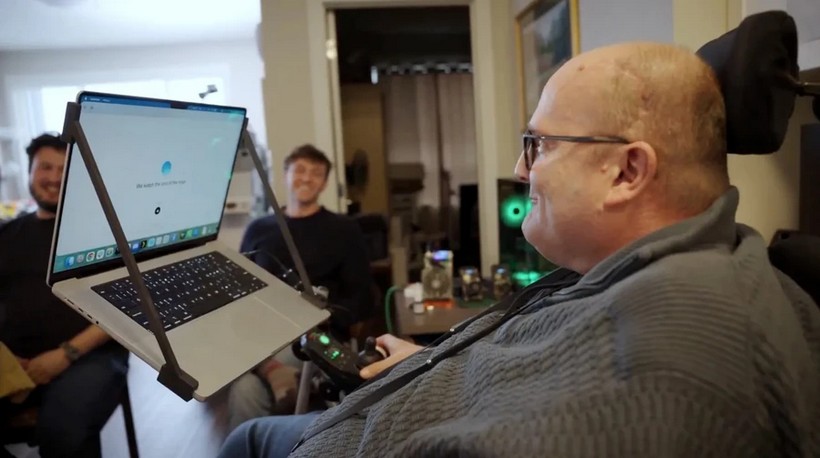
A patient with amyotrophic lateral sclerosis (ALS) has been able to produce speech thanks to a brain chip that converts neural signals into words and vocalizes them through a computer. The company Neuralink released a video demonstrating the N1 device, implanted in Kenneth Shock in January 2026.
How the Brain-Computer Interface Works
The implant detects activity in brain regions responsible for controlling the speech apparatus and maps these signals to phonemes — the smallest units of sound. The system gradually learns to recognize the patient’s intent to speak, eventually eliminating the need for physical lip or vocal movements. Previously, such devices only allowed users to control a cursor or a robotic arm, but now they enable direct communication powered solely by thought.
Step-by-Step Training of the Patient
Initially, Shock spoke phrases aloud so the system could “learn” the correlation between neural activity and words. Then he repeated the phrases silently, moving only his lips. At the final stage, Neuralink’s software learned to recognize speech even when the patient made no movements at all. Engineers emphasize that the ultimate goal is to decode the intention to speak directly into voice.
Clinical and Technical Aspects
The demonstration is part of the VOICE clinical trial. The technology still requires refinement, particularly to increase signal processing speed: currently, the system may take several minutes to interpret words. Developers plan to increase the number and precision of sensors to achieve real-time speech transmission. Broad implementation of these solutions is expected only in a few years after further development and large-scale testing.
Don't miss interesting news
Subscribe to our channels and read announcements of high-tech news, tes

Oppo A6 Pro smartphone review: ambitious

 0
0 
Creating new mid-range smartphones is no easy task. Manufacturers have to balance performance, camera capabilities, displays, and the overall cost impact of each component. How the new Oppo A6 Pro balances these factors is discussed in our review.
In-Ear headphones Active Noise Cancellation: how Oppo eliminate noise
0 
In-ear headphones remain one of the most popular form factors due to their lightweight design. However, this design is considered one of the most challenging to implement active noise cancellation (ANC). We’ll explain how Oppo solved this problem.
Poco X8 Power Surfaces With Massive 10,000mAh Battery

Rumors have emerged regarding the development of the Poco X8 Power, a smartphone with an impressive 10,000mAh battery. The device promises striking screen specs and a Snapdragon 6 Gen 5 hardware base.
Baseus PicoGo Pro: A 60W Compact Charger With a Smart Display
Baseus has released its new PicoGo Pro (AE22) charger in China. Equipped with an intelligent display and supporting up to 60W fast charging, the device aims to compete with the popular Anker Nano adapters at an accessible price point.