

Google abandoned Samsung chips due to overheating
28.04.25
Google has changed its plans to use Samsung’s HBM3E chips for its AI servers and, according to the latest data, has switched to products from another manufacturer – most likely Micron. The decisions are related to technical difficulties encountered by the South Korean company.
The main reason is called problems with heat dissipation – a key aspect for obtaining certification from NVIDIA, one of the leading players in the field of AI accelerators. While SK Hynix has already achieved certification and is successfully increasing sales of HBM3E, Samsung is still trying to eliminate the shortcomings. Despite the design changes in its chips, the company could not pass the inspection by NVIDIA.
The company itself has also spoken about the problems with Samsung’s HBM products: at a recent meeting with shareholders, representatives acknowledged technical difficulties and announced the shift of focus to the development of HBM4 – the next generation of chips. However, it remains unclear whether Samsung will be able to regain its leadership in a market where competitors have already broken through.
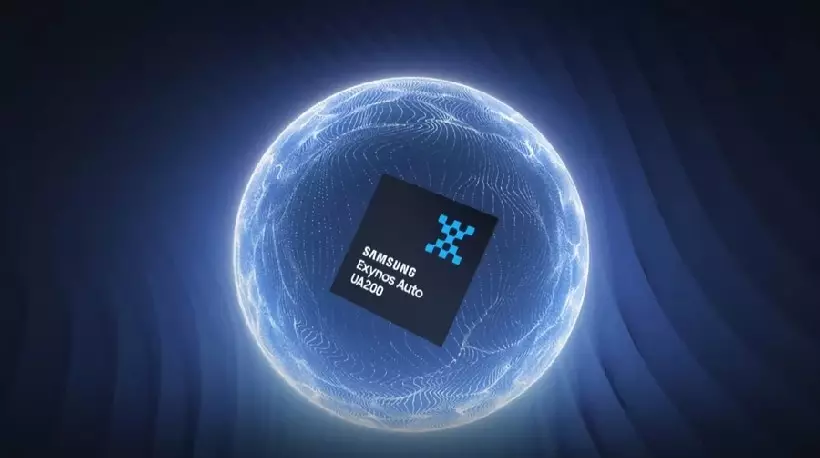
Samsung has introduced its new ultra-wideband (UWB) chip for cars, the Exynos Auto UA200.
The Exynos Auto UA200 chip provides high-precision distance measurement of up to one centimeter, and also offers advanced security features. When used in a vehicle key, it can accurately determine the owner’s location in relation to the car.
The Exynos Auto UA200 can interact with radar systems, allowing it to monitor the driver’s breathing and ensure the operation of the child presence detection system (CPD). This technology will become mandatory in European countries from 2025. To protect the temporal data of the signal, Scrambled Timestamp Sequence (STS) technology is used, which provides additional encryption.
The chip includes a tri-core Cortex-M33 microcontroller, a radio frequency module, a base unit, a power-efficient management unit (PMU), and built-in NVM memory. The amount of RAM is 416 KB, and the built-in eFlash flash memory is 2 MB.
The Exynos Auto UA200 is currently undergoing testing, and mass release is planned for the near future.
Don't miss interesting news
Subscribe to our channels and read announcements of high-tech news, tes

Oppo A6 Pro smartphone review: ambitious

 0
0 
Creating new mid-range smartphones is no easy task. Manufacturers have to balance performance, camera capabilities, displays, and the overall cost impact of each component. How the new Oppo A6 Pro balances these factors is discussed in our review.
Poco M8 Pro smartphone review: give us more
0 
Poco M8 Pro 5G immediately catches the eye with its size and the manufacturer’s desire to offer more than you’d typically expect from a device in this price range. It’s not just another mid-range device.
Google Translate has a chatbot mode powered by artificial intelligence Google

If you ask Google Translate a question in a certain way, the translator starts to behave more like a chatbot.
Boston Dynamics showed how the humanoid robot Atlas does new tricks robot

Boston Dynamics, together with researchers from the RAI Institute, published a video in which the updated humanoid robot Atlas performs complex acrobatic elements.