

Qualcomm Snapdragon 7 Gen 4 supports 5G, Wi-Fi 7 and Bluetooth 6
27.05.25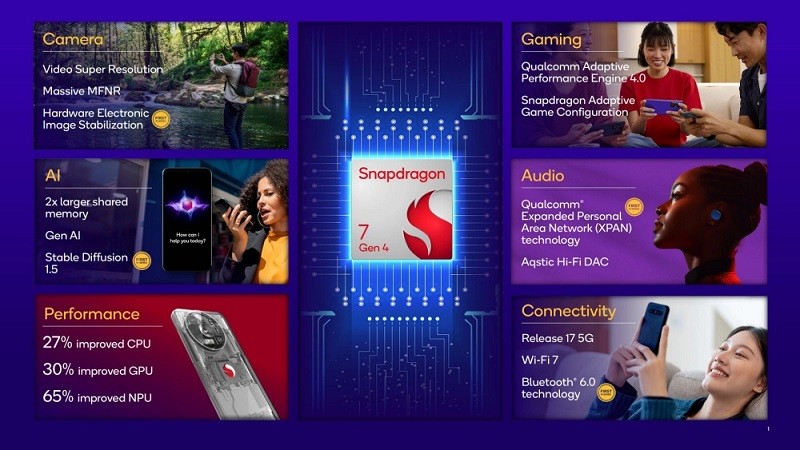
Qualcomm has announced a new mid-range chipset – Snapdragon 7 Gen 4, made using a 4-nm process technology. The processor has eight cores: one high-performance core with a frequency of up to 2.8 GHz, four productive cores at 2.4 GHz and three energy-efficient cores with a frequency of up to 1.84 GHz.
According to the company, the new chip provides a performance increase of up to 27% in computing tasks, up to 30% in graphics and up to 65% in tasks related to AI.
Qualcomm Snapdragon 7 Gen 4 supports 4K video recording at 60 frames per second and is able to locally run speech models. Communication capabilities include support for 5G, Wi-Fi 7 and Bluetooth 6. The first devices based on the new processor will be released by Honor and vivo in May 2025.
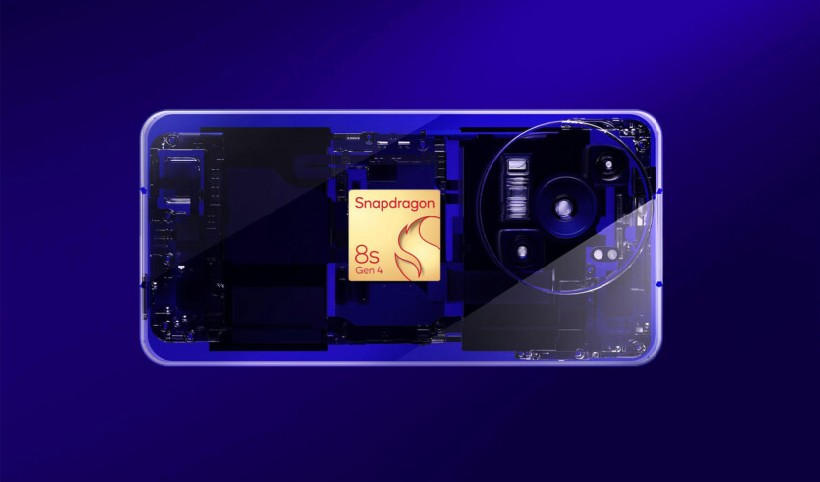
Qualcomm also introduced a new system-on-chip Snapdragon 8s Gen 4, which will complement the line of mobile processors, including the flagship Snapdragon 8 Elite. The new chipset offers high performance and modern technologies at a more affordable price.
One of the key differences of the Snapdragon 8s Gen 4 was the preservation of the Kryo architecture instead of using proprietary Oryon cores. Despite this, the chip’s performance has increased by 49% compared to its predecessor, along with other improvements. The manufacturing process is based on 4-nm technology, presumably N4P from TSMC, which makes it less energy-efficient compared to the Snapdragon 8 Elite.
The processor has a core configuration in the format 1 + 3 + 2 + 2. The maximum frequency of the most powerful core reaches 3.20 GHz, the other high-performance cores operate at 3.00 GHz. Although Qualcomm did not disclose details about the graphics accelerator, the claimed increase in graphics power is 49% compared to the Snapdragon 8s Gen 3. Overall, computing performance has increased by 31%, and power consumption has decreased by 39%.
The chip is equipped with a 5G modem, but without mmWave support. Instead, it operates in the sub-6 GHz range with a maximum download speed of 4.2 Gbps. Bluetooth 6.0, Wi-Fi 7, UFS 4.0 and LPDDR5X RAM with a frequency of 4800 MHz are also supported.
In addition, the Snapdragon 8s Gen 4 received an upgraded NPU, which accelerates AI-related calculations by 44%. The improved image processing unit (ISP) supports cameras with resolutions up to 320 MP, 8K HDR playback at 60 frames per second, and 4K HDR video recording at the same frequency.
Don't miss interesting news
Subscribe to our channels and read announcements of high-tech news, tes

Oppo A6 Pro smartphone review: ambitious

 0
0 
Creating new mid-range smartphones is no easy task. Manufacturers have to balance performance, camera capabilities, displays, and the overall cost impact of each component. How the new Oppo A6 Pro balances these factors is discussed in our review.
Oppo Reno16 Pro 5G smartphone review: well-heeled
0 
Oppo Reno16 Pro 5G looks like a balanced smartphone, in which the manufacturer tried not to make a single characteristic the defining one. It has many advantages. Let’s tell you what
First Foldable iPhone Ultra: MagSafe Support Details Surface

Apple is expected to unveil its first foldable smartphone, the iPhone Ultra, at a September 9 event. Insiders confirm the integration of MagSafe technology and share details regarding the device’s design and display.
Danger in the Driver’s Seat: Waymo and Zoox Robotaxis Surface with Brake-Related Injuries

Dozens of robotaxi test drivers have been injured due to flaws in autonomous driving systems. The primary culprit is erratic emergency braking, which has led to significant neck and back injuries.