

AMD Targets Custom AI Silicon With Acquisition of Taalas
11.08.26
AMD has announced the acquisition of Canadian startup Taalas, which offers a revolutionary approach to artificial intelligence computing. Instead of fighting for general-purpose versatility, AMD is pivoting toward highly specialized hardware, a move that could reshape the AI market landscape.
Hardwiring Neural Networks Into Silicon
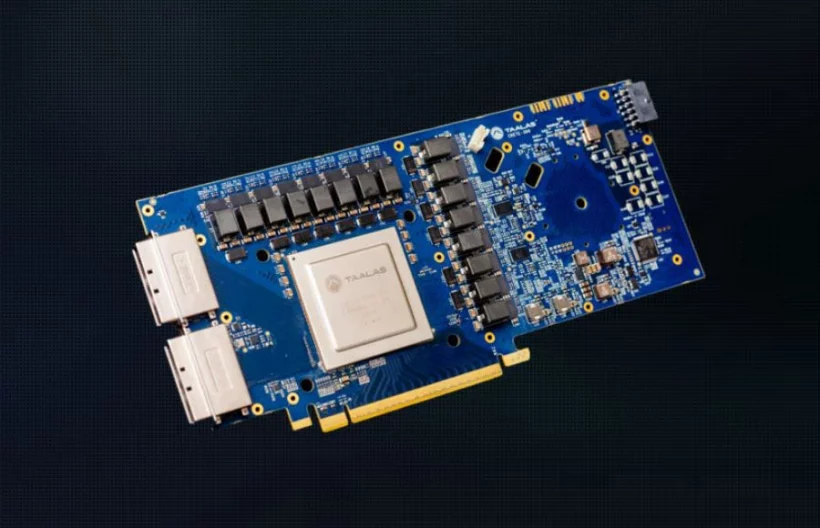
Taalas’ concept differs radically from current standards, such as Nvidia’s GPUs. Instead of relying on flexible software architectures, the company proposes designing chips where specific AI models, such as Llama-level models, are physically integrated directly into the processor’s structure.
Performance and Efficiency of Specialized Solutions
According to Taalas developers, this hardware-centric approach provides significant advantages over general-purpose accelerators:
- Production costs are up to 20 times lower than those of top-tier general-purpose competitors.
- Increased energy efficiency and inference speed are achieved by eliminating redundant computational operations.
- Narrow focus allows for chip optimization for specific neural network architectures, minimizing resource waste.
Performance Comparison and Market Positioning
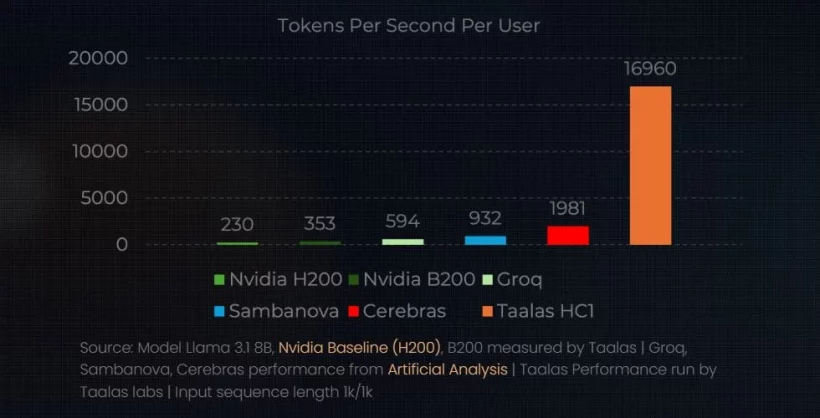
The primary advantage of the Taalas HC1 system is its optimization for specific tasks. For data centers that have used fixed algorithms for search, recommendations, or translation for years, the “inflexibility” of specialized chips is offset by exponential performance gains.
AMD’s Strategy: Why It Matters
Following the acquisitions of Silo AI and ZT Systems, the purchase of Taalas demonstrates Lisa Su’s drive to find bottlenecks in Nvidia’s dominance. While Nvidia relies on the CUDA ecosystem, AMD is finding value in pricing and narrow specialization. The Taalas deal confirms this course: a transition from universal GPUs to model-specific chips. Despite recent success, where record-breaking profits haven’t kept AMD stock from market-driven volatility, these acquisitions remain the foundation of the corporation’s growth strategy.
The main risk of this strategy is obsolescence. If a neural network architecture changes drastically, these “hardwired” chips could become ineffective. However, for industrial scales, where algorithm stability is more critical than versatility, this move by AMD could prove to be a decisive factor in the race for leadership in AI computing.
Don't miss interesting news
Subscribe to our channels and read announcements of high-tech news, tes

Oppo A6 Pro smartphone review: ambitious

 0
0 
Creating new mid-range smartphones is no easy task. Manufacturers have to balance performance, camera capabilities, displays, and the overall cost impact of each component. How the new Oppo A6 Pro balances these factors is discussed in our review.
Oppo Reno16 Pro 5G smartphone review: well-heeled
0 
Oppo Reno16 Pro 5G looks like a balanced smartphone, in which the manufacturer tried not to make a single characteristic the defining one. It has many advantages. Let’s tell you what
Gemini, Keep, and Motion Assist: The New Android Drop Features

Google introduced a fresh package of Android Drop updates for smartphone users, including AI integration in search, new messaging capabilities, and health-related features.
Acer Predator Atlas 7: A New Handheld With 24GB RAM and 1TB SSD

At IFA 2026, Acer introduced the Predator Atlas 7, an updated 7-inch handheld gaming console.