

NVIDIA Rubin may trigger a global shortage of smartphone memory
20.05.26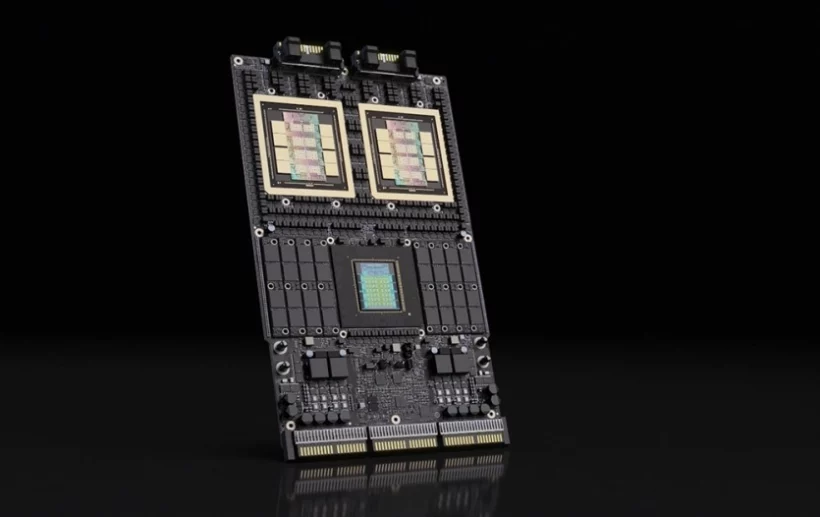
The artificial intelligence industry is slowly becoming the largest consumer of semiconductors on the planet — and now one of the key components of mobile electronics is under attack. Analysts warn that in the coming years, server platforms for AI will begin to consume more LPDDR memory than the largest smartphone manufacturers. The main symbol of this shift is the NVIDIA Rubin architecture, which risks literally “sucking” a significant part of the world’s DRAM supply.
It’s not just about growing demand. AI-infrastructure is beginning to reshape the entire memory market for itself, creating the threat of shortages and a new surge in prices for manufacturers of smartphones, laptops and other mass electronics.
AI servers reach a new level of memory consumption
According to the forecast of Citrini Research analysts, by 2027 the NVIDIA Rubin AI platform will require more than 6 billion GB of LPDDR memory. This is a volume that a few years ago seemed almost impossible even for the entire mobile industry.
For comparison:
- Apple is expected to purchase about 2,966 million GB of LPDDR for iPhone production;
- Samsung Electronics – approximately 2724 million GB.
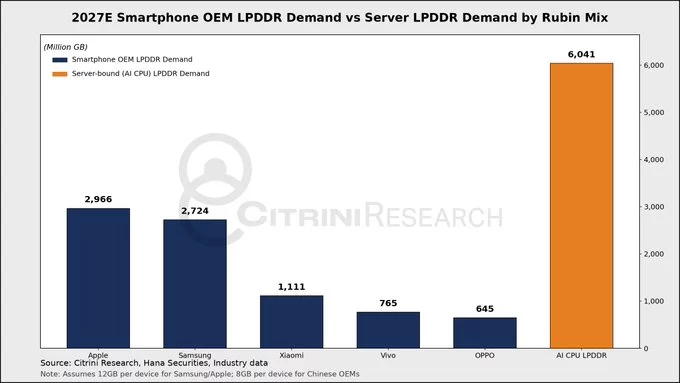
Even together, the world’s two largest smartphone manufacturers will consume less memory than a single NVIDIA Rubin server AI platform. The difference is estimated at about 6%, and this is without taking into account other players in the artificial intelligence market.
At the same time, Rubin is not the only project capable of dramatically increasing the pressure on the DRAM market. In the coming years, a similar demand will be created by new-generation server platforms from AMD, as well as the infrastructure of large cloud companies that are actively increasing computing power for generative AI and agent systems.
LPDDR as a strategic resource for AI
LPDDR has traditionally been associated with smartphones, tablets and energy-efficient laptops. The main advantages of this type of memory are low energy consumption, high placement density and compact dimensions.
But the architecture of modern AI systems has radically changed the requirements for server infrastructure.
Large language models are becoming increasingly large, and agent-based AI requires constant storage of vast arrays of context and fast access to data. That is why the industry is more actively using LPDDR in server solutions: it allows to increase the energy efficiency of data centers under colossal loads.
In fact, memory is becoming one of the main resources of the AI era — as important as GPUs themselves.
Crisis for smartphones
For manufacturers of mobile electronics, the consequences can be very painful.
If AI companies continue to buy up huge volumes of LPDDR, the market will face several problems at once:
- memory deficit;
- increasing contract prices;
- increasing prices of smartphones;
- by reducing the marginality of producers;
- delays in the delivery of certain models.
The average and budget segment of Android smartphones looks especially vulnerable, where the cost of components affects the final price of the device.
In addition, AI companies are willing to pay significantly more for a stable supply for their data centers. As a result, mobile brands may find themselves in a losing position in the battle for the manufacturing power of Samsung, SK Hynix and Micron.
Don't miss interesting news
Subscribe to our channels and read announcements of high-tech news, tes

Oppo A6 Pro smartphone review: ambitious

 0
0 
Creating new mid-range smartphones is no easy task. Manufacturers have to balance performance, camera capabilities, displays, and the overall cost impact of each component. How the new Oppo A6 Pro balances these factors is discussed in our review.
In-Ear headphones Active Noise Cancellation: how Oppo eliminate noise
0 
In-ear headphones remain one of the most popular form factors due to their lightweight design. However, this design is considered one of the most challenging to implement active noise cancellation (ANC). We’ll explain how Oppo solved this problem.
Apple Music to Introduce AI Music Labels

Apple Music will introduce special Made With AI labels for songs created with generative artificial intelligence by the end of 2026.
Windows 11 Update Breaks Games: The RGB Fix

The latest cumulative Windows 11 update has caused issues with game performance and stability. Microsoft confirmed the conflict is triggered by RGB peripheral software.