

Microsoft: AI at work rests not on technology, but on management decisions
24.05.26
In a new report, the Work Trend Index 2026, Microsoft tried to answer a simple question: why some companies quickly benefit from the adoption of artificial intelligence, while others lag, despite equal access to technology. The result turned out to be unexpectedly “non-technical” – the main barrier is not in algorithms, but in management and corporate culture.
Scale of data
The study covered 20,000 employees from 10 countries and was complemented by the analysis of trillions of work signals within Microsoft 365. More than 100,000 anonymized user dialogues with Microsoft 365 Copilot were separately studied.
Almost half of all interactions with AI – 49% – relate to cognitive work: analyzing information, finding solutions, generating ideas and evaluating options. This means that AI is perceived less and less as “routine automation” and more and more as a thinking tool.
AI changes the level of tasks
According to Microsoft, 58% of users say that thanks to AI, they have started to perform tasks that were impossible for them a year ago. Among the most advanced users – Frontier Professionals – already 80% of them.
In parallel, a new model of skills is being formed. Users are increasingly citing critical thinking (46%) and quality assurance (50%) as key competencies alongside AI. In other words, the value shifts from “the ability to do” to “the ability to check and direct.”
Effect of organizational gap
Despite the high level of use of AI at the level of employees, a persistent tension is forming within companies:
- 65% of users are afraid of falling behind in learning AI;
- 45% prefer not to change the usual processes;
- only 13% feel real support from the company;
- only 26% believe that management understands the AI implementation strategy.
A paradox arises: employees already live in the logic of AI, but the organization does not yet exist. Because of this, technologies are used pointwise and do not turn into a systemic advantage.
Key conclusion
Microsoft records an important shift in the logic of efficiency: the impact of the corporate environment and management decisions on the outcome of AI implementation is 67%, while the individual efforts of employees are only 32%.
This means that success is not determined by the skills of individual specialists, but by how the company restructures processes, roles and management models.
Separately, Microsoft singles out Frontier Firms – organizations that are not limited to pilot projects, but integrate AI into the structure of work.
In such companies, a new model of human-technology interaction is being formed: the roles of “author”, “editor”, “manager” and “orchestrator” of processes. This is not just automation, but redistribution of functions within the team.
According to Microsoft’s forecast, it is precisely such companies that will increase efficiency faster and gradually increase the gap with competitors.
Summary
The main conclusion of the study is extremely practical: AI is already ready to work at the employee level, but many companies are not. And while technologies develop faster than management models, the decisive factor remains the power of algorithms, and the ability of organizations to rebuild the very logic of work.
Don't miss interesting news
Subscribe to our channels and read announcements of high-tech news, tes

Oppo A6 Pro smartphone review: ambitious

 0
0 
Creating new mid-range smartphones is no easy task. Manufacturers have to balance performance, camera capabilities, displays, and the overall cost impact of each component. How the new Oppo A6 Pro balances these factors is discussed in our review.
In-Ear headphones Active Noise Cancellation: how Oppo eliminate noise
0 
In-ear headphones remain one of the most popular form factors due to their lightweight design. However, this design is considered one of the most challenging to implement active noise cancellation (ANC). We’ll explain how Oppo solved this problem.
Ninkear L20: A Compact Intel Lunar Lake Mini PC With Copilot+ Support
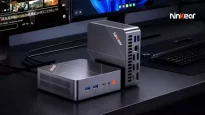
Ninkear L20 is a new mini PC based on the Intel Lunar Lake architecture with 40 TOPS NPU support and official Copilot+ PC compliance.
Samsung Wallet Adds Digital Key Support for Volkswagen EVs
Samsung Wallet is adding support for digital car keys for Volkswagen ID series electric vehicles, allowing Galaxy smartphone users to unlock and start their cars key-free.