

Dell Pro Max GB300: A Desktop System with Data-Center-Class Computing Power
24.03.26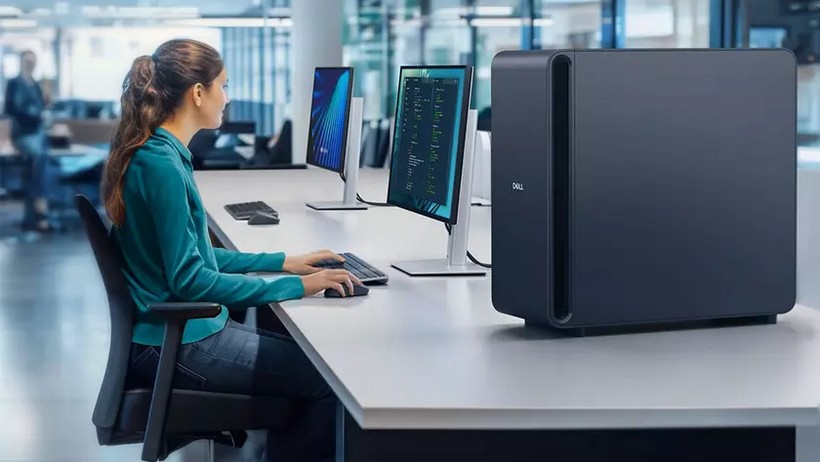
Dell has introduced a new workstation whose specifications make it resemble a server more than a conventional desktop computer. Weighing around 40 kilograms, the device integrates, within a single chassis, components typically found in data-center infrastructure, while formally remaining a desktop solution—although moving it without assistance is difficult.
This development reflects a broader shift across the industry: accelerators for artificial intelligence workloads are gradually ceasing to exist as standalone expansion cards. Instead, manufacturers are transitioning to integrated platforms in which the central processing unit and graphics processor are placed on a single board. The Dell Pro Max GB300 workstation follows this approach and is designed to deliver peak performance of up to 20 petaflops.
Integrated Architecture Based on Blackwell
At the core of the system is the Nvidia GB300 Grace Blackwell Ultra superchip, which combines a 72-core Grace processor based on the Arm Neoverse V2 architecture with the DGX B300 graphics accelerator. The latter is equipped with 288 gigabytes of high-bandwidth HBM3E memory, enabling it to process large volumes of data without relying on external sources.
All key components are mounted on a single large motherboard and connected directly, without the conventional cables or replaceable modules. This approach reduces latency in data transfer between the processor and the graphics accelerator, but effectively eliminates the possibility for users to upgrade the system independently in the future.
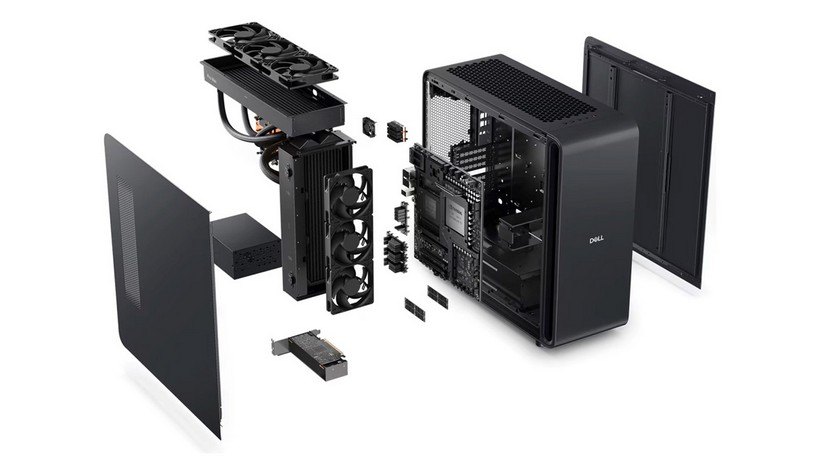
Despite the high level of integration, the configuration includes one discrete element—the RTX Pro 1000 Blackwell graphics card. Compared to the main compute module, it appears relatively modest, offering only 8 gigabytes of memory. Its role is primarily limited to display output and auxiliary tasks, while the superchip handles the bulk of computational workloads.
The total amount of system memory also exceeds typical desktop standards. The workstation is equipped with 496 gigabytes of LPDDR5X-6400 memory in the SOCAMM form factor. When combined with the graphics accelerator’s memory, the total available memory reaches 748 gigabytes, allowing large language models and other resource-intensive workloads to run directly on a local machine.
A Desktop Computer as a Local Supercomputer
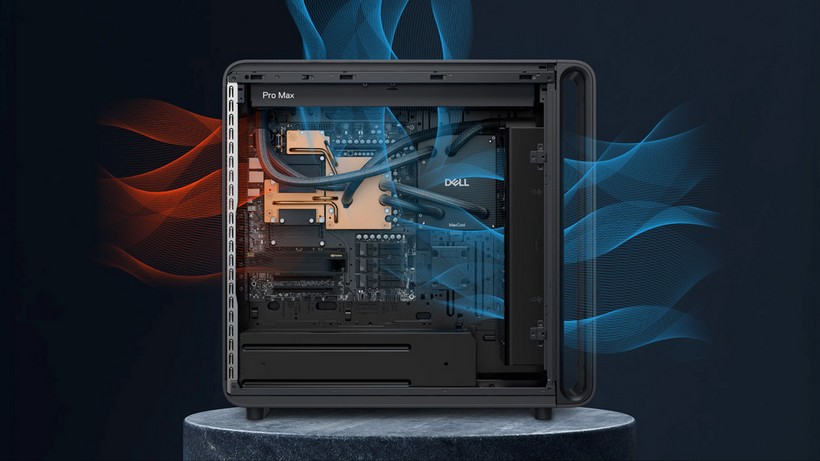
The manufacturer positions the Dell Pro Max GB300 as a tool for developers and enterprise teams that require substantial computing power without relying on cloud services. The main emphasis is on the ability to develop and run autonomous artificial intelligence systems within an organization’s own infrastructure while maintaining full control over sensitive data.
High performance comes with corresponding power requirements. The system is powered by a 1,600-watt power supply, which is closer to server-grade standards than to those of typical desktop computers. This underscores that the device is intended for professional workloads and sustained intensive operation.
For data storage, the workstation includes four solid-state drives with a capacity of 4 terabytes each. In total, this provides 16 terabytes of high-speed storage designed to handle large datasets and machine-learning projects.
Despite being formally categorized as a desktop system, such a workstation cannot be purchased through standard retail channels. The company does not publicly disclose the device’s price, instead inviting potential customers to request a commercial quotation directly—a common practice for solutions aimed at enterprise clients and research organizations.
Don't miss interesting news
Subscribe to our channels and read announcements of high-tech news, tes

Oppo A6 Pro smartphone review: ambitious

 0
0 
Creating new mid-range smartphones is no easy task. Manufacturers have to balance performance, camera capabilities, displays, and the overall cost impact of each component. How the new Oppo A6 Pro balances these factors is discussed in our review.
In-Ear headphones Active Noise Cancellation: how Oppo eliminate noise
0 
In-ear headphones remain one of the most popular form factors due to their lightweight design. However, this design is considered one of the most challenging to implement active noise cancellation (ANC). We’ll explain how Oppo solved this problem.
China Accelerates Government Transition from Windows to Linux

Chinese government agencies are accelerating their move away from Windows in favor of national Linux distributions. The transition, originally slated for February 2027, has been pushed up to late 2026 as part of a push for technological independence.
ZTE U25: 5G Connectivity for 32 Devices with 8-Hour Battery Life

The ZTE U25 is one of the company’s first portable routers to feature 5G RedCap support.