

A Cyberpunk 2077 fan created a jacket with flexible OLED screens and a Raspberry Pi
27.05.26
While big companies are just experimenting with the electronics of the future, enthusiasts are already assembling it with their own hands. Roboticist and cosplayer Zibartas has unveiled one of the most unusual fan projects inspired by Cyberpunk 2077 – a fully functional version of the NUSA Infiltrator jacket with integrated flexible OLED displays.
The main feature of the project is not in the visual similarity with the game original, but in the fact that the screen on the collar really functions as a full-fledged mini-display. What’s more, you can run games on it, display animations, and actually use it as a wearable computer interface straight out of the cyberpunk world.
Cosplay that turned into an engineering project
According to Zibartas, the aesthetics of Cyberpunk 2077 have long inspired him to create experimental devices and futuristic costumes. A few years ago, he already assembled a jacket with built-in LED lighting, but the new project became much more complex and closer to real high-tech clothing.
This time the goal was to recreate a rare white version of the NUSA Infiltrator jacket – one of the most famous pieces of gear from the game. But instead of a decorative imitation, the author decided to implement the main visual element literally: to embed a real screen in a high collar.
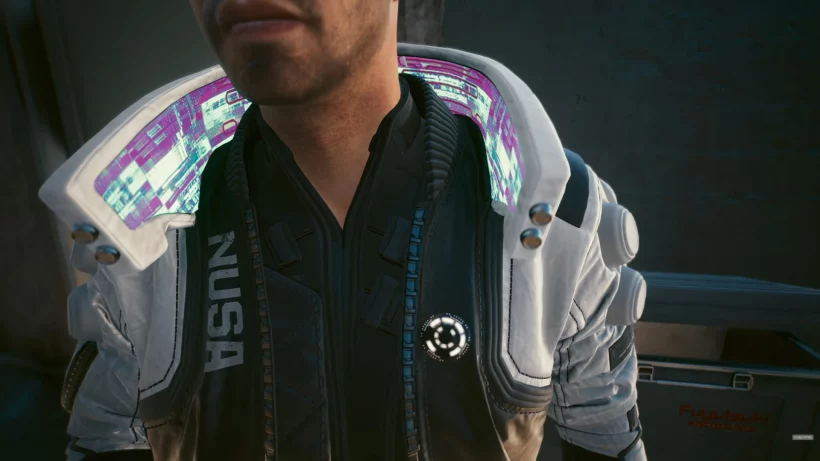
Flexible OLED displays cost $1,200
The project used four flexible OLED panels with a total cost of about $1,200. They form a futuristic screen on the collar of the jacket.
Such screens are extremely sensitive to loads and deformations, so their integration into clothing turned out to be much more difficult than the usual installation of electronics. Unlike rigid displays, flexible OLED matrices are easily damaged even by accidental bending or twisting.
This is exactly what happened during the first tests: one of the screens was broken when trying to install it in the curved structure of the collar, lined with EVA foam. The mistake cost the author approximately $300 and forced a complete revision of the design.
Engineering instead of a normal suit
After the failure, Zibartas developed a new rigid collar frame with special guide elements. Such a system keeps the OLED panels in a stable position and minimizes the risk of damage during movement.
In fact, the collar has turned into a separate engineering platform with a well-thought-out load distribution system.
Additional complexity was created by the weight of the structure and the need to secretly place electronics inside the clothes without destroying the visual aesthetics of the suit.
Why Raspberry Pi 4 turned out to be better than Raspberry Pi 5
Two Raspberry Pi Foundation Raspberry Pi 4 single-board computers are responsible for the operation of the entire system. At first, the enthusiast tried to use the more modern Raspberry Pi 5, but he encountered an unexpected problem: the hardware video decoders of the previous generation did a better job of processing content for OLED panels.
Synchronizing the screens turned out to be an equally difficult task. At first, the author used a gigabit network connection, but signal delays made the image unstable. As a result, it switched to hardware synchronization via GPIO pulses and custom Python scripts.
This made it possible to achieve almost simultaneous display of the image on all panels without noticeable lags.
Full-fledged system running with Linux inside
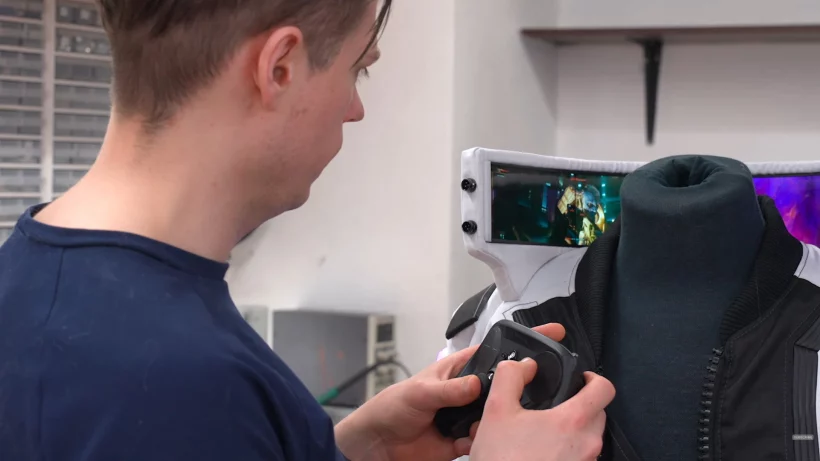
Two Raspberry Pi 4 and two power banks are hidden inside the jacket, providing about three hours of autonomous operation of the entire system.
Currently, the displays mainly reproduce pre-prepared animations, stylized as the interfaces of Cyberpunk 2077. However, thanks to Linux and HDMI support, the possibilities of the design are practically unlimited.
To prove it, Zibartas demonstrated launching Cyberpunk 2077 right on the collar of his jacket with the Steam Controller.
In fact, the project turned into not just a costume, but a real wearable computer, reminiscent of experimental gadgets from science fiction.
Cyberpunk is gradually becoming a reality
The Zibartas project is a good example of how quickly the line between cosplay, DIY electronics and full device technology is blurring.
A few years ago, such structures looked like a concept from a movie or an expensive CGI prop. Today, enthusiasts are already able to independently create clothes with built-in displays, autonomous power, mini-computers and interactive interfaces.
For now, it remains an experiment for fans and enthusiastic engineers, but the very idea of ”smart clothes” with flexible screens and a built-in computing system is no longer looking like a fantasy.
Don't miss interesting news
Subscribe to our channels and read announcements of high-tech news, tes

Oppo A6 Pro smartphone review: ambitious

 0
0 
Creating new mid-range smartphones is no easy task. Manufacturers have to balance performance, camera capabilities, displays, and the overall cost impact of each component. How the new Oppo A6 Pro balances these factors is discussed in our review.
Oppo Reno16 Pro 5G smartphone review: well-heeled
0 
Oppo Reno16 Pro 5G looks like a balanced smartphone, in which the manufacturer tried not to make a single characteristic the defining one. It has many advantages. Let’s tell you what
Humanoid Robots Smash Usain Bolt’s 100m World Record at Beijing Games

At the Beijing games, humanoid robots surpassed Usain Bolt’s world record in the 100-meter sprint, though not without crashes. Beyond running, the industry is focusing on autonomous skills vital for the future of manufacturing.
Samsung Exynos 2700 Spotted in Geekbench With Boosted 4.24 GHz Clock Speed
The upcoming flagship Samsung Exynos 2700 chipset has reappeared in the Geekbench database, this time showcasing significantly increased clock speeds. The engineering sample is closing the gap on Qualcomm’s offerings by utilizing advanced compute cores.