

The 2-in-1 format returns: Huawei Watch Buds 2 continues the experiment of embedding earbuds inside a smartwatch
17.04.26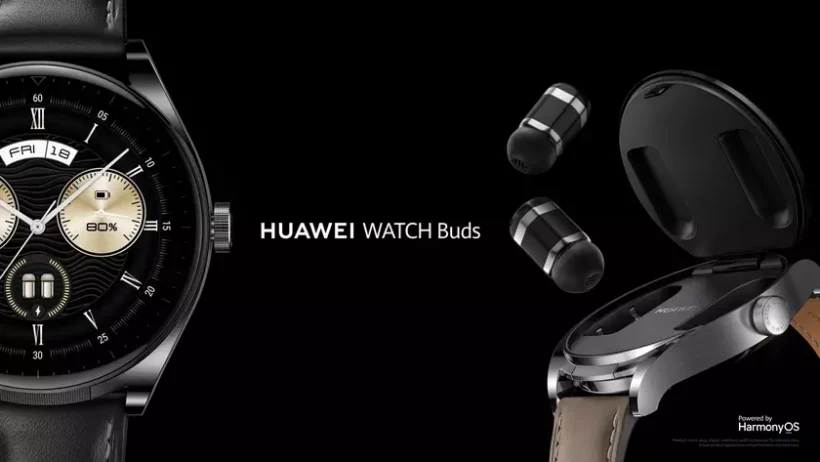
Huawei is preparing to revisit an unconventional hardware concept in the wearable segment. The company has confirmed that on April 20, alongside the new Pura smartphone lineup, it will introduce the Huawei Watch Buds 2 — the second generation of a device that combines a smartwatch and wireless earbuds within a single frame.
This is not merely an incremental update, but another attempt to establish a niche format that sits between convenience and structural trade-offs.
A dual-purpose design: smartwatch as an earbud case
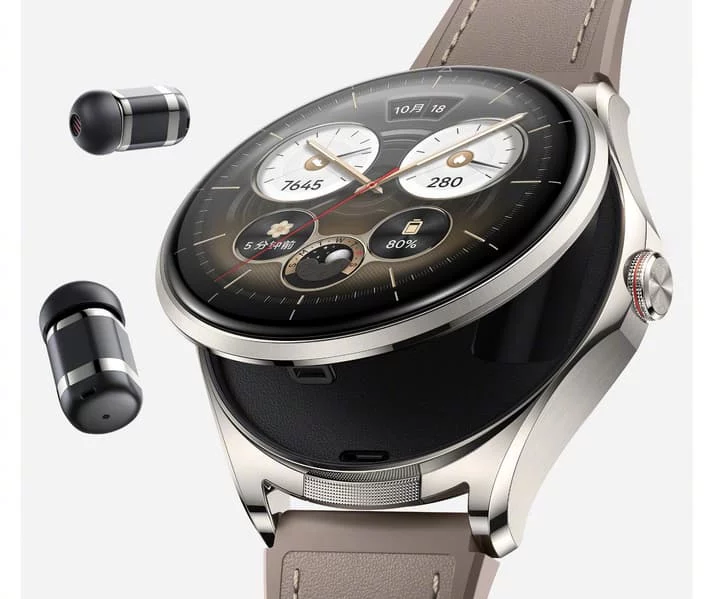
The core concept remains unchanged: the watch корпус doubles as both a charging dock and storage for the earbuds. Access is enabled through a mechanical mechanism — pressing a button causes the display to flip open, revealing an internal compartment.
Inside, two compact earbuds are secured with magnetic mounts. This approach eliminates the need for a separate charging case, but introduces constraints in terms of device thickness. As a result, the watch departs from the traditional slim smartwatch form factor, reflecting a compromise driven by functional integration.
Universal earbuds without left/right distinction
The earbuds retain an unconventional design language, featuring a compact cylindrical form with faceted elements. In the previous generation, they did not have fixed left/right channels: the system automatically detected orientation after insertion.
This logic is expected to carry over into the new version. At the same time, improvements are likely to focus on voice transmission quality and noise reduction algorithms, potentially enhanced with AI-based processing.
Smartwatch functionality with battery life trade-offs
Despite its hybrid nature, the device continues to function as a полноценный smartwatch with fitness tracking capabilities. Support for more than 80 sports modes is expected, along with standard activity monitoring features.
Battery life remains one of the key challenges. The first generation was rated for up to 30 hours of operation, but continuous charging of the встроенных earbuds effectively increased power consumption. This creates additional constraints, particularly in intensive usage scenarios.
Positioning dilemma: convenience versus form factor
Huawei is effectively testing whether users are willing to accept a bulkier device in exchange for eliminating the need to carry separate earbuds. Instead of the conventional combination of smartwatch and charging case, the company proposes a unified gadget, albeit with increased size and design complexity.
This format may appeal to users who prioritize device consolidation, but its broader adoption will depend on how these trade-offs are perceived in everyday use.
Awaiting full specifications
At this stage, Huawei has not disclosed detailed specifications or pricing for the Watch Buds 2. These details are expected to be revealed during the official presentation.
The second-generation device thus represents a continuation of Huawei’s exploration of hybrid hardware formats, where combining multiple functions within a single корпус requires balancing usability, battery life, and physical design constraints.
Don't miss interesting news
Subscribe to our channels and read announcements of high-tech news, tes

Oppo A6 Pro smartphone review: ambitious

 0
0 
Creating new mid-range smartphones is no easy task. Manufacturers have to balance performance, camera capabilities, displays, and the overall cost impact of each component. How the new Oppo A6 Pro balances these factors is discussed in our review.
In-Ear headphones Active Noise Cancellation: how Oppo eliminate noise
0 
In-ear headphones remain one of the most popular form factors due to their lightweight design. However, this design is considered one of the most challenging to implement active noise cancellation (ANC). We’ll explain how Oppo solved this problem.
Qualcomm Snapdragon C Challenges Intel in Budget Windows Laptops
Qualcomm has introduced the Snapdragon C. The chip features an 8-core Kryo CPU, Adreno graphics, and a Hexagon NPU, demonstrating a clear performance edge over the Intel N250.
Gears of War: E-Day Gets Limited Edition Xbox Controllers

Microsoft has unveiled two limited-edition Xbox controllers featuring a unique Gears of War: E-Day aesthetic.