

Solar eclipse on April 8, 2024. Where to see and how to be ready
03.04.24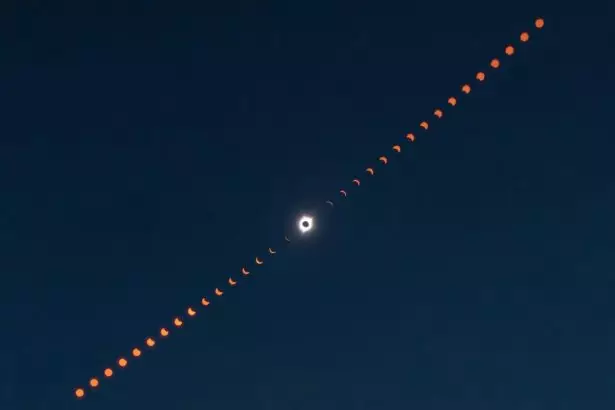
A composite image showing the progression of a total solar eclipse from partial to total to partial again. Photo: NASA/Aubrey Gemignani.
A solar eclipse occurs when the Moon is directly between the Earth and the Sun and casts its shadow on the planet.
On April 8 there will be a total solar eclipse. Astronomers say the eclipse is a repeat of the total solar eclipse that occurred on March 29, 2006.
The full phase can be observed on April 8 in Mexico, the USA and Canada. Partial phase of darkening will occur in North America, and in Western Europe and Central America.
In Ukraine, this eclipse will not be visible, but everyone will be able to watch it in real time thanks to NASA’s broadcast on YouTube. The peak of darkening will come at 20:18 Kyiv time.
The next eclipse will occur on October 2, 2024. It will take the form of an annular solar eclipse. It can be seen from the southern regions of Argentina and Chile, as well as Easter Island in the southeastern Pacific Ocean.
How to look at solar eclipse safely
Direct observation of the Sun during partial eclipse can be hazardous to vision due to aggressive solar radiation. It is recommended to avoid prolonged exposure to the sun without protection, limiting the time to 15 seconds.
Solar eclipse glasses and sunglasses are very different from each other. Sunglasses will not protect against potential eye damage caused by looking directly at the sun. Sunglasses are usually made from plastic, glass or polycarbonate lenses and tend to let in more sunlight.
Eclipse glasses use solar filters that consist of a black polymer, a resin containing carbon particles, or an aluminum-coated polyester film. Although these lenses are similar to sunglasses, these filtered versions reduce the amount of visible light transmitted to a much safer level for theeyes. Make sure there are no scratches, dents or bubbles on the lenses as these stains can reduce the effectiveness of the glasses.
Special glasses will last indefinitely if you take care of them. Make sure they are not damaged when put on, store them in a cool, dry place and make sure they are in good condition before use
Residents who will directly observe the eclipse should buy glasses in advance for viewing the eclipse while they still have the opportunity.
Let us remind you that observing a lunar eclipse does not require special protection, since the Moon does not emit its own light, but only reflects the sun’s rays.
All solar eclipses that will occur in the next 10 years:
- August 12, 2026
- August 2, 2027
- July 22, 2028
- November 25, 2030
- March 30, 2033
- March 20, 2034
Don't miss interesting news
Subscribe to our channels and read announcements of high-tech news, tes

Oppo A6 Pro smartphone review: ambitious

 0
0 
Creating new mid-range smartphones is no easy task. Manufacturers have to balance performance, camera capabilities, displays, and the overall cost impact of each component. How the new Oppo A6 Pro balances these factors is discussed in our review.
In-Ear headphones Active Noise Cancellation: how Oppo eliminate noise
0 
In-ear headphones remain one of the most popular form factors due to their lightweight design. However, this design is considered one of the most challenging to implement active noise cancellation (ANC). We’ll explain how Oppo solved this problem.
Xiaomi Unveils HyperOS 4: Glass-Look UI, AI Upgrades, and Faster Performance

Xiaomi has announced HyperOS 4, featuring a brand-new glass-themed interface and expanded AI capabilities. The update boosts app launch speeds by 18% and integrates a new AI assistant powered by the MiMo model.
Ford Debuts AI Assistant That Knows Everything About Your Car
Ford has introduced a new AI assistant that brings personalized vehicle diagnostics and support to Ford and Lincoln owners.