

Samsung Electronics crossed the $1 trillion mark: the market for memory and AI chips dramatically strengthened the company’s position
08.05.26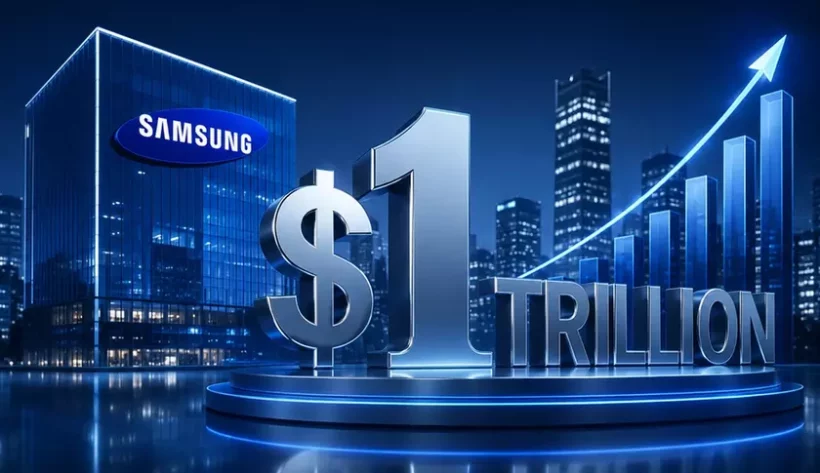
South Korean Samsung Electronics has for the first time entered the club of companies with a market capitalization of more than one trillion dollars. The rise in stock value came amid a sharp increase in demand for mentions for artificial intelligence systems, as well as the publication of record financial results for the first quarter of 2026.
The company’s shares rose more than 15% in trading, marking one of the biggest one-day jumps in Samsung’s history. Expectations of a further shortage of DRAM and HBM memory used in modern AI accelerators became an additional growth factor.
The memory market is once again at the center of a technological boom
The memory segment, which until recently was experiencing a difficult period of overproduction and falling prices, unexpectedly became one of the key growth drivers for the entire semiconductor industry. The spread of artificial intelligence systems, the learning of large language models and the growth of computing loads have led to a sharp increase in the demand for high-speed memory.
For Samsung, this became an opportunity to dramatically increase profitability. The company remains one of the world’s largest producers of DRAM and NAND memory, and is also actively expanding its presence in the HBM segment — high-speed memory used in AI accelerators and server solutions.
According to FactSet data, Samsung became the second Asian technology company after TSMC whose market value exceeded one trillion dollars.
Financial indicators broke records
The company’s latest quarterly report was one of the main factors behind the market rally. According to the results of the first quarter of 2026, Samsung’s operating profit grew more than eight times and reached about 57.2 trillion, which is equivalent to approximately 39.5 billion dollars.
The company’s revenue also set a new maximum — about 133.9 trillion. won or more than 92 billion dollars. It is noteworthy that Samsung’s profit for one quarter has already exceeded the company’s cumulative profit for the entire year of 2025.
Investors attribute this result primarily to the rise in memory prices and an increase in the supply of components for the AI infrastructure. Morningstar analysts note that the market continues to experience a shortage of DRAM and NAND chips, especially in the segment of solutions for data centers and machine learning accelerators.
HBM4 and cooperation with the AI industry
Additional interest of the market was caused by the news about the mass production of HBM4 memory. Earlier, Samsung announced that it was the first to start production of the sixth generation of high-speed HBM memory, which is considered one of the key components of future AI platforms.
Such chips are necessary for modern artificial intelligence accelerators, including new-generation architectures from NVIDIA. The high bandwidth of HBM memory allows you to speed up the processing of large data sets during the training of neural networks.
Against this background, the market began to see Samsung not only as a consumer electronics manufacturer, but also as one of the key infrastructure providers for the AI industry.
Possible contracts with Apple increased investor interest
Bloomberg’s reports on preliminary talks between Apple, Samsung and Intel Corporation were an additional factor of growth. According to sources, the possibility of manufacturing part of the chips for Apple devices at American enterprises is being discussed.
For Apple, such a move could be a way to reduce dependence on TSMC and diversify supply chains. For Samsung, this potentially means expanding its contract business and strengthening its position in the semiconductor manufacturing market.
Competition with SK Hynix persists
Despite the record figures, Samsung continues to compete with SK hynix in the most profitable segment of the market – HBM memory for AI accelerators. SK Hynix currently holds more than half of the global HBM market, while Samsung’s share is estimated to be around a quarter.
However, analysts note that Samsung is gradually reducing the technological lag and at the same time winning due to the high profitability of classic DRAM memory. Against the background of growing demand for server infrastructure, the profitability of this direction has also increased significantly in recent quarters.
Don't miss interesting news
Subscribe to our channels and read announcements of high-tech news, tes

Oppo A6 Pro smartphone review: ambitious

 0
0 
Creating new mid-range smartphones is no easy task. Manufacturers have to balance performance, camera capabilities, displays, and the overall cost impact of each component. How the new Oppo A6 Pro balances these factors is discussed in our review.
In-Ear headphones Active Noise Cancellation: how Oppo eliminate noise
0 
In-ear headphones remain one of the most popular form factors due to their lightweight design. However, this design is considered one of the most challenging to implement active noise cancellation (ANC). We’ll explain how Oppo solved this problem.
Samsung Galaxy S27 Ultra Camera Design Surfaces
A potential camera design for the Samsung Galaxy S27 Ultra has surfaced. The smartphone may adopt a protruding platform module, similar to Apple’s design language.
Garmin Fenix 9 Surface: Everything We Know Before the Official Launch

A Czech retailer has accidentally revealed the full Garmin Fenix 9 lineup, consisting of 18 different variants. The new models feature various case sizes, integrated satellite connectivity, and an official launch scheduled for August 25.