

From toilets to chips: how Toto unexpectedly found itself at the center of the AI boom
06.05.26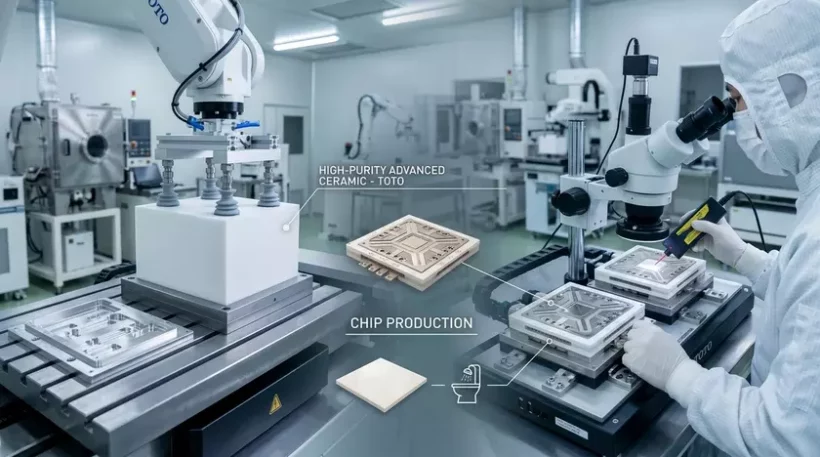
While the market is obsessed with finding the next Nvidia, real growth is increasingly happening in less obvious segments of the supply chain. Japan’s Toto – a company that has been associated with high-tech plumbing for decades – unexpectedly found itself among the beneficiaries of the global demand for AI chips. The jump in quotations by almost 18% in one day is not a speculative surge, but a reaction to a structural factor: in the age of the most sophisticated semiconductor technologies, materials and components that were almost never talked about before play a critical role.
Competencies that “ripened” in time
On the surface, Toto’s business looks far from microelectronics, but at the level of technology, the difference is not so great. For more than a hundred years, the company has been developing expertise in the field of ceramics, a material that in recent years has become a key element for high-precision manufacturing processes.
A special role is played by Advanced Ceramics, where Toto produces electrostatic clamps (ESC). These components hold the silicon wafers in the process of their processing – at the stages where the calculation goes to nanometers. In conditions of vacuum, high temperatures and aggressive chemical environments, ceramics must maintain stability, not deform and not introduce even minimal deviations.
With the complexity of AI chip architecture, the requirements for such details have increased dramatically. If previously the permissible errors were wider, today even microscopic fluctuations can lead to the marriage of a whole batch of plates. This is where Toto’s advantage comes in: its experience in controlling material properties has suddenly become in demand in an industry where the price of an error is measured in millions of dollars.
AI as a catalyst for re-evaluating supply chains
The growing interest in the company is connected not only with its current products, but also with a change in the very logic of the market. The boom in artificial intelligence has increased the strain on the entire chip manufacturing infrastructure from lithography to packaging.
Technologies like EUV-lithography require absolute stability: any vibrations, temperature jumps or surface microdefects make the process unpredictable. As a result, equipment manufacturers and factories are increasingly dependent on specialized material suppliers.
Investors began to take this factor into account. It announced capacity expansion in the high-tech ceramics segment and also demonstrated strong financial results. Collectively, this created the effect of a “reevaluation of the role” of the company: from a niche supplier, it turns into one of the elements of the critical infrastructure of the AI industry.
Why this is not a fluke
It is important that Toto did not change the strategy radically and did not try to integrate into the hype around AI artificially. Its transformation is the result of a long-term accumulation of competencies that simply coincided with the current needs of the market.
Unlike companies that build businesses around software solutions, Toto works at a deeper level—the level of the physical limitations of technology. And this level is becoming a bottleneck today: algorithms can develop faster than the production capabilities of the industry.
This makes suppliers of materials and components not just participants in the chain, but factors limiting or accelerating progress.
New logic of technological leadership
Toto’s story shows a broader trend: leadership in the AI age is defined not only by computing power or the quality of models, but also by the ability to ensure their production.
Companies that were previously considered “traditional” get a chance to take strategic positions if their expertise is relevant to new technological challenges. In this context, Toto is not an exception, but one of the first notable examples.
In fact, the market is beginning to rethink the value of industries that have long remained in the shadows. And if demand for AI continues to grow at its current rate, it is these “hidden players” who may be the key beneficiaries of the next phase of the technology race.
Don't miss interesting news
Subscribe to our channels and read announcements of high-tech news, tes

Oppo A6 Pro smartphone review: ambitious

 0
0 
Creating new mid-range smartphones is no easy task. Manufacturers have to balance performance, camera capabilities, displays, and the overall cost impact of each component. How the new Oppo A6 Pro balances these factors is discussed in our review.
Oppo Reno16 Pro 5G smartphone review: well-heeled
0 
Oppo Reno16 Pro 5G looks like a balanced smartphone, in which the manufacturer tried not to make a single characteristic the defining one. It has many advantages. Let’s tell you what
Anbernic RG 55G1 Surfaces as Brand’s First Snapdragon-Powered Handheld

The Anbernic RG 55G1 is the company’s first console to run on the Snapdragon G1 Gen 2 processor, featuring a 5.5-inch Full HD display and Hall Effect joysticks and triggers.
Squadron 42 Delayed to 2027 to Avoid GTA 6 Clash

Cloud Imperium Games has pushed the release of Squadron 42 to the second quarter of 2027 due to the launch of GTA 6.