

China is preparing an army of humanoids for industry and services
26.05.26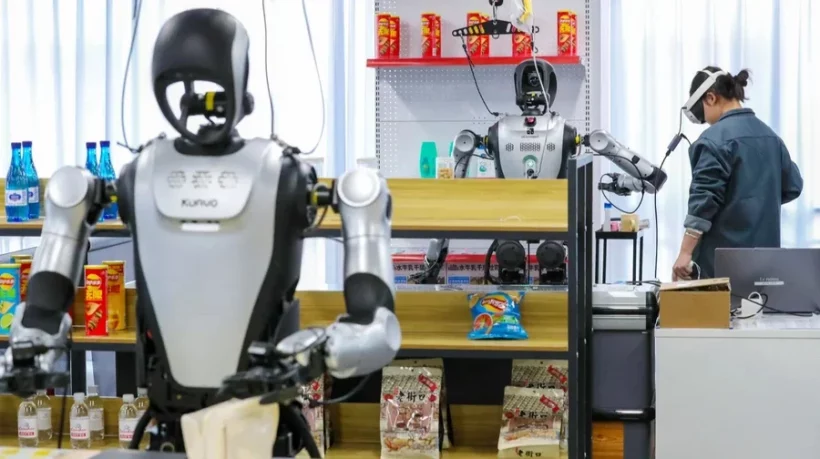
In China, the mass training of a new generation of labor has begun – humanoid robots for further work in factories, stores and the service sector. For accelerated adaptation, advanced specialized training centers are being created in the country, which have already been called “robot schools” in the local press. The first major public education platform was opened with the direct support of the Beijing government.
“Robot schools” are scientific research training hubs where Chinese technology corporations test and improve the firmware of AI-humanoids. At the landfills, specialists train the mechanisms for the widest range of practical tasks: from sorting logistics shipments and laying out goods on the shelves of retail chains to sanitary and hygienic cleaning, precise massage and delicate repair of sheet metal parts.
Robot under human control
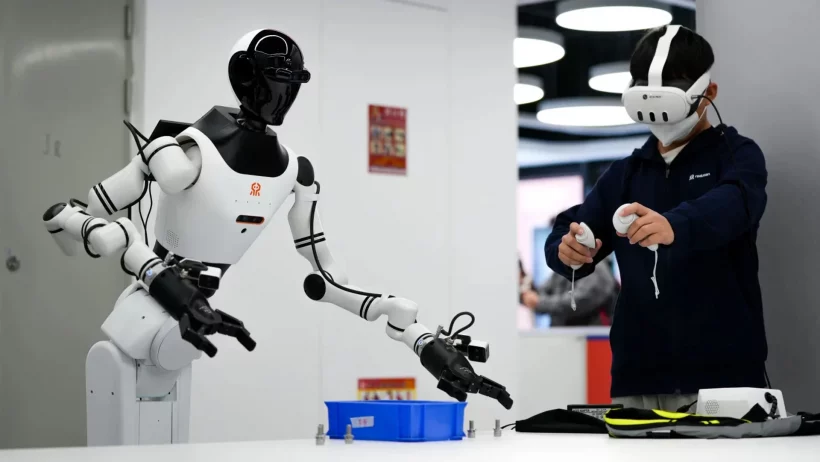
The process of physical programming of robots is complex and time-consuming. Since AI models initially do not have sensory and muscle reflexes of the human body, a qualified trainer is attached to each device.
The entire educational process looks like this:
- Operators physically coordinate the work of the machines, remotely controlling the joints with the help of specialized touch manipulators, stereo cameras and motion capture suits.
- Multiple (hundreds of times in a row) repetition of the same task generates the necessary digital data sample for the robot’s neural network.
- The gradually formed AI model accumulates feedback data from pressure sensors and gives the android the opportunity to perform this sequence completely independently.
Instructor Fudi Luo (a former art teacher) told reporters in an interview that her typical work schedule at the Beijing facility is the classic 8 hours of monotonous manual repetition of simple movements with her robot ward. Luo confirms that in the first days of training, any advanced humanoid does not have even a banal spatial understanding of objects, and any errors must be corrected by a human in manual mode.
Perspectives
The strategy of creating robot training centers is a fundamental part of the long-term industrialization plan of the Celestial Empire. Just as Beijing once made a highly successful economic expansion at the expense of the electric car market and domestic generative AI, so today the PRC is laying the technological foundation for monopolizing the global sphere of industrial and household robotics. According to internal research by analysts, the financial scale of the humanoid robot sector in China is capable of growing to a whopping 6 trillion yuan (approximately $837 billion) by the beginning of 2050.
From learning to practice
One-on-one robot trials are moving beyond the walls of landfills, with individual commercial factories and startups across Asia already piloting versions of the smart devices as bartenders, chefs, salespeople, and traffic controllers at intersections.
Although China’s global robotization indicators are developing dynamically, it is still too early to shift all the responsibilities onto the shoulders of iron assistants. The structural basis, touch finger systems and software still have weak stress resistance in critical contingencies and depend on remote human interventions. However, the existence of special training bases gives a clear signal to global corporations: the emergence of 100% commercially effective serial humanoid models is only a matter of time and investment.
Don't miss interesting news
Subscribe to our channels and read announcements of high-tech news, tes

Oppo A6 Pro smartphone review: ambitious

 0
0 
Creating new mid-range smartphones is no easy task. Manufacturers have to balance performance, camera capabilities, displays, and the overall cost impact of each component. How the new Oppo A6 Pro balances these factors is discussed in our review.
Oppo Reno16 Pro 5G smartphone review: well-heeled
0 
Oppo Reno16 Pro 5G looks like a balanced smartphone, in which the manufacturer tried not to make a single characteristic the defining one. It has many advantages. Let’s tell you what
Sony Xperia 10 VIII: Conservative Design Meets 5000 mAh Battery

Sony has introduced the Xperia 10 VIII, offering an improved OLED screen with 50% higher brightness and enhanced audio quality.
ChatGPT Locked Chats Spotted: PIN and Biometric Security

OpenAI is working on a Locked Chats feature that will allow users to hide individual ChatGPT conversations.