

Electronics Breakthrough: SiC Transistor Withstands Extreme Heat
25.08.26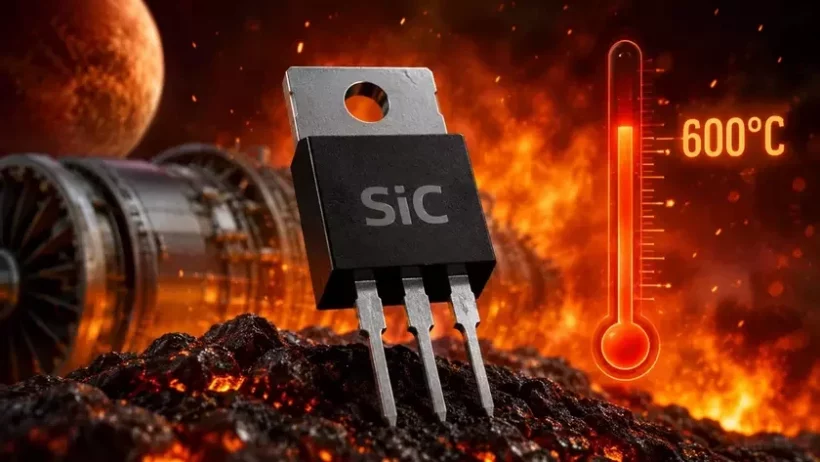
Researchers at Kyoto University have achieved a breakthrough in the field of semiconductors by creating a silicon carbide (SiC) transistor capable of functioning at extreme temperatures of up to 600 °C. This achievement significantly exceeds the capabilities of standard silicon electronics, which fail when temperatures exceed 250 °C.
SiC Transistor Features
Conventional silicon chips require effective cooling or must be kept away from heat zones, as critical temperatures for them begin after 250 °C. Silicon carbide naturally possesses high thermal stability, but creating stable, logic-based circuits with it had previously encountered technical difficulties. Japanese engineers utilized ion implantation—a standard industry doping method—which simplifies the integration of this development into existing mass production processes.
Technical Specifications

The Kyoto team developed an SiC JFET transistor with a “bottom-gate” architecture and a unique insulating structure. The primary challenge with traditional approaches is the “channeling effect,” where ions penetrate deeper than intended during implantation, distorting characteristics. The new design successfully compensates for this process.
Compared to previous experimental samples, where the gap between design and actual voltage exceeded 2 V, this new development shows outstanding precision: at 400 °C, the threshold deviation is less than 0.1 V. Dual insulation also effectively suppresses leakage currents that occur during critical substrate heating.
Applications
Potential applications include:
- Aerospace industry and jet engines.
- Industrial gas turbines.
- Exploration probes for the surface of Venus (where temperatures reach 460 °C).
Using electronics that can operate without active cooling systems under such intense heat will radically change the architecture of future high-tech machinery.
Outlook and Timeline
At this stage, the transistor is a “normally-on” device (it conducts current without a gate voltage). The scientists’ main task remains designing “normally-off” components and creating energy-efficient logic. The research findings were published on August 17, 2026, in the journal APL Electronic Devices. Future steps include testing the device’s durability and finding packaging solutions to protect connections in extreme conditions.
The development by the Kyoto scientists could be a crucial step toward creating electronics that no longer have to “fear” extreme heat. Transistors capable of working where ordinary microchips fail could eventually become part of engines, turbines, and even Venus exploration probes. While the technology still has a long way to go from a laboratory prototype to finished devices, the idea of electronics that can operate stably at 600 °C is no longer just science fiction.
Don't miss interesting news
Subscribe to our channels and read announcements of high-tech news, tes

Oppo A6 Pro smartphone review: ambitious

 0
0 
Creating new mid-range smartphones is no easy task. Manufacturers have to balance performance, camera capabilities, displays, and the overall cost impact of each component. How the new Oppo A6 Pro balances these factors is discussed in our review.
Oppo Reno16 Pro 5G smartphone review: well-heeled
0 
Oppo Reno16 Pro 5G looks like a balanced smartphone, in which the manufacturer tried not to make a single characteristic the defining one. It has many advantages. Let’s tell you what
Sony Xperia 10 VIII: Conservative Design Meets 5000 mAh Battery

Sony has introduced the Xperia 10 VIII, offering an improved OLED screen with 50% higher brightness and enhanced audio quality.
ChatGPT Locked Chats Spotted: PIN and Biometric Security

OpenAI is working on a Locked Chats feature that will allow users to hide individual ChatGPT conversations.