

Solidigm SSD has a record-breaking capacity of 122.88 TB. It costs $12,400
02.06.25
Solidigm, a subsidiary of South Korean SK Hynix, has announced the D5-P5336 solid-state drive with a record capacity of 122.88 TB. The device is aimed at the corporate segment, including tasks related to artificial intelligence, machine learning and storing large amounts of data.
According to the manufacturer, the SSD is designed for use in data centers and server systems II. Due to the high density of data storage, the device can replace nine standard racks, occupying only one, and also reduce the power consumption of such systems by 90%.
Main characteristics of Solidigm SSD:
- Interface: PCIe 4.0
- Form factor: U.2 (already available) and E1.L (in development)
- Memory type: 192-layer QLC NAND
- Endurance: 0.6 full writes per day (equivalent to 134.3 PB over 5 years)
- Random Read: Up to 930,000 IOPS
- Sequential Read: Up to 7.4 GB/s
The maximum capacity model costs $12,400.
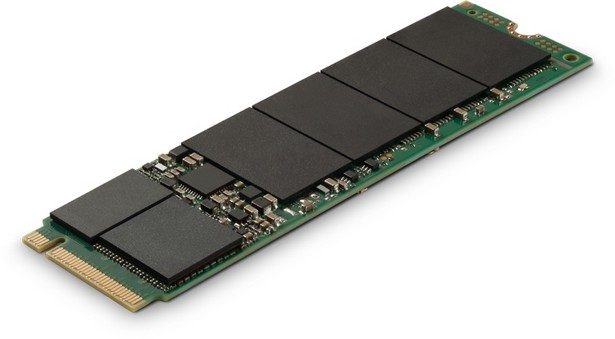
Against the background of PCIe 5.0 solid-state drives that transfer data at speeds of up to 15 GB/s, the new product from Micron looks like a real leap: the 9650 Pro model showed a result of 30.25 GB/s in sequential reading and writing. However, this is not a production device, but an engineering prototype.
The SSD prototype was spotted by journalists at the Astera Labs booth at Computex 2025. The drive was used to demonstrate the capabilities of the new generation PCIe 6.0 switches and software. The device is installed in a massive metal case and connected via an expansion card – the form factor is clearly different from the usual M.2 solutions.
The drive is currently at the EVT3 (Engineering Validation Test 3) stage – this is the stage at which performance tuning and compatibility testing are taking place. Ahead are the DVT (Design Validation) and PVT (Production Process Validation) tests. There is no talk of a consumer launch yet.
An important nuance: at the moment, no mass processor supports PCIe 6.0, and PCI-SIG certification is expected no earlier than the end of 2025. This means that even in theory, it is not yet possible to use such drives in real systems – there is a lack of compatible chipsets, motherboards and platforms.
The interest in the demonstration is not only due to the record speed. PCIe 6.0-based solutions allow data to be transferred between drives and other components directly without the participation of the central processor, thereby reducing the load on the system.
Don't miss interesting news
Subscribe to our channels and read announcements of high-tech news, tes

Oppo A6 Pro smartphone review: ambitious

 0
0 
Creating new mid-range smartphones is no easy task. Manufacturers have to balance performance, camera capabilities, displays, and the overall cost impact of each component. How the new Oppo A6 Pro balances these factors is discussed in our review.
In-Ear headphones Active Noise Cancellation: how Oppo eliminate noise
0 
In-ear headphones remain one of the most popular form factors due to their lightweight design. However, this design is considered one of the most challenging to implement active noise cancellation (ANC). We’ll explain how Oppo solved this problem.
The new Razer Huntsman V3 HE Magnetic: less speed, more capabilities

Razer introduces the Huntsman V3 HE Magnetic series with Hall Effect switches, support for Rapid Trigger, Snap Tap, and an 8000Hz polling rate.
CMF Clip Pro: Focusing on comfort, open design, and long battery life

The CMF Clip Pro launches as an open-ear design offering Hi-Res Audio support, fast charging, and up to 32.5 hours of total playback time.