

Samsung RGB OLEDoS Micro-OLED: a revolution of screens for AR and VR headsets
22.06.26
South Korean tech giant Samsung Display has demonstrated impressive innovations in the field of ultra-compact Micro-OLED screens for augmented reality (XR) devices. Samsung’s new RGB OLEDoS technology microdisplay became the central event of the presentation at the AWE USA 2026 exhibition, marking the future vector of the development of spatial monitors.
The development is an OLEDoS (OLED on Silicon) display, designed on a special silicon substrate to ensure a record density of elements. The fundamental technological difference of this microdisplay from analogues of previous years is the absolute rejection of the traditional scheme with built-in color filters. Samsung introduced an innovative structure with direct emission pixels. According to the official statement of the developer’s representatives, this decision multiplies the light output of the entire structure, which minimizes the energy consumption of the device, increasing the time of its autonomous use from one battery charge.
Features of the revolutionary OLEDoS panel
The key exhibit at the Samsung Display stand was an advanced 1.3-inch micro-display panel with the following most important parameters:
- Structure type: RGB OLEDoS with direct emission (no filters);
- Diagonal: 1.3 inches;
- Record peak brightness: 40,000 nits.
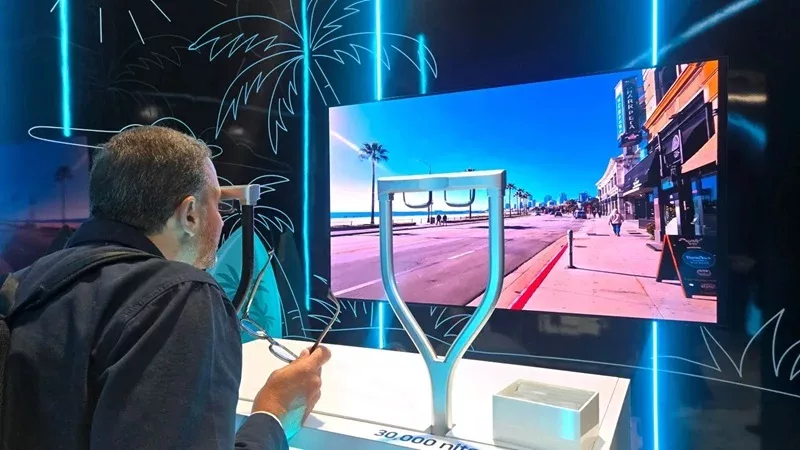
Incredibly high brightness is extremely important when using wearable mixed and augmented reality (AR/MR), as the virtual image is projected on top of the user’s real environment and must effectively compete with bright sunlight or saturated artificial room light. To prove the unprecedented optical parameters of the matrix in practice, Samsung representatives equipped a completely isolated darkened space with a spectacular composition called “The Big Dipper”. Seven screens participated in the collective constellation. Only two of them were experienced RGB OLEDoS displays of ultra-high brightness – the difference in color richness, backlight strength and gamut depth was obvious to everyone present.
Development of technology

The company’s engineers immediately created a whole range of related developments to meet the requirements of the modern technological market:
- A super-compact 0.62-inch display modification that produces a peak brightness of up to 30,000 nits. It is adapted for the most inconspicuous and stylish “smart” glasses of augmented reality;
- MR (Mixed Reality) headset as a live working mock-up of placing such panels inside the helmet;
- Unique displays of a new type (stretchable display), which are stretchable, the physical plane of which can be deformed in space without a drop in broadcast quality;
- 3D panels based on light field principles. This format is able to project a complete and high-quality volume illusion for the viewer, visible to the human eye even without wearing stereo glasses.
Release date and price
As the Samsung Display products shown are engineering concepts at this time, there are no details on the retail price of these parts. The supplier has not yet announced official timelines for the transition of these parts to serial factory production. The biggest players in the XR market are already looking at OLEDoS as the future standard for equipping consumer and specialized electronics.
Don't miss interesting news
Subscribe to our channels and read announcements of high-tech news, tes

Oppo A6 Pro smartphone review: ambitious

 0
0 
Creating new mid-range smartphones is no easy task. Manufacturers have to balance performance, camera capabilities, displays, and the overall cost impact of each component. How the new Oppo A6 Pro balances these factors is discussed in our review.
Oppo Reno16 Pro 5G smartphone review: well-heeled
0 
Oppo Reno16 Pro 5G looks like a balanced smartphone, in which the manufacturer tried not to make a single characteristic the defining one. It has many advantages. Let’s tell you what
iPhone 18 Price Hike Surfaces: $100 Increase Expected

It has emerged that the iPhone 18 lineup will likely see a price hike. Apple is forced to increase costs by $100 due to rising prices for RAM and NAND memory.
Apple Debuts M6 and M5 Ultra Chips for Pro Workflows
Apple has introduced the revolutionary M6 and M5 Ultra processors. The M6 utilizes a 2nm architecture with advanced AI capabilities, while the M5 Ultra stands as the company’s most powerful solution for 8K video production.