

Orbital computing moves into practice: Kepler deploys a commercial GPU network in space
16.04.26
Canadian company Kepler Communications is gradually shifting the concept of space-based data centers from theory into practical deployment. The company reports that its orbital computing infrastructure is already operating commercially and serving 18 clients. Among the newest is startup Sophia Space, which plans to test its software stack for distributed computing directly in space using Kepler’s satellite network.
From space data center concepts to a distributed orbital architecture
For years, processing data in orbit remained a largely theoretical idea rather than an engineering reality. Kepler is now gradually building a working model in which computation and data transfer occur not only between satellites but also within a unified orbital network.
In January, the company deployed a cluster of 10 satellites linked by laser communication channels. These satellites host around 40 NVIDIA Orin processors, effectively forming a distributed edge computing infrastructure in space. Unlike traditional terrestrial data centers, computing resources are distributed across autonomous nodes connected via high-speed optical links.
GPUs in space as a constrained resource and an early-stage market
Despite growing interest in orbital computing, space-based GPU infrastructure remains highly limited. Current deployments are still experimental and pilot-scale, forming the foundational architecture of a future market.
Industry experts suggest that fully scaled space data centers comparable to large cloud platforms are unlikely to emerge before the 2030s. Until then, the primary use case will be on-orbit data processing at the moment of collection, eliminating the need to transmit large datasets back to Earth for analysis.
Kepler as an infrastructure layer for space services
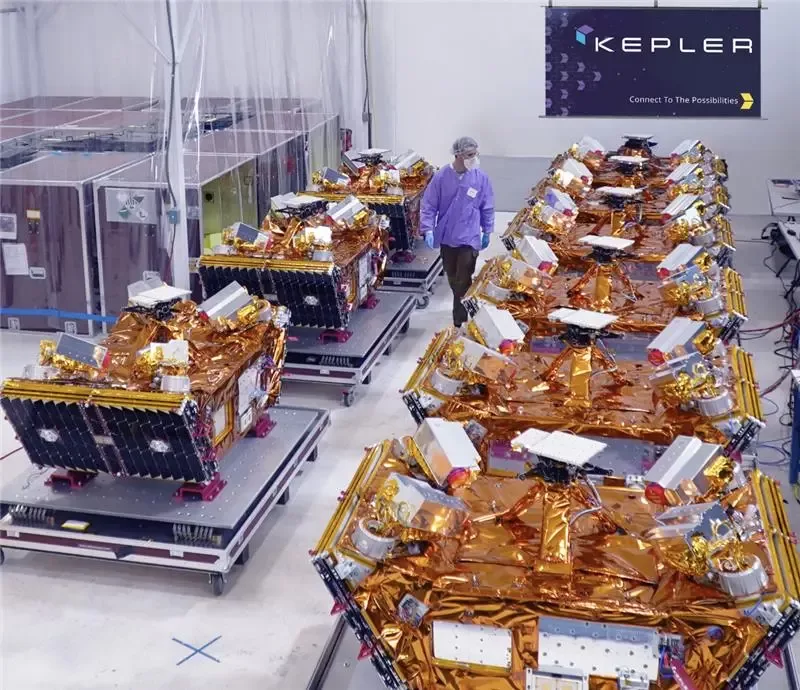
Kepler emphasizes that it does not aim to replicate traditional data center models. Instead, it positions itself as a network infrastructure layer enabling data exchange and computing functions across different space systems.
The company’s leadership describes this architecture as an intermediate layer between satellites, aircraft, and ground-based systems. This approach reframes the orbital network not as a single computing center, but as a distributed platform for a range of tasks — from sensor data processing to real-time autonomous system support.
Testing Sophia Space’s orbital software stack
The partnership with Sophia Space is focused on validating the application layer of this infrastructure. The startup is developing computing modules with passive cooling, a critical requirement in space where traditional thermal management systems are highly constrained.
As part of the joint experiment, Sophia plans to upload its operating system to a Kepler satellite platform and run it across several GPUs distributed between two spacecraft. While such operations are routine in terrestrial data centers, performing them in orbit represents a stress test for the entire computing model.
For Sophia, this also serves as a technology validation step ahead of its planned satellite launch scheduled for late 2027.
Fault tolerance and distributed orbital network logic
Kepler’s architecture accounts for the possibility of satellite failures or temporary communication loss. In such cases, computational workloads are automatically redistributed across remaining network nodes.
This transforms the satellite constellation into a dynamic computing system where the failure of a single element does not disrupt overall operations. Essentially, it is a software-defined network that adapts in real time to changing conditions.
The company notes that combining AI infrastructure with optical communication channels enables data processing directly in orbit, reducing reliance on Earth-based transmission.
Orbit as a site for primary data processing
One of the key use cases for orbital computing is on-site data processing. Instead of transmitting large datasets to Earth for analysis, systems process data where it is generated.
This is particularly relevant for modern sensor systems, including synthetic aperture radar, which produces extremely large data volumes. As a result, there is increasing demand for architectures capable of filtering, analyzing, and interpreting signals directly onboard satellites.
Potential customers include government agencies, particularly the U.S. defense sector, which is developing satellite-based early warning and tracking systems.
Scaling and the economics of always-on GPU utilization
From a business perspective, Kepler focuses on distributed GPUs that operate continuously rather than isolated high-performance nodes with uneven utilization. According to the company, this approach improves resource efficiency in space environments.
Looking ahead, Kepler plans to scale through regular satellite launches. The next phase is scheduled for early 2028 and will introduce faster optical links up to 100 Gbps, as well as higher onboard computing density.
As a result, orbital infrastructure is gradually evolving into a new type of distributed computing network, where data processing is not a secondary function but a core operational capability of satellite systems
Don't miss interesting news
Subscribe to our channels and read announcements of high-tech news, tes

Oppo A6 Pro smartphone review: ambitious

 0
0 
Creating new mid-range smartphones is no easy task. Manufacturers have to balance performance, camera capabilities, displays, and the overall cost impact of each component. How the new Oppo A6 Pro balances these factors is discussed in our review.
Oppo Reno16 Pro 5G smartphone review: well-heeled
0 
Oppo Reno16 Pro 5G looks like a balanced smartphone, in which the manufacturer tried not to make a single characteristic the defining one. It has many advantages. Let’s tell you what
Danger in the Driver’s Seat: Waymo and Zoox Robotaxis Surface with Brake-Related Injuries

Dozens of robotaxi test drivers have been injured due to flaws in autonomous driving systems. The primary culprit is erratic emergency braking, which has led to significant neck and back injuries.
Samsung Galaxy Book6: An Affordable Laptop With 25-Hour Battery Life

Samsung has introduced a new affordable version of the Galaxy Book6. The device features Intel Core 3 or Core 5 processors, up to 16GB of RAM, up to 1TB of storage, and a rated battery life of up to 25 hours.