

Nano Banana 2 in Google Earth failed verification: a wave of realistic fakes
08.08.26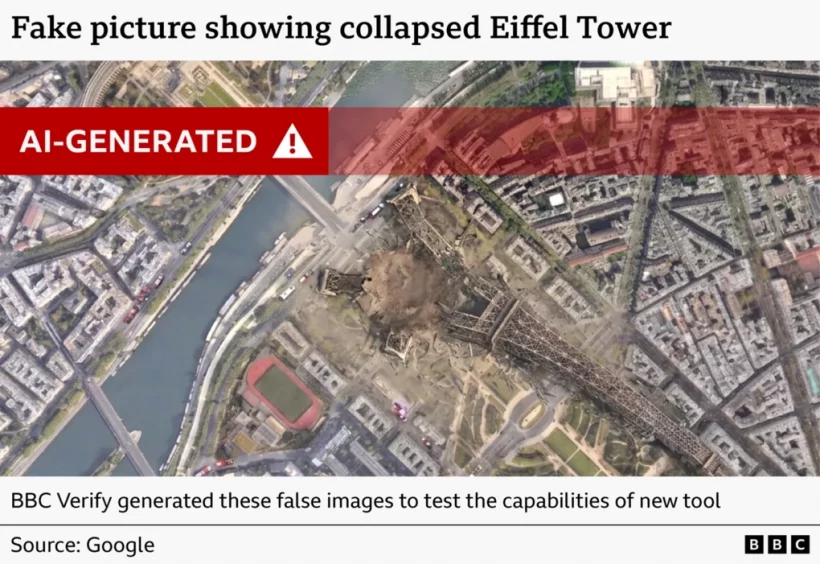
Google has suspended the rollout of its new image generation feature in Google Earth just a few dozen hours after launch. The decision came after users demonstrated the ability to create fake satellite imagery that was nearly indistinguishable from genuine Earth observation data. Following the first reports, the company announced that the tool would remain unavailable until its safety mechanisms undergo significant improvements. The story was first reported by BBC.
The incident has sparked widespread concern among digital security experts, as it marks the first time generative artificial intelligence has been so deeply integrated into a mapping platform relied upon by journalists, researchers, investigators, and analysts around the world.
A Wave of Fake Satellite Images
Nano Banana 2 allowed users to generate images directly within Google Earth. Despite built-in safeguards, it quickly became apparent that the system could visualize fictional events in a way that closely resembled authentic satellite imagery.
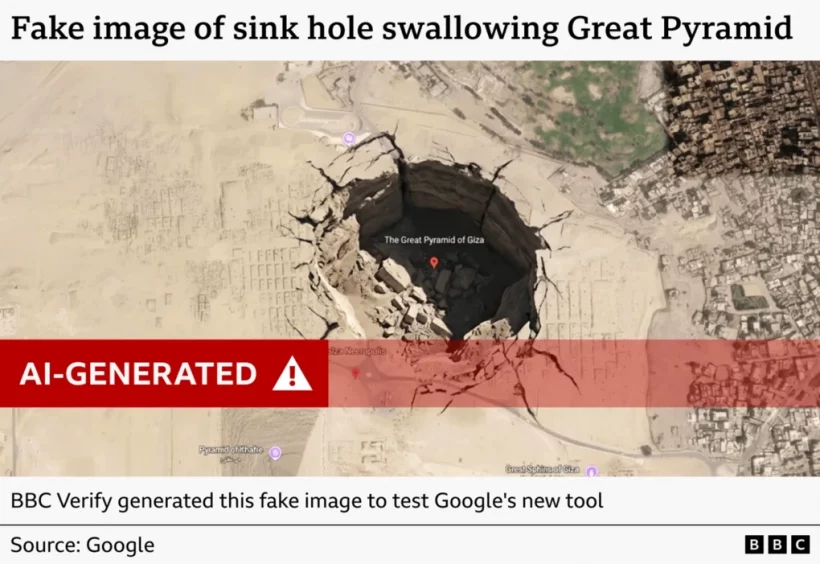
BBC Verify journalists tested the feature themselves. During their experiments, they successfully generated images depicting Russian armored vehicles supposedly positioned in Kyiv, the Eiffel Tower in ruins, and a massive sinkhole near the Pyramids of Giza.
The generated images appeared seamlessly within the familiar Google Earth interface, making them appear highly credible. To an average user, they were virtually indistinguishable from genuine satellite photographs.
Safety Filters Proved Easy to Circumvent
Google implemented content filters designed to block the generation of images related to warfare, disasters, and other potentially harmful scenarios. However, testing revealed that these restrictions were effective only when users submitted straightforward or obvious prompts.
By slightly rewording requests and avoiding explicit references to prohibited subjects, users were able to bypass the safeguards and generate unrestricted images.
This loophole quickly enabled the large-scale creation and online distribution of fabricated satellite imagery.
A New Tool for Large-Scale Disinformation
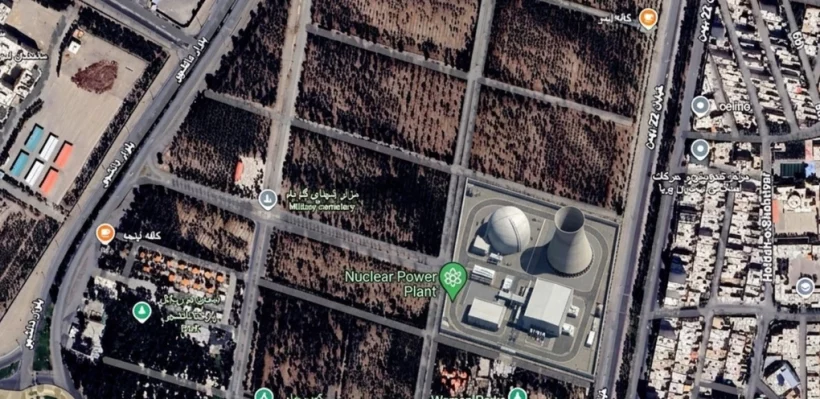
Artificial intelligence and digital disinformation researcher Henk van Ess also conducted an independent series of experiments using Nano Banana 2.
He generated images of a fictional nuclear power plant in Iran, a refugee camp along the U.S.–Mexico border, and a hospital in the Gaza Strip with what appeared to be a freshly formed impact crater nearby.
According to the researcher, the greatest risk lies not only in the realism of the generated images. More concerning is the fact that they are automatically linked to real geographic coordinates. As a result, users are presented not simply with AI-generated artwork but with fabricated imagery embedded directly into an authentic mapping environment.
Experts warn that this capability significantly increases the potential for information manipulation, particularly during armed conflicts, natural disasters, humanitarian emergencies, and political crises.
Even Google’s Own Detection Tools Struggled
Google says every AI-generated image receives an invisible SynthID digital watermark designed to verify its origin during later analysis.
The company also recommends using Gemini and Google Lens to assess suspicious images.
However, independent testing raised questions about the effectiveness of these safeguards.
According to BBC Verify, several third-party AI detection services failed to recognize many images generated by Nano Banana 2 as artificial.
Even more revealing was an experiment involving Gemini itself. Journalists managed to create a scenario in which Google’s own chatbot identified several AI-generated satellite images as authentic, failing to detect any signs of synthetic generation.
The findings suggest that current identification methods do not yet provide reliable protection—even within Google’s own ecosystem.
Google Suspends the Feature
Following the initial reports, Google quickly disabled access to Nano Banana 2.
The company stated that its engineers are already working on additional safeguards intended to prevent the creation of images that could be used to spread false information. Until those improvements are complete, the image generator will remain unavailable.
Google has not announced a timeline for the feature’s return.
Experts Warn of a Growing Challenge
Until recently, satellite imagery was widely regarded as one of the most trustworthy forms of visual evidence. It is routinely used by journalists, research institutions, human rights organizations, intelligence analysts, and investigators documenting war crimes.
The emergence of generative AI models capable of producing satellite images that are nearly indistinguishable from reality could make information verification significantly more difficult. Whereas manipulated photographs were once the primary source of visual deception, entire mapping platforms can now become vehicles for fabricated evidence.
Experts believe the continued evolution of these technologies will require entirely new approaches to digital verification. Otherwise, public trust in satellite imagery as one of the world’s most reliable sources of visual documentation may gradually erode.
The Nano Banana 2 incident demonstrates that modern generative AI is already capable of producing imagery convincing enough to undermine confidence even in satellite maps, long regarded as one of the most reliable forms of visual evidence. In the years ahead, developers of such platforms will likely need to invest as heavily in verification and safety systems as they do in advancing generative AI itself.
Don't miss interesting news
Subscribe to our channels and read announcements of high-tech news, tes

Oppo A6 Pro smartphone review: ambitious

 0
0 
Creating new mid-range smartphones is no easy task. Manufacturers have to balance performance, camera capabilities, displays, and the overall cost impact of each component. How the new Oppo A6 Pro balances these factors is discussed in our review.
Oppo Reno16 Pro 5G smartphone review: well-heeled
0 
Oppo Reno16 Pro 5G looks like a balanced smartphone, in which the manufacturer tried not to make a single characteristic the defining one. It has many advantages. Let’s tell you what
Huawei Readies Slimmer Watch D3 and New FreeBuds Neo
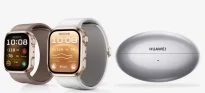
Huawei has teased the Watch D3 smartwatch with blood pressure monitoring and the new FreeBuds Neo earbuds. The official announcement is scheduled for September 2.
Made in Germany: Does the Gigaset GS6 Pro Live Up to the Hype?

The Gigaset GS6 Pro bets on German engineering and repairability. We explore what this status really means and whether it holds up against the competition.