

Humanoid Robots Smash Usain Bolt’s 100m World Record at Beijing Games
24.08.26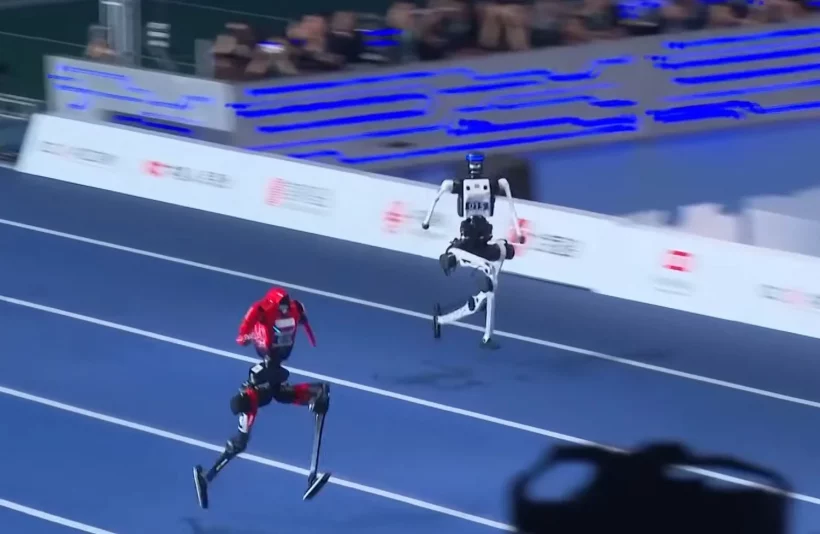
From August 22 to 26, Beijing is hosting the World Humanoid Robot Games. A new world record has already been set: the humanoid robot Tiangong Ultra completed the 100-meter dash in 9.39 seconds. This result officially beats the historic record set by Usain Bolt in 2009 (9.58 seconds). Despite the impressive speed, the competition has exposed serious flaws: the robots lack a proper mechanism to stop after crossing the finish line.
More Than Just Running
The competition demonstrated not only the physical superiority of machines over humans but also the incredible pace of progress. Back in 2025, Tiangong Ultra took 21.50 seconds to complete the same distance—the time has been cut by more than half in just one year. Second place went to Honor Lightning, which finished with a time of 9.47 seconds. Although Lightning recorded even better times in test runs (9.32 seconds) and set new standards in half-marathons, both robots had to rely on special barriers to brake on the track.
| Parameter | 2025 Games (Debut) | 2026 Games (Current) |
|---|---|---|
| Dates | August 15–17, 2025 | August 22–26, 2026 |
| Location (Beijing) | Bird’s Nest and Ice Ribbon | National Speed Skating Oval |
| Number of Robots | Over 500 units | 2,056 robots |
| Number of Teams | 280 teams | 666 teams from 16 countries |
| Total Disciplines | 26 types | 51 disciplines |
| Total Matches | 487 | 1,301 matches |
How These Games Are Changing the World
For the average person, these achievements mean that the line between a highly specialized machine and a general-purpose assistant has finally blurred. The adaptation technologies being refined on sprint tracks will eventually form the basis for service robots: couriers, medical assistants, or domestic operators capable of navigating the chaotic environment of a modern city.
Furthermore, it is possible that in the future, such robotic sports competitions will become as popular globally as the Olympic Games or world championships for human athletes.
FAQ
How dangerous are these races for the robots themselves?
Equipment failure is common—during the tournament, one participant, Honor Lightning, lost stability and required evacuation on a stretcher. Emergency braking systems remain the weakest link in current humanoid models.
Is the competition limited to running?
No, the athletic portion is only a small fraction of the 51 events. Robots compete in strength exercises, martial arts, and professional skills such as cable handling.
How many participants are in the competition?
In 2026, 2,056 robots from 666 teams representing all continents are taking part in the tournament.
Why is China actively promoting this field?
The development of humanoid robots has been identified by China as a key strategy for automating heavy industry, logistics, and the consumer economy, as well as for promoting its own technologies.
Don't miss interesting news
Subscribe to our channels and read announcements of high-tech news, tes

Oppo A6 Pro smartphone review: ambitious

 0
0 
Creating new mid-range smartphones is no easy task. Manufacturers have to balance performance, camera capabilities, displays, and the overall cost impact of each component. How the new Oppo A6 Pro balances these factors is discussed in our review.
Oppo Reno16 Pro 5G smartphone review: well-heeled
0 
Oppo Reno16 Pro 5G looks like a balanced smartphone, in which the manufacturer tried not to make a single characteristic the defining one. It has many advantages. Let’s tell you what
RAM Crisis: Nvidia AI Servers Face 15% Price Hike
Nvidia has warned its largest clients of an upcoming price increase for AI servers due to a shortage of memory components. The cost hike will affect systems based on Vera Rubin and Grace Blackwell chips.
Xiaomi Smart Band 11 Active Debuts With 21-Day Battery Life
Xiaomi has officially released its new budget-friendly fitness tracker, the Smart Band 11 Active, for the global market. The device sports a 1.47-inch screen, essential health sensors, and impressive battery life.