

ZTE G5 Pro: a home router that turned out to be more powerful than many office networks
26.05.26
While most users are still debating whether they need Wi-Fi 7 and whether it makes sense to overpay for 5G, Chinese manufacturers are already actively assembling the infrastructure for the next stage of network development. The ZTE company is preparing for release the flagship router ZTE G5 Pro – a device that looks like an attempt to turn a home Internet center into a full-fledged communication hub of the future.
The novelty received support for 5G-Advanced (5.5G), Wi-Fi 7, eSIM, multi-gigabit Ethernet ports and external antennas. In fact, before us is not just a router for distributing Wi-Fi, but a device designed for an era where mobile networks gradually begin to compete with wired Internet not only in terms of convenience, but also in terms of performance.
5.5G
The main focus of the ZTE G5 Pro is support for the 5G-Advanced standard, which the industry promotes under the name 5.5G. It is an intermediate stage between the current 5G and future sixth generation networks.
If conventional 5G was primarily a marketing speed bump, 5.5G is already trying to solve the real limitations of today’s mobile networks: infrastructure load, instability under high load, and latency issues.
Theoretically, the router is capable of providing a download speed of up to 4.29 Gbps. In practice, such numbers will remain a demonstration of capabilities for the time being, as the operators’ infrastructure is still far from such a level. However, the very fact of the appearance of consumer devices with a similar reserve of power shows how quickly the market is moving towards wireless Internet.
It is especially important that 5.5G emphasizes more than speed. Minimal delays and channel stability are becoming increasingly critical for modern services. This applies to cloud gaming, VR services, 8K video streaming, remote workstations, and artificial intelligence systems that require the constant transfer of large amounts of data in real time.
In fact, ZTE is not creating a router for current usage scenarios, but for those that will become mainstream in a few years.
eSIM instead of plastic and a bet on connection flexibility
One of the most striking features of the device is full eSIM support. This means that the router can connect to a mobile operator without a physical SIM card.
This is gradually becoming the new standard for the network equipment market, as eSIM makes it much easier to change operators, set tariffs and connect devices in different regions.
But ZTE understands another problem of mobile Internet: even the most modern standards are useless where the signal is weak. That is why the G5 Pro received TS-9 connectors for connecting external antennas.
Such a solution makes the device especially interesting for country houses, small offices, cottages and remote facilities, where wired Internet is either absent or works unstable. In some scenarios, a properly configured external antenna can increase the speed of the mobile connection many times over.
Almost “computer” processors
Modern routers look less and less like simple network boxes and more and more turn into specialized mini-servers. That is why the ZTE G5 Pro has a processor manufactured using a 4-nanometer process.
The chip received four cores with a frequency of 2.2 GHz – and such performance no longer looks excessive. Wi-Fi 7 requires significantly more computing than previous generations of wireless networks.
The router simultaneously manages several communication bands, distributes the load between devices, processes a huge flow of data, optimizes delays and supports high-speed information transmission for dozens of connected gadgets at once.
In fact, a home router is gradually turning into a separate computing node within the digital ecosystem of an apartment or office.
Wi-Fi 7: taking wireless networks to a new level
Wi-Fi 7 support here isn’t just a marketing point in the specs. The new standard was created for Wednesday, where dozens of devices work simultaneously: smartphones, laptops, game consoles, surveillance cameras, TVs, VR headsets and smart home systems.
The main advantage of Wi-Fi 7 is not only an increase in peak speed, but also more efficient work in congested networks. The difference will be especially noticeable in apartment buildings and offices, where a huge number of neighboring networks creates constant interference.
That is why routers of the new generation receive more and more powerful cooling, productive processors and complex traffic distribution systems.
Wired connection is not going anywhere
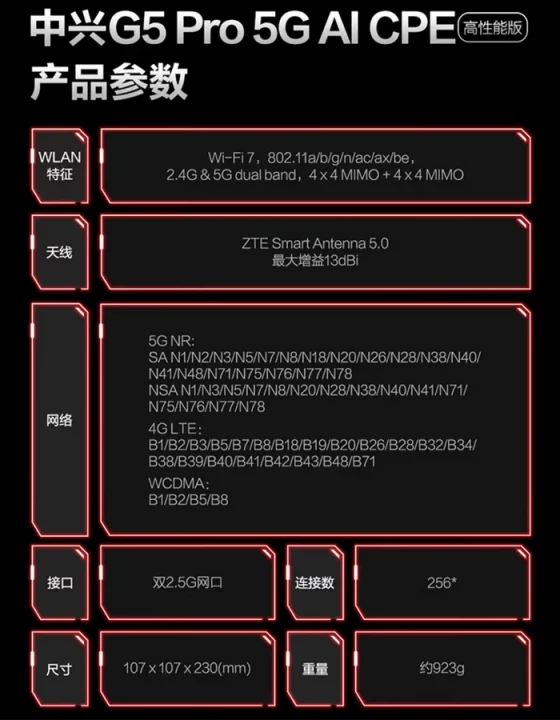
Despite the development of wireless technologies, ZTE has not abandoned the leading infrastructure. The G5 Pro is equipped with two 2.5G Ethernet ports.
For owners of NAS storage, gaming PCs, workstations and home media servers, a wired connection is still the most stable data transfer option.
This is especially true for local networks where work with large files is required — for example, when editing video, backing up, or streaming content in high resolution.
NFC and simplifying everyday use
The manufacturer paid special attention to the little things that affect the user experience. An NFC module is placed on the case for quickly connecting smartphones to a Wi-Fi network.
Now, instead of entering a long password, simply attach the device to the router. Such functions are gradually becoming a mandatory part of premium network devices, especially against the background of the growing number of home gadgets.
Cost
ZTE G5 Pro sales will start in China on May 28. The cost of the device will be about 2,099 yuan – approximately $310.
For a router with support for Wi-Fi 7, 5.5G, eSIM and a multi-gigabit wired network, the price looks quite low, especially if you consider that many technologies for which the device was created are still just beginning to be implemented on a large scale.
In essence, ZTE G5 Pro is an attempt to prepare the home infrastructure in advance for the moment when the mobile Internet will finally cease to be perceived as a backup option and will begin to fully compete with traditional wired networks.
Don't miss interesting news
Subscribe to our channels and read announcements of high-tech news, tes

Oppo A6 Pro smartphone review: ambitious

 0
0 
Creating new mid-range smartphones is no easy task. Manufacturers have to balance performance, camera capabilities, displays, and the overall cost impact of each component. How the new Oppo A6 Pro balances these factors is discussed in our review.
Oppo Reno16 Pro 5G smartphone review: well-heeled
0 
Oppo Reno16 Pro 5G looks like a balanced smartphone, in which the manufacturer tried not to make a single characteristic the defining one. It has many advantages. Let’s tell you what
Iron Man Game Trailer Surfaces: Combat and Flight Mechanics Detailed

A gameplay trailer for the highly anticipated Iron Man game from EA and Motive Studios has leaked. The two-and-a-half-minute video showcases Tony Stark’s abilities and combat mechanics.
Haptic Feedback in Smart Rings: The Future of Wearable Interaction

Integrating a vibration motor into the RingConn Gen 3 changes the significance of the ring as a wearable device. We examine why haptic signals are the next step in smart ring evolution, what the feature can currently do, and the technical challenges involved.