

Samsung began shipping samples of advanced HBM4E memory with increased speed and capacity
29.05.26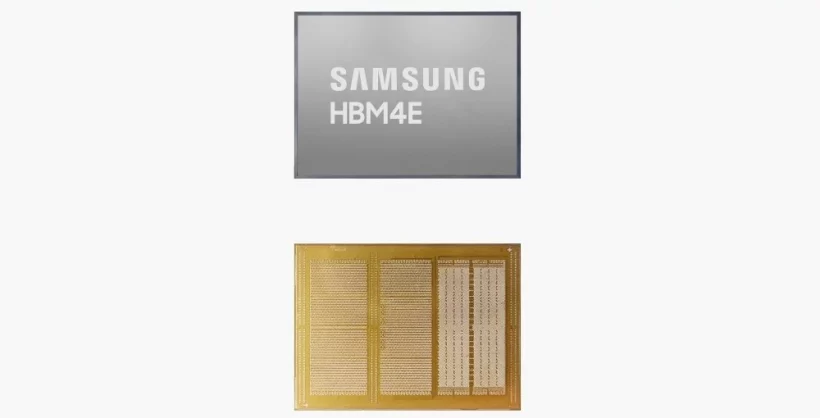
Samsung has taken an important step forward in the semiconductor segment and has officially begun shipping samples of the new generation of high-performance RAM HBM4E. This launch follows shortly after the start of shipments of standard generation HBM4 memory in February of this year. The new chip format offers customers a significant increase in capacity and higher bandwidth, while the memory heats up much less than previous options.
What is the new Samsung HBM4E memory
Having set itself the ambitious goal of shipping chips by the end of this year, Samsung met the deadline. The HBM4E modification is positioned as an ultra-fast solution developed in response to rapidly growing demand from artificial intelligence platforms and systems. Due to the optimized layout and transition to a new bus, this memory can significantly boost the performance of AI computing.
Technical characteristics and design features of HBM4E
When producing HBM4E chips, the Korean giant used a complex hybrid layout. The technology combines the sixth generation of state-of-the-art “1c” memory dies (classified as 10 nm) and a logic base die produced using an advanced 4 nm process technology. Thanks to this solution, Samsung developers redesigned the connection diagram and achieved significant success:
- Increased energy efficiency: Overall memory power consumption is reduced by 16%. Thanks to reduced power consumption, components generate noticeably less heat under active load.
- Cooling Efficiency: The thermal resistance of the finished stack has been reduced by at least 14%, greatly simplifying heat dissipation. Such thermophysical characteristics make the assembly optimal for use in compact servers with high node density.
Differences in memory sizes and speed versions
The current basic version of HBM4E retains the physical form factor of its predecessor (12-layer configuration), but engineers were able to fundamentally improve its performance parameters:
- Volume comparison: A standard HBM4 memory module with a 12-layer layout provides a total capacity of 36 GB. The architecture of the new HBM4E memory with the same number of layers expands the capacity to 48 GB, which means an increase in working capacity by a record 33%.
- Additional configurations: In addition to the basic model, Samsung developers are also actively designing 8-layer variants with a capacity of 32 GB, as well as ultra-high-capacity 16-layer versions with a total capacity of 64 GB. This will provide hardware manufacturers with a flexible set of tools when scaling hardware AI platforms.
- Increased performance: In terms of interface bus speed, HBM4E memory is approximately 20% faster than HBM4. The transfer speed per physical contact here reaches 14 Gbps, giving a resulting total speed of 3.6 TB/s per stack. The previous HBM4 line, on the contrary, transfers data at 11.7 Gbps per contact with a total throughput of the same 3.6 TB/s per stack.
Current production status and development prospects
Mass production of the original HBM4 specification has already been established, according to the company, and a systematic transition to the testing and shipping phase of the new improved HBM4E specification will give the sector additional acceleration. In addition, the design potential inherent in the newest platform is quite deep. The power bus voltage and channel properties are designed to ensure that the base performance level of 14 Gbit/s memory chips can be planned to be scaled up to 16 Gbit/s in the near future without radically rebuilding production pipelines.
“Following the rollout of the HBM4 series of chips, Samsung has reaffirmed its strong technological advantage with the development of the HBM4E. With our advanced manufacturing capabilities and proactive investments in supporting infrastructure, we will continue to drive growth in the global AI memory market,” said Sang Joon Hwang, executive vice president and head of memory development at Samsung Electronics.
Don't miss interesting news
Subscribe to our channels and read announcements of high-tech news, tes

Oppo A6 Pro smartphone review: ambitious

 0
0 
Creating new mid-range smartphones is no easy task. Manufacturers have to balance performance, camera capabilities, displays, and the overall cost impact of each component. How the new Oppo A6 Pro balances these factors is discussed in our review.
Oppo Reno16 Pro 5G smartphone review: well-heeled
0 
Oppo Reno16 Pro 5G looks like a balanced smartphone, in which the manufacturer tried not to make a single characteristic the defining one. It has many advantages. Let’s tell you what
Amazon Hikes Prices on Popular Electronics

Amazon has increased the cost of its popular gadgets without prior notice.
Redmi 17C 5G Debuts With Dimensity 6300 and 6000mAh Battery

Xiaomi has announced the budget-friendly Redmi 17C 5G smartphone. The new device comes equipped with a Dimensity 6300 chip, a 6000mAh battery, a 120Hz IPS display, and runs on HyperOS 3.