

Intel Panther Lake Chips Surface for Budget Handhelds
17.08.26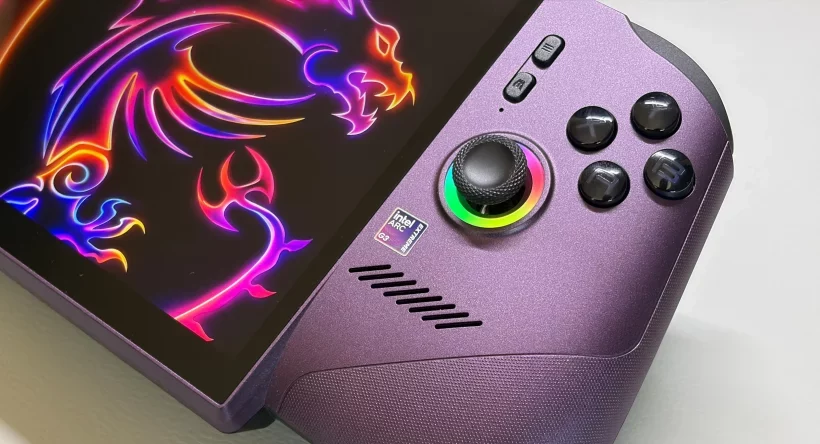
The portable gaming market is bracing for another refresh: industry insiders, including the well-known leaker Jaykihn (@jaykihn0), have revealed specifications for Intel’s upcoming Panther Lake processor, designed for compact consoles. Unlike the high-performance Arc G3 series used in the MSI Claw 8 EX AI+, this new offering is aimed at the more affordable and energy-efficient segment.
According to leaks, the chip features a 4P+0E+4LP-E configuration, complemented by a GPU with 4 Xe3 cores. For comparison, premium G3 Extreme family solutions rely on a 2P+8E+4LP-E setup with 10 or 12 Xe3 cores. Clearly, the manufacturer intends to target different market niches, with this new chip serving as the foundation for lightweight, affordable consoles that prioritize portability over the raw power of flagship models.
Intel is already shipping Core Ultra 7 355 and Core Ultra 5 325 (Panther Lake-U) processors, currently installed in laptops such as the Dell XPS 14 and XPS 16. These devices allow us to gauge the potential of consoles running on similar hardware.
Performance Analysis: A Balancing Act
Cinebench R20 testing demonstrates that the Intel-based solution significantly outperforms the Steam Deck OLED APU. In single-core mode, the Core Ultra 7 355 scores 733 points—roughly double the 357 points of the Steam Deck’s Zen 2 architecture. In multi-core tasks, the gap is even wider: 4,359 versus 1,521 points, respectively.
When compared to the AMD Ryzen Z1 Extreme processor, the current standard for devices like the ROG Ally X, the results are more nuanced:
| Cinebench R20 | Intel Core Ultra 7 355 | Asus ROG Ally X (Z1 Extreme) | Steam Deck OLED |
| CPU (Single Core) | 733 | 672 | 357 |
| CPU (Multi Core) | 4 359 | 5 794 | 1 521 |
Insiders note that the new Intel chip performs exceptionally well in single-threaded tasks, though it trails the established Z1 Extreme leader in multi-core scenarios and graphics performance. Geekbench 6.7 GPU testing shows that the Intel integrated graphics with 4 Xe3 cores lag 19% behind the Radeon 780M, yet still outperform the Steam Deck OLED’s integrated graphics by 34%.
Impact on User Experience
The arrival of this chip in the budget portable gaming category will expand options for end users. If manufacturers can successfully optimize cooling and power consumption for a handheld form factor, these devices could offer stiff competition to the Steam Deck, providing snappier interface responsiveness and decent frame rates for gaming.
While this new chip is unlikely to challenge high-end gaming PCs powered by Extreme-level processors, its efficiency in a compact chassis will enable the creation of thin and affordable gaming solutions, keeping it highly relevant for fans of indie titles and less demanding AAA games.
FAQ
Will this chip be faster than the Steam Deck OLED?
Yes, according to benchmarks, the Intel Panther Lake outperforms the Steam Deck OLED APU in both CPU and graphics tests.
How much does the chip lag behind the AMD Ryzen Z1 Extreme?
In multi-threaded CPU tasks, there is about a 25% performance gap in favor of the AMD chip. In Vulkan graphics tests, the Intel solution trails the Radeon 780M by approximately 19%.
Which laptops currently use this hardware?
The Core Ultra 7 355 and Core Ultra 5 325 (Panther Lake-U series) processors are already available in the Dell XPS 14 and XPS 16 laptops.
What is the main feature of this chip?
It is an energy-efficient solution designed for thin and affordable portable devices rather than for maximum gaming performance.
Don't miss interesting news
Subscribe to our channels and read announcements of high-tech news, tes

Oppo A6 Pro smartphone review: ambitious

 0
0 
Creating new mid-range smartphones is no easy task. Manufacturers have to balance performance, camera capabilities, displays, and the overall cost impact of each component. How the new Oppo A6 Pro balances these factors is discussed in our review.
In-Ear headphones Active Noise Cancellation: how Oppo eliminate noise
0 
In-ear headphones remain one of the most popular form factors due to their lightweight design. However, this design is considered one of the most challenging to implement active noise cancellation (ANC). We’ll explain how Oppo solved this problem.
Intel Panther Lake Chips Surface for Budget Handhelds

Intel is preparing a new Panther Lake family chip for the budget handheld console segment. We analyze how the new hardware performs in benchmarks against market leaders like Steam Deck and ROG Ally.
Grok 4.6 Builds a 3D Shooter Without Human Help

The Grok 4.6 neural network has achieved a breakthrough by spending 48 hours autonomously creating a full-featured 3D shooter.